AI, engineered like money
Your search, woven — by systems I run in production every day.
Your AI feature will work in the demo. Month three is what I build for.
Here's the script nobody puts in the pitch deck. Month one: the AI feature demos beautifully, everyone celebrates. Month two: usage grows, the invoice from the model provider triples, nobody can say which feature spent it. Month three: a retried request double-charges a customer, the provider has an outage with no fallback, and an error message leaks the vendor's name into your product like a tag left on a suit.
Calling a model API takes an afternoon. AI integration is everything that keeps month three from happening — and it's what I do, not theoretically, but in production, with real customers spending real credits through systems I built and operate every day.
01
Running in my production right now
- 19
- models behind one gateway, swappable without customers noticing
- 2
- credits per answer — metered idempotently, refunded on provider misses
- 0
- vendor names ever leaked into a customer-facing string
- closed
- how balances fail — empty accounts can't spend
02
The unglamorous parts are the whole job
What separates an AI feature from an AI liability, in the order clients usually learn it the hard way:
Metering that can't lie
Every generation charged exactly once — idempotent under retries, reconciled against a ledger built like bank software. When your accountant asks where the AI spend went, there's an answer to the penny.
Refunds on failure
Provider times out? Model returns garbage? The customer's credit comes back automatically. Nothing erodes trust faster than paying for nothing — so mine can't.
Vendor-blind architecture
Models sit behind a gateway. When a better or cheaper one appears — it's 2026, one appears monthly — you switch in an afternoon, and your customers never know there was a switch.
Fallback chains
Primary provider down? Requests route to the next model, transparently. Your feature's uptime stops being hostage to anyone's status page.
Cost math before you build
What every generation costs at 10 users and at 10,000 — in writing, before a line of code. AI features should have unit economics, not vibes.
03
For small businesses, this is the great equalizer
AI integration isn't just venture-backed startups bolting chat onto dashboards. The most satisfying builds I do are for small businesses: an assistant that actually knows the business — hours, inventory, policies, tone — answering customers at 2 AM, metered to the credit so it can't overspend. I've shipped exactly that, live, for exactly those businesses. Suddenly a two-person shop responds like a company fifty times its size.
The window matters. The forward-thinkers wiring this in now will spend years harvesting what the wait-and-see crowd eventually pays premium prices to catch up on. That's not hype — it's just what early competence has always done in crowded markets.
04
What AI integration costs
| Scope | Honest range | Includes |
|---|---|---|
| One engineered feature in your product | $2,000 – $8,000 | Metering, fallbacks, moderation, cost math |
| Customer-facing assistant | $3,000 – $10,000 | Your data, your tone, credit-metered |
| Full AI product | $10,000+ | The whole system, billing-grade |
| The afternoon chatbot | $500 elsewhere | Month three, at full price |
Proof over promises
Open the work. Judge it live.
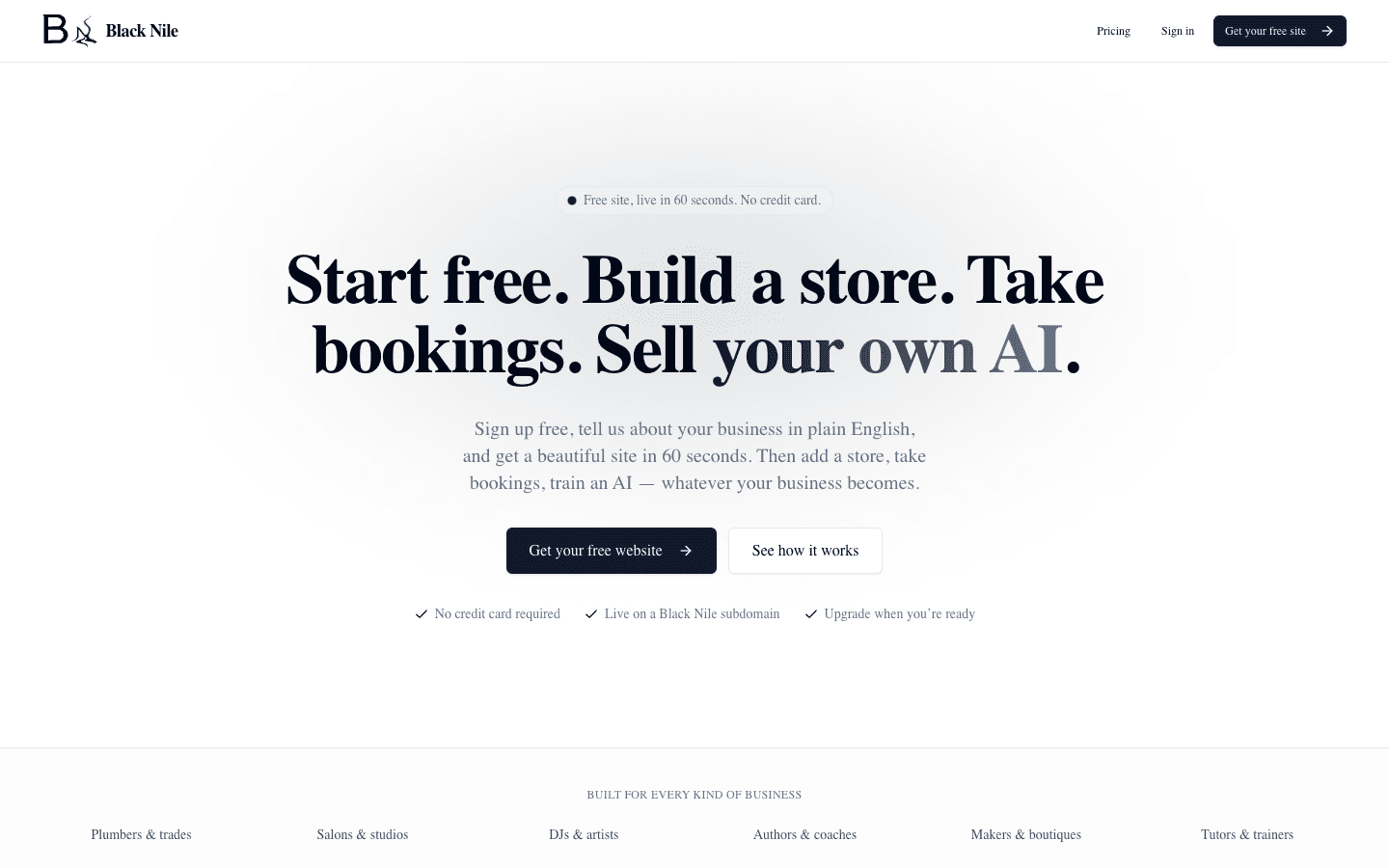
2026 · Software · Shipped
Black Nile
A conversational website builder where small businesses talk, a site appears, and their own AI answers customers — metered to the credit.

2026 · Software · Shipped
BookWriter
AI book-writing software from an author with thirty books of skin in the game — live, billing, and tested 454 files deep.

2026 · Software · Shipped
House of Faith
A private AI faith companion for believers, pastors, and churches — web and native mobile, with memory that lasts longer than a session.
Straight answers
Asked often. Answered honestly.
- What are AI integration services, exactly?
- The engineering that turns 'we call an AI API' into a reliable product feature: metering and billing, fallbacks, moderation, rate limiting, prompt architecture, and cost controls. The model is maybe a tenth of it. The other nine tenths are why month three goes fine.
- What do AI integration services cost?
- A focused, engineered feature: $2,000–$8,000. Customer-facing assistants: $3,000–$10,000. Full AI products: from $10,000. Every quote includes the running-cost math — what tokens will cost you at scale — because build price without run price is half a number.
- Which AI models do you work with — Claude, GPT, Gemini?
- All of the majors, behind a gateway, chosen per feature on merit — reasoning quality, latency, and unit cost. Vendor loyalty is a liability in a field that ships a better model every month; architecture that lets you switch is the actual moat.
- Can you integrate AI into my existing app?
- Yes — most of my AI work lands inside existing products. Your stack stays; the AI layer arrives with metering, moderation, and fallbacks already engineered. Next.js is home turf, but the pattern is stack-agnostic.
- What is AI integration for small business — is it worth it?
- The highest-value version: an assistant that knows YOUR business answering customers around the clock, costing credits instead of a salary. I run one in production for a multi-tenant platform where every small-business site gets its own. Worth it is measurable: count the after-hours questions you currently miss.
- How do you keep AI costs from running away?
- Ledger-level control: users spend credits, credits map to real token costs with margin, empty balances fail closed, and failures refund automatically. An AI feature that can lose money silently is a bug — mine treat overspend as an impossibility, not a dashboard alert.
- What about AI chatbot integration for customer service?
- Done right it's excellent — grounded in your actual data, honest about what it doesn't know, escalating to humans gracefully, never inventing policies. Done cheap it hallucinates discounts at your customers. The difference is engineering and evaluation, both included.
- What's generative AI integration vs. agentic AI integration?
- Generative produces content on request; agentic takes multi-step actions toward goals — and multiplies both the power and the blast radius. I build both, with guardrails scaled to the blast radius: an agent that can act on your systems gets the engineering scrutiny of an employee with keys.
- Will you tell me if AI is the wrong solution?
- In the first conversation, yes — some problems want a database query, not a model. An honest 'you don't need AI for this' is free and occasionally the most valuable thing I say all week.
Tell me what you want AI to do in your product. I'll tell you what it takes to build — and what it costs to run, which is the number everyone else forgets to mention.