Vet before you pay
Your search, knit by hand. Vet me the way I'm telling you to vet everyone.
Vetting a web developer near you? Ask these questions first.
You typed "web developer near me" because you want someone you can hold accountable — a real person who picks up, ships, and doesn't vanish after the deposit. "Near" is shorthand for reachable. It rarely means you plan to drive to their office.
Most people searching this have already been burned once: a half-built site, a freelancer who ghosted, an agency that billed for meetings. So the real question is not who is closest. It is who you can trust with money and a deadline.
I'm David Weaver. I'm in Columbus, Georgia, and I work remotely — one person who designs, builds, deploys, and answers your email. No junior bench, no account-manager relay. Below is a free tool that vets a developer and estimates your project, then the questions I'd ask if I were hiring me.
01
Vet a developer and estimate your build
Vet a web developer + project estimator
Checklist (toggle what's true of the person you're considering)
What are you hiring for?
Vet score 2/6 · project range
$1,500 – $8,000
Walk away or demand proof. A developer without live work, mobile discipline, or accountability is a liability — not a bargain.
02
Five questions a web developer should answer without stalling
Ask these before any deposit leaves your account. The answers separate builders from people who resell templates.
Show me three live URLs you built
Not screenshots, not a reel. Real sites I can open on my phone right now. If everything is "under NDA" or "taken down," be careful.
Who actually writes the code?
The senior who charms you in the pitch is often not the one on the keyboard. Ask for the name of the person shipping — in writing.
What happens when I want to leave?
You should own the code, the domain, and the accounts from day one. If handoff sounds expensive or vague, you are being locked in.
How do you handle changes and overruns?
A written scope and a change process protects both sides. "We'll figure it out" means you will pay for the figuring.
How will we know it worked?
Analytics, conversion events, Core Web Vitals. A developer who cannot tell you what success looks like is selling decoration.
03
Why proximity is a bad proxy for a good hire
A local office tells you where someone rents a desk, not whether they can build. The best developer for your project might be two miles away or two time zones away. What you actually need is response time, a paper trail, and code you own — none of which require a shared zip code.
Remote-first is more accountable, not less, when it is done in writing. Every decision lives in email or a shared doc. Staging links let you click the real thing from your couch before launch, so you are never waiting on a Tuesday meeting to see progress. If you truly need someone on-site to plug in hardware, hire local. For building and shipping a website or app, distance is not the variable that decides quality.
04
Red flags, decoded
What each warning sign usually means, and the question that flushes it out.
| Red flag | What it often means | Ask this |
|---|---|---|
| No live links, only a video reel | The real site was too fragile to leave running | "Send me three URLs I can open now." |
| "Pricing on a call" | The number flexes to what they think you'll pay | "What's the range for something like this?" |
| A new account manager every week | Juniors on the keys, seniors on the sales | "Who writes the code, and can I talk to them?" |
| Fuzzy about code and domain ownership | You'll pay a ransom to move later | "Do I own the repo and accounts from day one?" |
| Guaranteed #1 on Google | They don't understand how ranking works | Walk away. Nobody can promise a position. |
None of these is disqualifying on its own. Two or three together are a pattern.
05
Proof you can test before you pay
When we work together, one person is accountable for the whole build: the design, the code, the copy, the deploy, and the reply when staging breaks at 9 PM. You get written scope, staging URLs you can click, and code you own on day one.
Judge that before you spend a dollar. /work has live products, Roblox games you can play right now, and published books, and the homepage runs a WebGL loom you can pull apart. That is production craft you can test on your own phone — not a pitch PDF.
Proof over promises
Open the work. Judge it live.

2026 · Software · Prototype
BABA Smoke Shop
A local-business marketing site for a Columbus, GA smoke shop. No backend, complete local-SEO metadata, and deliberate restraint.
2026 · Software · Shipped
Near Me
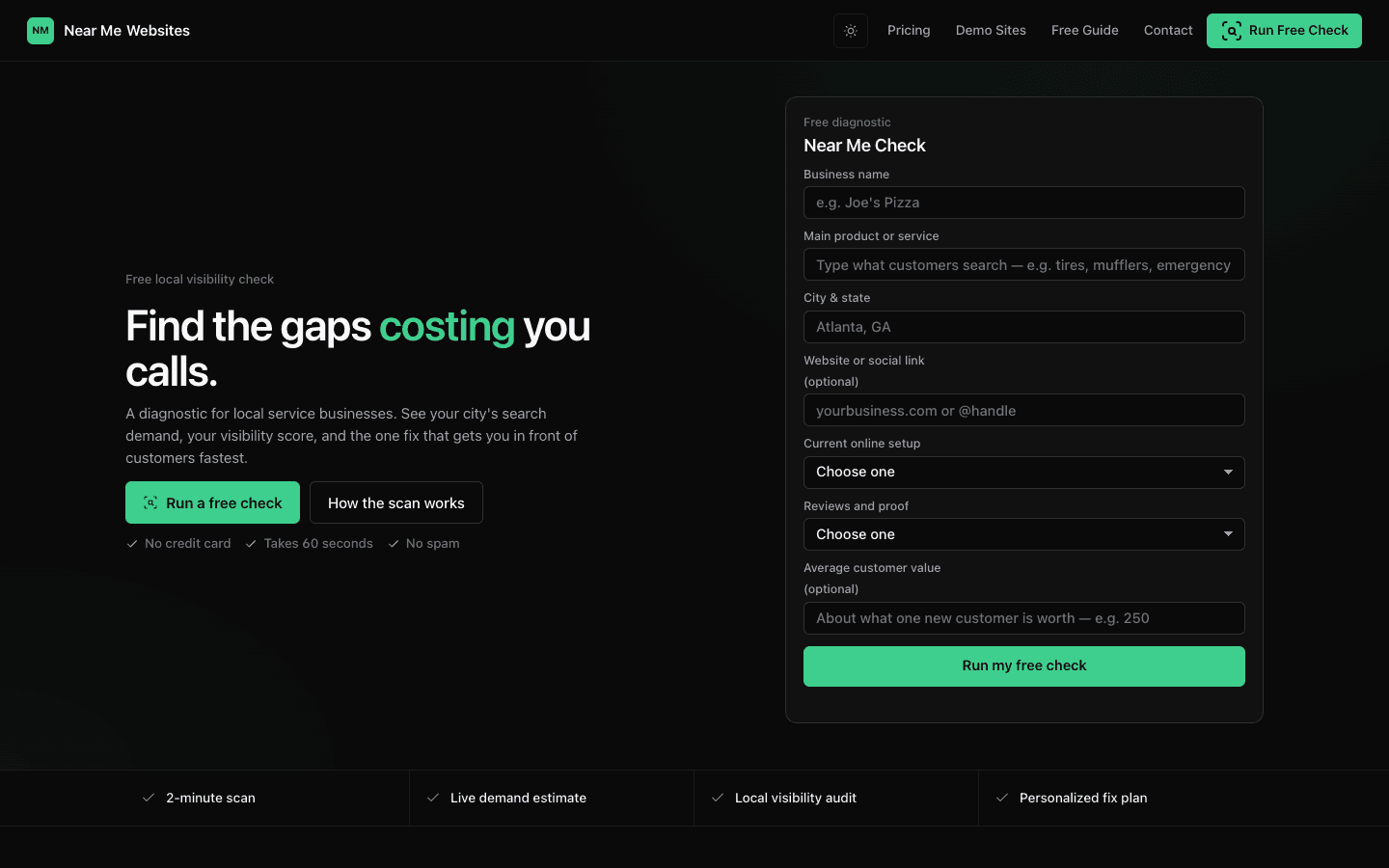
A local-SEO website and lead-generation service with server-side conversion tracking.

2026 · Software · Shipped
BookWriter
AI book-writing software from an author with thirty books of skin in the game — live, billing, and tested 454 files deep.
Straight answers
Asked often. Answered honestly.
- How do I check a web developer is legit before I pay?
- Open three of their live sites on your phone. Confirm the person who pitches you is the person who codes. Get scope, a price range, and code ownership in writing. Anyone who resists all three is telling you something.
- Does "near me" actually matter when hiring a web developer?
- Less than you'd think. You need fast replies, a written trail, and code you own — not a shared zip code. I'm in Columbus, Georgia and work remotely worldwide, and you talk to the builder, not a queue. Hire strictly local only if you genuinely need someone physically on-site.
- What are the biggest red flags when hiring a developer?
- No live links, pricing hidden behind a call, unclear code ownership, a rotating cast of account managers, and anyone guaranteeing a #1 Google ranking. One might be nothing. A cluster is a pattern — slow down.
- Should I hire a freelancer, an agency, or a solo senior developer?
- A commodity freelancer is fine for a simple brochure with a clear brief. An agency suits large multi-team programs and carries the overhead to match. A solo senior gets you craft plus one accountable name. Match the hire to the risk, not the logo.
- Can you take over a project another developer started or abandoned?
- Often, yes. A lot of my work is finishing or rescuing half-built sites. Send me the repo or the live URL and I'll tell you honestly whether it's fixable or a rebuild — before you commit.
- What does the tool on this page do?
- It walks you through vetting a developer against real criteria and gives you a planning estimate for your build. It's free, runs in your browser, and needs no email. Bring the output to any developer, including me.
Run the tool, then ask me the same questions you'd ask anyone else. If I don't answer better, use them on the next developer.