What is affray? The UK charge Chris Brown just pleaded guilty to
Chris Brown pleaded guilty to affray at Southwark Crown Court on Friday, July 24, 2026. Here is what that Public Order Act 1986 charge really means — who can commit it, how it differs from assault, and how the singer’s case resolved.

By David Weaver
Publisher & Editor
Published July 24, 2026, 10:17 AM ET
Affray is one of the older offences in English law, and for most people it is also one of the least understood — until a famous name is attached to it. On Friday, the name was Chris Brown.
The American singer pleaded guilty to affray at Southwark Crown Court in London on July 24, 2026, as NBC News and the Associated Press reported. His co-defendant pleaded guilty to the same charge, and the more serious charges that had hung over the case for more than a year were dropped. To understand what that plea actually means — what Brown admitted, and, just as importantly, what he did not — you have to start with the charge itself. This is general legal information, not legal advice; the statute and the courts are the authority on any real case.
What is affray?
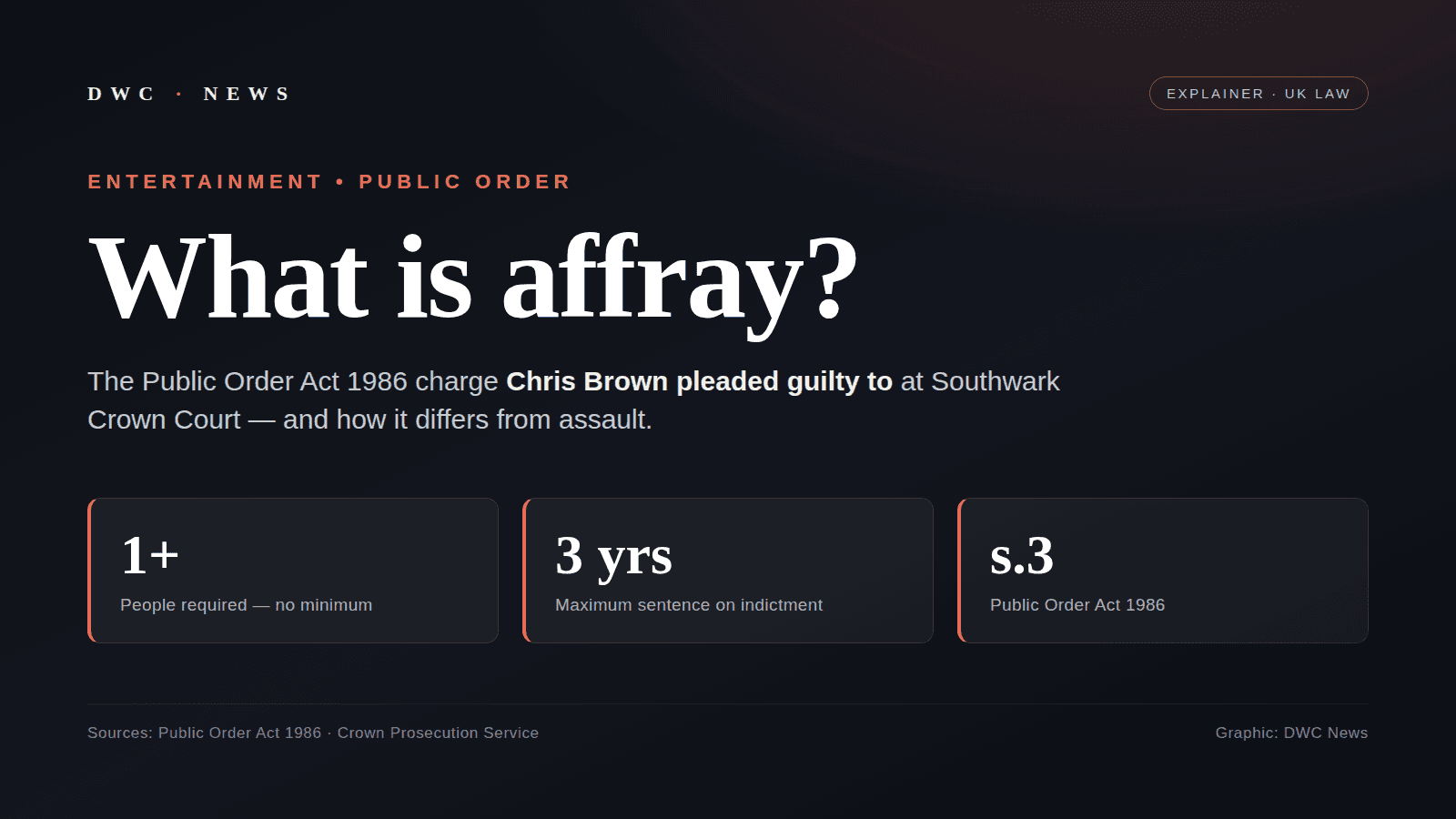
Affray is defined in section 3 of the Public Order Act 1986. A person is guilty of affray if they use or threaten unlawful violence toward another and their conduct is such as would cause a person of reasonable firmness present at the scene to fear for their personal safety — the wording of the statute, as summarized in the Crown Prosecution Service charging standard.
A few features make affray unusual, and every one of them matters in a case like this:
- One person is enough. Unlike riot or violent disorder, affray has no minimum number of people involved.
- A threat cannot be made by words alone. Section 3(3) says so explicitly; there must be conduct beyond speech.
- No bystander needs to actually be present or actually frightened. Section 3(4) makes the test hypothetical — a person of reasonable firmness — not a real witness.
- No identified, injured victim has to be proven. Affray is about conduct that would alarm the public, not about a specific person’s wounds.
- It can happen in private or in public.
- It is an either-way offence, and the maximum sentence on indictment is three years.
Affray vs. assault: the distinction that shaped this case
This is the part that explains the headlines. Affray is a public-order offence: the thing the law is protecting is public peace, not one particular person. Assault offences — common assault, actual bodily harm (ABH), and grievous bodily harm (GBH) under the Offences Against the Person Act 1861 — are the opposite. They require harm, or the fear of harm, to a specific victim.
That difference is exactly why a case can resolve the way Brown’s did. A defendant can admit affray — conduct that would frighten a hypothetical bystander — without any court ever finding that a named person was actually assaulted or injured. Prosecutors can accept that plea and drop the assault charges, which then never go to trial. That is what happened on Friday.
The four Public Order Act offences, compared
Affray sits in the middle of a ladder of public-order offences that runs from a summary "threatening behaviour" charge up to riot. The tool below lays the four main offences side by side — how many people each requires, the maximum sentence, whether it is tried in a magistrates’ court or the Crown Court, and a one-line definition. Every row is sourced to the statute on legislation.gov.uk and the CPS charging standard. Use the search box to jump to a specific offence.
UK Public-Order Offences, Compared
Riot, violent disorder, affray and s.4: the Public Order Act 1986 offences compared
A searchable side-by-side of the four main Public Order Act 1986 offences — riot (s.1), violent disorder (s.2), affray (s.3) and fear or provocation of violence (s.4): how many people each needs, the maximum sentence, the mode of trial and a one-line definition. General legal information, not legal advice.
| Riot | Public Order Act 1986, s.1 | 12 or more, present together | 10 years | Indictable only | 12+ people using or threatening unlawful violence for a common purpose; the most serious public-order offence, and only the DPP can consent to a charge. |
| Violent disorder | Public Order Act 1986, s.2 | 3 or more, present together | 5 years | Either way | 3+ people using or threatening unlawful violence; a smaller-scale disorder charge with no need to prove a common purpose. |
| Affray | Public Order Act 1986, s.3 | 1 or more (no minimum) | 3 years | Either way | One person is enough: using or threatening unlawful violence so a hypothetical bystander of reasonable firmness would fear for their safety. A threat cannot be by words alone. |
| Fear or provocation of violence | Public Order Act 1986, s.4 | 1 or more | 6 months | Summary only | Threatening, abusive or insulting words or behaviour meant to make someone fear immediate unlawful violence, or to provoke it; the lowest tier shown here. |
How this is calculated
Each row states the offence as defined in the Public Order Act 1986 and summarised in the Crown Prosecution Service (CPS) public order charging standard. 'People required' reflects the statutory threshold (12+ for riot, 3+ for violent disorder, no minimum for affray and s.4). 'Max sentence' is the maximum on conviction on indictment, taken from the Act and the CPS guidance; actual sentences follow the Sentencing Council guidelines and are usually far lower. 'Mode of trial' notes whether the offence is indictable-only, either-way or summary-only. Definitions are paraphrased for plain reading; the statute controls. This is general legal information, not legal advice.
Data as of July 23, 2026 · verified July 23, 2026 · v1
Assumptions, limitations & sources
Assumptions
- · Reflects the law of England and Wales under the Public Order Act 1986 as in force in July 2026.
- · Affray differs from assault: it is a public-order offence that protects the public peace and needs no identified injured victim, whereas assault, ABH and GBH (Offences Against the Person Act 1861) require harm, or the fear of harm, to a specific person. That distinction is why a defendant can plead guilty to affray while assault and GBH charges are dropped.
- · Maximum sentences are statutory ceilings, not typical outcomes; the Sentencing Council guidelines set the actual starting points and ranges.
Limitations
- · This is a plain-English summary for orientation, not legal advice. For any real matter, read the statute on legislation.gov.uk and consult a qualified solicitor.
- · It covers the four main Part I public-order offences only; the Act and later legislation contain further offences (for example harassment, alarm or distress under s.4A and s.5).
- · A threat for the purposes of affray cannot be made by words alone, and no bystander need actually be present or frightened — nuances the one-line column cannot fully capture.
Sources
- Public Order Act 1986, section 1 (Riot) — legislation.gov.uk (The National Archives), checked July 23, 2026
- Public Order Act 1986, section 2 (Violent disorder) — legislation.gov.uk (The National Archives), checked July 23, 2026
- Public Order Act 1986, section 3 (Affray) — legislation.gov.uk (The National Archives), checked July 23, 2026
- Public Order Act 1986, section 4 (Fear or provocation of violence) — legislation.gov.uk (The National Archives), checked July 23, 2026
- Public Order Offences incorporating the Charging Standard — Crown Prosecution Service, checked July 23, 2026
- New sentencing guidelines for public order offences published — Sentencing Council for England and Wales, checked July 23, 2026
This is what modern SEO looks like: not just an article, but a useful resource people can return to, cite, and share. See how this newsroom is growing · See DavidWeaver's SEO packages
What Chris Brown pleaded guilty to (established)
Here is what is confirmed. On July 24, 2026, Chris Brown, 37, pleaded guilty to a single charge of affray. His co-defendant, vocal coach Omololu Akinlolu, 40 — a rapper who performs as HoodyBaby — also pleaded guilty to affray. Prosecutor Heidi Stonecliffe KC had applied for the affray charge to be added to the indictment by agreement of all parties, CNN reported.
In return, the more serious charges — attempting to cause grievous bodily harm with intent, assault, and possessing an offensive weapon — were dropped. Stonecliffe told the court they would "not proceed to trial." Judge Tony Baumgartner bailed both men to be sentenced on October 26, 2026, at Southwark Crown Court and said "all options" remain open, per ITV News. No sentence has been passed.
What was alleged — and never proven
The charges that were dropped rested on an allegation, and it is important to keep it in that box. Prosecutors had alleged that on February 19, 2023, at the Tape nightclub in Mayfair, Brown struck music producer Abe Diaw with a bottle and then punched and kicked him. Those were the prosecution’s allegations, tied to the GBH and assault counts.
Because those counts were dropped, the allegations were never tested at a trial, and no court has made any finding on them. Brown is entitled to the presumption of innocence on everything he did not admit. The affray he pleaded guilty to does not require proof that any specific person was struck or hurt; the injury claims attributed to Diaw remain allegations, not court findings. A civil lawsuit reportedly brought by Diaw in the United States has been mentioned in coverage, but its current status is unconfirmed, and we are not asserting any outcome.
What happens next
Sentencing is scheduled for October 26, 2026. The maximum for affray is three years, but the maximum is a ceiling, not a forecast: actual sentences follow the Sentencing Council’s guidelines and turn on the facts, and the judge’s comment that "all options" remain open means custody is possible but not certain.
The case has moved slowly. Brown was arrested in Manchester on May 15, 2025, and initially charged with grievous bodily harm over the 2023 incident. He was held, then released on a £5 million security — a condition that allowed his "Breezy Bowl XX" tour to go ahead, which it did. He had pleaded not guilty in 2025, with a trial expected in 2026, before switching his plea to guilty on the new affray charge.
Questions people are asking
What is affray?
Affray is a public-order offence under section 3 of the Public Order Act 1986: using or threatening unlawful violence toward another so that a hypothetical bystander "of reasonable firmness" would fear for their safety. It can be committed by a single person, a threat cannot be made by words alone, and no actual bystander need be present or frightened. The maximum sentence on indictment is three years.
What did Chris Brown do — what did he plead guilty to?
He pleaded guilty to one charge of affray. What he admitted, in legal terms, is conduct that would cause a bystander of reasonable firmness to fear for their safety. He did not plead guilty to assaulting anyone: the assault, GBH and offensive-weapon charges were dropped and will not go to trial.
Is Chris Brown guilty? Was he convicted?
Yes — of affray, by his own guilty plea. He is not convicted of GBH or assault; those charges were dropped and never proven. He has not yet been sentenced.
What is the maximum sentence for affray?
Three years’ imprisonment on conviction on indictment, under the Public Order Act 1986. That is the statutory maximum; the actual sentence will be set at the October hearing under the Sentencing Council guidelines.
When and where is Chris Brown being sentenced?
On October 26, 2026, at Southwark Crown Court in London. Judge Tony Baumgartner said "all options" remain open, so a range of outcomes is still possible.
Is Chris Brown’s tour affected?
His "Breezy Bowl XX" tour proceeded. After his May 2025 arrest he was released on a £5 million security, a condition set specifically so the tour could go ahead. He remains on bail until sentencing.
Who else was charged?
His co-defendant, vocal coach and rapper Omololu "HoodyBaby" Akinlolu, 40, also pleaded guilty to affray and is bailed to be sentenced on the same date.
Who was the victim?
The man named in the prosecution’s account was music producer Abe Diaw, who prosecutors alleged was struck at the Mayfair club in 2023. Because the assault and GBH charges were dropped, those injury claims were never tested in court and remain allegations. We are naming him because it is central to the public record, while being clear that no court has made a finding about what happened to him.
The bottom line
Strip away the celebrity and the story is a clean illustration of what affray is for. It lets the justice system respond to violent conduct that alarms the public without having to prove an assault on a named victim — which is precisely how a case built on a disputed 2023 altercation ended with a guilty plea to a public-order charge and the assault counts dropped.
So the honest, narrow summary is this: Chris Brown is guilty of affray, by his own plea; he is not convicted of assaulting anyone; the maximum penalty is three years; and sentencing is on October 26. Everything beyond the affray plea remains an allegation, and this is a developing story.
Sources
- Singer Chris Brown pleads guilty to affray over altercation at London nightclub — NBC News / Associated Press · primary source
- Singer Chris Brown pleads guilty to affray over altercation at London nightclub — CNN
- Chris Brown pleads guilty to affray after Mayfair nightclub confrontation — ITV News
- Public Order Act 1986, section 3 (Affray) — legislation.gov.uk (The National Archives)
- Public Order Offences incorporating the Charging Standard — Crown Prosecution Service