Christopher Bell cannot win his way into the NASCAR postseason this year. Nobody can — that rule is gone
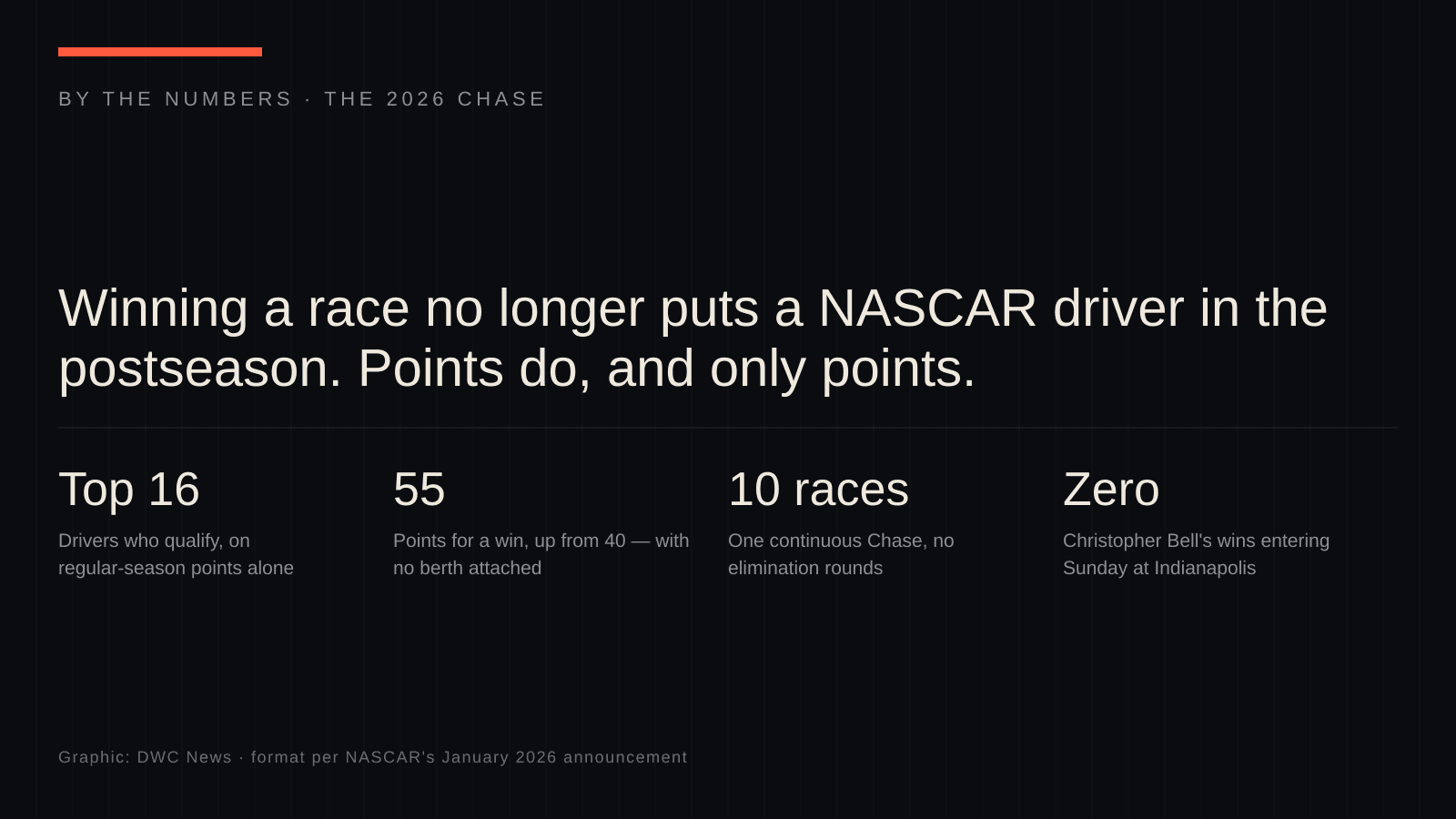
NASCAR retired the elimination playoffs and brought back a single 10-race Chase. The top 16 qualify on regular-season points, a race win is worth 55 points and nothing more, and a winless Christopher Bell is the clearest test of what that changes.

By David Weaver
Publisher & Editor
Published July 26, 2026, 6:13 PM ET
For twelve seasons, the most important sentence in NASCAR was four words long: win and you're in. Take one race anywhere in the regular season and your postseason was booked. It shaped how teams gambled on strategy, how commentators framed August, and how a driver with a mediocre year could still be racing for a championship in November.
It is gone.
NASCAR announced on January 12, 2026 that it was retiring the elimination playoffs and bringing back The Chase — 26 regular-season races, then a single continuous 10-race run for the title. The top 16 drivers in regular-season points qualify. Points are the only route. A race win is now worth 55 points, up from 40, and that is all it is worth.
Which brings us to Christopher Bell.
A note on timing: this piece was published while Sunday's Brickyard 400 result was still being confirmed, and it does not report the finish. Nothing below depends on it.
Why Bell is the test case
Bell is one of the most consistently fast drivers in the series and he went into Sunday at Indianapolis without a win in 2026. NASCAR's own preview of the weekend described the Brickyard as a crown without a king, and Bell's search for a first win of the season as one of its storylines. He was fastest in Friday practice — 49.043 seconds, 183.512 mph in the No. 20 Joe Gibbs Racing Toyota.
He has also had the kind of year that used to be survivable and now is not. In June, at Michigan, Chase Elliott lost control alongside him on lap 148 and both cars went into the Turn 4 SAFER barrier. Bell fractured his left wrist. Joe Gibbs Racing said surgery was not required and he was cleared to race the following weekend at Pocono. He said afterwards that he did not have the ability to make sharp, quick corrections to the car.
Under the old rules, none of that would have mattered much. One win at any point in twenty-six races and the season resets. Under the 2026 rules, a driver in Bell's position is doing the thing NASCAR now asks of everyone: accumulating.
That is the change in a sentence. The format no longer offers a redemption button.
What actually changed
Compare the two systems side by side and the scale of it is clearer than any summary.
Compare the Two Systems
NASCAR's 2026 Chase versus the elimination playoffs it replaced, rule by rule
Every rule that changed when NASCAR retired the 2014–2025 elimination playoffs and brought back a single 10-race Chase: qualification, field size, points, resets, and how the championship is finally decided.
Tap a column to highlight it
| How you qualify | Top 16 in regular-season points after the 26th race. Points only. | Race winners took the first berths; any remaining places went to the highest drivers in points, up to 16. |
|---|---|---|
| Does winning a race put you in? | No. Win-and-you're-in is gone. A win is worth points, and points are the only currency. | Yes. A single win in the regular season effectively guaranteed a berth. |
| What a win is worth | 55 points — up from 40, a 37% increase, and the largest single reward in the system. | 40 points, plus a postseason berth that made the points close to irrelevant. |
| What the rest of the field scores | Unchanged: 35 for second, 34 for third, 33 for fourth, and down from there. | 35 for second, 34 for third, 33 for fourth, and down from there. |
| Stage points | Kept. The top 10 in each of the first two stages score 10 down to 1, so a driver sweeping both stages and the race can bank 75 points in a day. | Top 10 in each of the first two stages scored 10 down to 1. |
| Postseason structure | One continuous 10-race Chase. No rounds, no cut lines, no eliminations. | Four rounds over 10 races — Round of 16, 12, 8, then a Championship 4 — with drivers eliminated at each cut. |
| How the champion is decided | The eligible driver with the most points across the 10 Chase races. | Whichever of the final four drivers finished highest in the season's last race, regardless of the other 35 races. |
| Points reset and seeding | Field reset for the Chase. The regular-season champion starts on 2,100 — a 25-point premium — then 2,075 for second, 2,065 for third, and five-point steps down to 2,000 for the 16th seed. | Field reset to a common baseline, with bankable playoff points added on top. |
| Bankable playoff points | Abolished. Nothing carries over from the regular season except the seeding premium. | Earned for wins and stage wins during the regular season and carried into each playoff round. |
| Length of the regular season | 26 races, ending at Daytona, then the 10-race Chase. | 26 races, then the 10-race playoffs. |
| What the format rewards | Full-season consistency to get in, then sustained speed over 10 races to win it. One bad race is damaging but not fatal. | One win to get in, then survival at three cut lines and a single race for the title. One bad race at the wrong moment ended a season. |
How this is calculated
Two columns, one per format, with each rule stated as NASCAR announced it. The 2026 column comes from NASCAR's own January 12, 2026 announcement and its accompanying explainer. The 2014–2025 column describes the elimination playoff format as it operated in its final seasons: 16 qualifiers, a win-and-you're-in berth for race winners, four rounds of elimination, and a winner-take-all final race among four drivers. Where a rule varied across the older era, the description reflects how it worked at the end of that era rather than an average across it.
Data as of July 25, 2026 · verified July 25, 2026 · v1
Assumptions, limitations & sources
Assumptions
- · The 2026 column reflects the NASCAR Cup Series. Qualification counts differ in the Xfinity and Craftsman Truck series.
- · The 2014–2025 column describes the elimination format as it stood in its final seasons.
Limitations
- · This is a rules comparison, not a standings tracker. It does not show who is currently in a playoff position.
- · Sanctioning bodies adjust rules between seasons and occasionally mid-season. NASCAR's own rulebook and announcements are the authority.
- · The original 2004–2013 Chase is deliberately not included: its qualification and reset rules changed several times inside that decade, and compressing them into one column would misrepresent all of them.
- · Tie-breakers, encumbered finishes, waivers for missed races and other edge cases are outside the scope of the table.
Sources
- NASCAR returns to Chase championship format for 2026 — NASCAR, checked July 25, 2026
- The Chase 101: how NASCAR's new championship format works — NASCAR, checked July 25, 2026
- Explaining NASCAR's new championship format for 2026: 'The Chase' is back — NBC Los Angeles, checked July 25, 2026
- NASCAR playoff format explained: the 2026 Chase — Red Bull, checked July 25, 2026
- How the NASCAR Cup Series points system works in 2026 — FloRacing, checked July 25, 2026
This is what modern SEO looks like: not just an article, but a useful resource people can return to, cite, and share. See how this newsroom is growing · See DavidWeaver's SEO packages
Three consequences are worth pulling out of that table.
A win is worth more and means less. 55 points is a big number — 20 clear of second place, and a driver sweeping both stages and the race can take 75 in a day. But it is points, and points can be matched over time by someone finishing sixth every week. NASCAR raised the reward for winning precisely because it removed the guarantee.
Nothing carries forward. Bankable playoff points are abolished. A dominant regular season now buys exactly one thing: the top seed, worth 2,100 points at the reset against 2,075 for second and five-point steps down to 2,000 for sixteenth. That is a 25-point cushion for the best 26 races anyone has run. It is not nothing. It is not much.
The last race is no longer the whole championship. The Championship 4 — four drivers, one race, highest finisher takes the title — is gone. The champion is whoever accumulates the most points across ten races. That is a different sport in November than the one fans got used to.
The questions readers are asking
Does winning a race still get you into the NASCAR playoffs? No. Not in 2026. This is the single most common misunderstanding about the new format, and it is the one that will produce the most confused August.
How many drivers make The Chase? Sixteen, in the Cup Series, on regular-season points after 26 races.
How many points is a win worth now? 55, up from 40. Second still pays 35, third 34, and so on down.
Do stage points still exist? Yes. The top 10 in each of the first two stages score 10 down to 1. The maximum available in a single race is 75.
What does the regular-season champion get? A 25-point premium at the reset — 2,100 points against 2,075 for the second seed.
Is Christopher Bell in the playoff picture? He is in the position the format was redesigned to expose: fast, winless as of Sunday morning, and dependent on points rather than on one good afternoon. Where any driver sits in the standings changes weekly, and the official standings are the authority, not a news article.
Why did NASCAR change it? The stated aim is to reward full-season consistency while making wins worth more within the points system. The elimination format produced champions who had been eliminated on merit at several points and survived on a single strong race, which was thrilling and, to a durable share of the audience, unsatisfying.
Is this the same Chase as 2004? In shape, yes: one 10-race run, points decide it. In detail, no. The original Chase changed its own rules repeatedly between 2004 and 2013 — field size, reset values, wild cards — which is why our comparison deliberately does not average it into a single column.
What to watch
The interesting stretch is the last few races before the cut at Daytona. Under the old system, a bubble driver's incentive was obvious: gamble everything on a win, because a win was a ticket. Under the new one, the same driver has to weigh a low-probability win worth 55 against a safe finish worth 30-something — and the math is much less romantic.
That is the change nobody has really watched play out yet. The first time a well-known driver is eliminated from championship contention while holding a race win, this format will get its first real argument. On the current rules, that is not a hypothetical. It is a matter of time.
Sources
- NASCAR returns to Chase championship format for 2026 — NASCAR · primary source
- The Chase 101: how NASCAR's new championship format works — NASCAR · primary source
- Explaining NASCAR's new championship format for 2026: 'The Chase' is back — NBC Los Angeles
- How the NASCAR Cup Series points system works in 2026 — FloRacing
- Christopher Bell sustains fractured left wrist at Michigan; cleared to race at Pocono — NASCAR · primary source
- Christopher Bell bolts to top of Cup Series leaderboard in Brickyard 400 practice — NASCAR · primary source
- Christopher Bell leads Brickyard 400 practice; Bubba Wallace and SVG hit wall — Motorsport.com
- A crown without a king: Brickyard title prospects up for grabs at Indianapolis — NASCAR · primary source