The 3M Open paid out $8.8 million on Sunday. About half the winner's check never reaches the winner
Jackson Koivun's first PGA Tour title came with $1,584,000 attached. A caddie's customary cut, Minnesota's 9.85% top rate and a 37% federal bracket all get there before he does — and the arithmetic is not a secret, just unpublished.

By David Weaver
Publisher & Editor
Published July 26, 2026, 6:09 PM ET
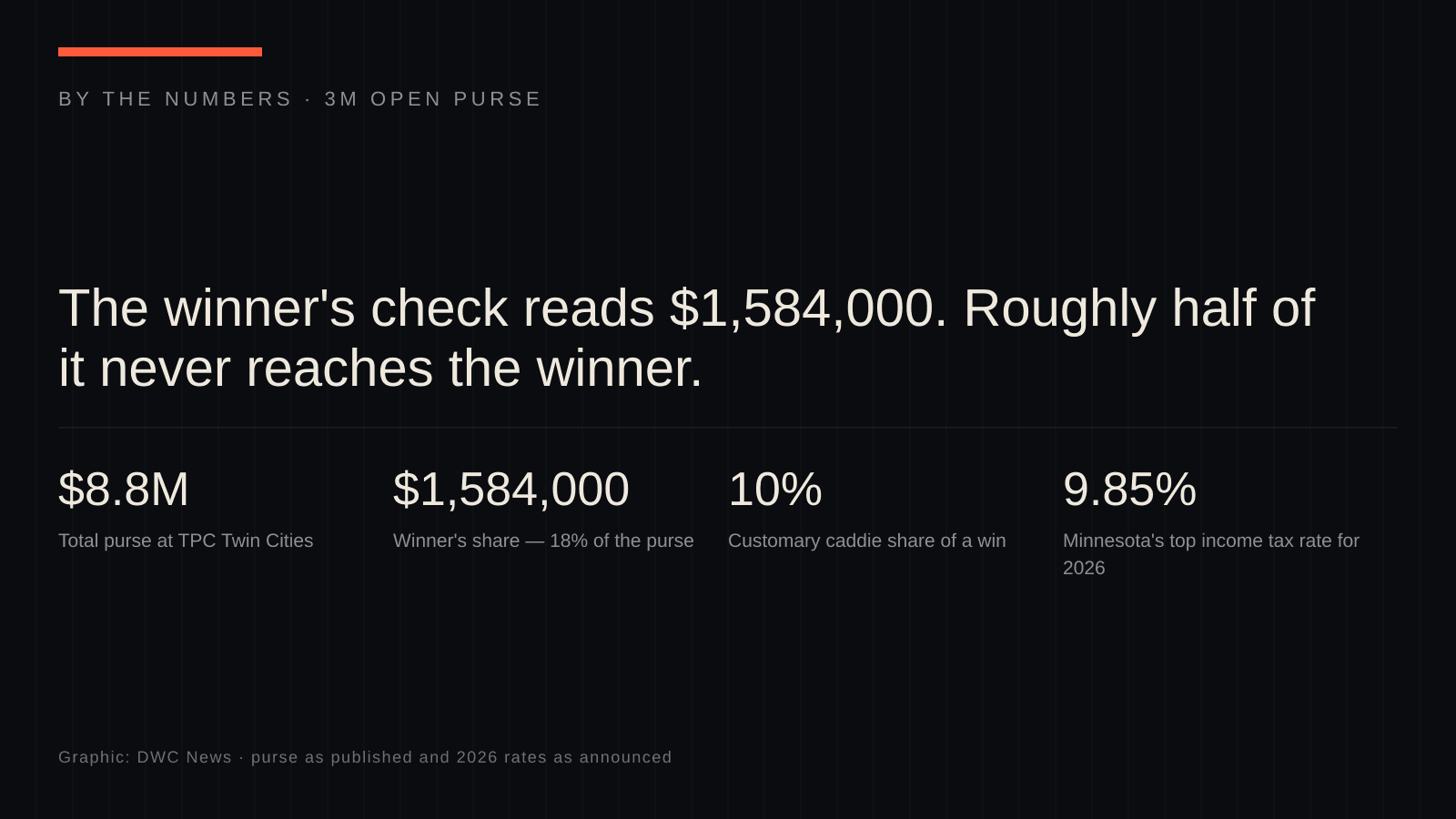
The 2026 3M Open finished at TPC Twin Cities in Blaine, Minnesota on Sunday with an $8.8 million purse distributed among every professional who made it through four rounds. First place: $1,584,000. Second: $959,200. Third: $607,200.
Those are real numbers, published every week, and they are the last honest thing most payout coverage does. The check is written for $1,584,000. Nobody is ever paid $1,584,000.
Who won it, and why the number is unusual for him
Jackson Koivun, 21, won his first PGA Tour title in his third start as a professional, closing with a 5-under 66 to finish at 25-under 259 — a tournament scoring record — three shots clear of world number one Scottie Scheffler. He set it up on Saturday with a 61 that included a back nine of 28, also a tournament record.
He arrives with an unusual amount of runway behind him. He led Auburn to a national championship in June, won six times in 13 collegiate starts in his final season, and became the first player in college golf history to sweep the Haskins, Hogan and Nicklaus awards twice — as a freshman in 2024 and again as a junior in 2026. He had already secured PGA Tour status through the Tour's University Accelerated programme in 2025 and went back to Auburn anyway.
So the $1,584,000 is his first significant professional payday. Which makes it a good week to explain what one of these actually is.
Where the purse split comes from
The PGA Tour distributes purses on a fixed percentage table, which is why the 3M Open's numbers look the way they do. The winner gets 18% of the purse. $8.8 million times 0.18 is $1,584,000. Second gets 10.9% — $959,200. Third gets 6.9% — $607,200. The percentages hold whatever the purse is, which is why you can predict a winner's share the moment a purse is announced.
Two wrinkles worth knowing. Ties split the combined money for the positions involved, so a two-way tie for fourth adds the fourth- and fifth-place shares and halves them. And the money is guaranteed down to the last professional who completes 72 holes. Missing the cut pays nothing.
Now the part nobody prints
Three things happen to that $1,584,000 before it becomes money the player can spend.
The caddie. The widely reported convention on tour is 10% of a win, 7% of a top-10 and 5% of anything else, on top of a weekly base fee. This is a custom, not a rule — every caddie agreement is a private contract and they vary — but 10% of a win is the number the industry quotes. On this check that is $158,400.
Minnesota. A touring professional pays income tax to the state where the money was earned, whether or not they live there. It is ordinary non-resident tax sourcing, nicknamed the jock tax, and 41 states apply some version of it. Minnesota's top marginal rate for 2026 is 9.85%, reached above $203,150 of taxable income for a single filer. A player based in Florida or Texas escapes their home state's income tax — those states have none — but not Minnesota's, on money earned in Blaine.
The federal government. The top federal rate for tax year 2026 is 37%, which applies above $640,600 of taxable income for a single filer. The One Big Beautiful Bill Act made the current seven-bracket structure permanent, cancelling the scheduled return to a 39.6% top rate.
Work those through in order — caddie first, because a caddie's pay is a business expense that reduces the income the player is taxed on — and roughly $757,706 survives. About 48% of the number in the headline.
See What Actually Reaches the Bank
PGA Tour prize money: what a winner's check is worth after the caddie and the tax collector
Work a tournament check down through the caddie's customary percentage and the state and federal income tax that applies to it — with the 2026 3M Open's $1,584,000 first prize loaded as the starting example.
Uses: Prize money won · Caddie's percentage · State where the tournament was played · Federal marginal rate
This is an estimate for general understanding, not tax advice, and it does not model self-employment tax, deductible expenses, multi-state credits or any individual's circumstances. Tax rates change and filing situations differ. For any real decision, talk to a qualified tax professional and rely on the IRS and your state revenue department, not on this page.
Example — adjust the inputs above for your situation
$1,584,000 on the leaderboard, an estimated $757,706 in hand — about 47.8% of the number in the headline.
The caddie's percentage comes off first: $158,400 at 10%. What is left, $1,425,600, is what tax applies to — a caddie's pay is a business expense for a self-employed player. Federal tax at a 37% marginal rate is $527,472. Minnesota's top bracket is 9.85%, reached above $203,150 of taxable income for a single filer in 2026. Applied to this check that is $140,422. That leaves an estimated $757,706. This is an estimate of the largest, most documentable deductions only — not a tax return, and not advice.
- Gross prize money
- $1,584,000
- Caddie's share (10%)
- − $158,400
- Taxable after the caddie
- $1,425,600
- Federal income tax (37% marginal)
- − $527,472
- Minnesota income tax (9.85%)
- − $140,422
- Estimated take-home
- $757,706
- Share of the printed figure kept
- 47.8%
- ※ Applying the top marginal rate to the whole check slightly overstates tax, because lower brackets are taxed at lower rates. For a seven-figure prize the difference is small; for a small check it is not.
- ※ Self-employment tax, deductible expenses (travel, coaching, equipment, agent fees), and credits for tax paid to other states are not modelled. Those move the number in both directions.
- ※ Caddie percentages are an industry convention, not a rule. Real agreements are private contracts and vary; some caddies take less on a win, some take more.
- ※ Where a player lives matters separately: a resident of a taxing state generally reports income earned everywhere and claims a credit for tax paid to the state where a tournament was played.
How this is calculated
The caddie's percentage is deducted from the gross prize first, because it is the player's business expense and reduces the income the player is taxed on. Federal tax is applied to that remainder at the marginal rate the reader selects, defaulting to 37% — the top 2026 federal rate, which applies above $640,600 of taxable income for a single filer. State tax is applied to the same remainder at the chosen state's top marginal rate: 9.85% for Minnesota, where the 3M Open is played; 13.3% for California; zero for Florida and Texas, which levy no income tax. A nonresident professional owes tax to the state where the money is earned — ordinary nonresident sourcing, commonly called the jock tax, which 41 states apply in some form. The result is gross minus caddie minus federal minus state. Caddie percentages come from the widely reported 10/7/5 convention (10% of a win, 7% of a top-10, 5% otherwise) and are a custom, not a rule.
Data as of July 25, 2026 · verified July 25, 2026 · v1
Assumptions, limitations & sources
Assumptions
- · The whole check is taxed at the selected marginal rate. Real returns run income through every lower bracket first, so this overstates tax somewhat — slightly for a large prize, substantially for a small one.
- · The caddie's percentage is treated as a deductible business expense, reducing taxable income.
- · Prize money from a tournament is sourced to the state where the tournament is played.
- · A single filer with no other modelled income, deductions or credits.
Limitations
- · This is an estimate of the two largest deductions, not a tax return, and it is not tax advice. A touring professional's actual return involves an accountant and a schedule of states.
- · Self-employment tax, the Medicare surtax, travel and coaching costs, equipment, agent fees, entry costs, and retirement-plan deferrals are all excluded. They move the final figure in both directions.
- · Credits for tax paid to another state are not modelled. A player domiciled in a taxing state generally reports the income at home and claims a credit for what was paid where the tournament was held; the two rarely cancel exactly.
- · Caddie agreements are private contracts. The 10/7/5 split is the reported convention, not a guarantee of what any individual caddie was paid.
- · Endorsement income, appearance fees, bonus pools and deferred programs are not prize money and are not included.
Sources
- IRS releases tax inflation adjustments for tax year 2026 — Internal Revenue Service, checked July 25, 2026 · Top marginal rate (37%) and its threshold used as the federal default.
- Minnesota sets income tax brackets and deductions for 2026 — KARE 11, checked July 25, 2026 · Top state rate (9.85%) and its single-filer threshold used for the Minnesota option.
- Minnesota tax rates and rankings — Tax Foundation, checked July 25, 2026
- 3M Open 2026 prize money: full payout from the $8.8 million purse — Golf Channel, checked July 25, 2026 · Winner's share ($1,584,000) used as the default prize input.
- Here's the prize money payout for each golfer at the 2026 3M Open — Golf Digest, checked July 25, 2026
- How much money do PGA Tour caddies make? — Front Office Sports, checked July 25, 2026 · Source for the reported 10/7/5 caddie convention, used as a labelled custom rather than a rule.
- Jock tax guide: how states tax athletes, state by state — SDO CPA, checked July 25, 2026
This is what modern SEO looks like: not just an article, but a useful resource people can return to, cite, and share. See how this newsroom is growing · See DavidWeaver's SEO packages
What the estimate deliberately leaves out
This is a floor-level model of the two biggest deductions, and it says so. Real tour accounting includes several things the calculator does not touch: self-employment tax, deductible travel and coaching and equipment costs, agent fees, credits for tax paid to other states, and the difference between a marginal rate and an effective rate across every lower bracket.
Some of those push the final figure down. Some push it up. The honest version of this story is not "the winner keeps exactly $757,706" — it is "roughly half of a tour paycheck is spoken for before the player sees it, and the parts you can document account for most of that."
If you want the exact number for any actual player, the answer is an accountant, not a web page. Including this one.
The questions readers are asking
What was the 3M Open purse in 2026? $8.8 million, with $1,584,000 to the winner.
How much did Jackson Koivun win? $1,584,000 for the victory. What he keeps after the caddie and tax is an estimate, not a published figure, and no tournament ever publishes it.
Do golfers really pay their caddies 10%? That is the reported convention for a win. Individual agreements are private and differ, and caddies also draw a weekly base fee that has nothing to do with how the player finishes.
Does a golfer pay tax in every state they play? In every state with an income tax, yes, on the money earned there. That is 41 states in some form. Home-state residents generally then claim a credit for tax paid elsewhere, which reduces double taxation without eliminating the paperwork.
Why do so many golfers live in Florida? No state income tax is a large part of it, along with year-round practice weather. It does not help with the tax on a week in Minnesota.
Do players get paid for missing the cut? Not from the purse at a standard PGA Tour event. The Tour operates other support programmes, but the purse pays professionals who complete 72 holes.
Is prize money the main income for a top player? For most players outside the very top, prize money is the bulk of it. At the very top, endorsements typically dwarf it — and none of that is modelled here, because this tool is about the check on the leaderboard.
Why this matters
Payout tables are among the most-read pages in golf, and they answer the smallest possible version of the question. "The winner gets $1,584,000" is true in the same way that a gross salary is true: it is the number on the paperwork and not the number in the account.
Nothing above is a complaint about any of these deductions. The caddie earned the percentage. The tax is the law. The point is only that the difference between the two numbers is large, entirely explicable, and almost never explained — and a reader who has just searched "3M Open purse" is exactly the person who would want to know.
Sources
- 3M Open 2026 prize money: full payout from the $8.8 million purse — Golf Channel
- Here's the prize money payout for each golfer at the 2026 3M Open — Golf Digest
- 2026 3M Open money: purse, winner's share, updated PGA Tour prize money payout — The Golf News Net
- Jackson Koivun wins the 3M Open in his third start as a PGA Tour pro — Yahoo Sports
- Jackson Koivun moves three strokes up at the 3M Open with a third-round 61 — PGA Tour · primary source
- IRS releases tax inflation adjustments for tax year 2026 — Internal Revenue Service · primary source
- Minnesota sets income tax brackets and deductions for 2026 — KARE 11
- How much money do PGA Tour caddies make? — Front Office Sports
- Jock tax guide: how states tax athletes, state by state — SDO CPA