An American landed in Kazakhstan on a Russian spacecraft Sunday. The deal that made it routine just got extended
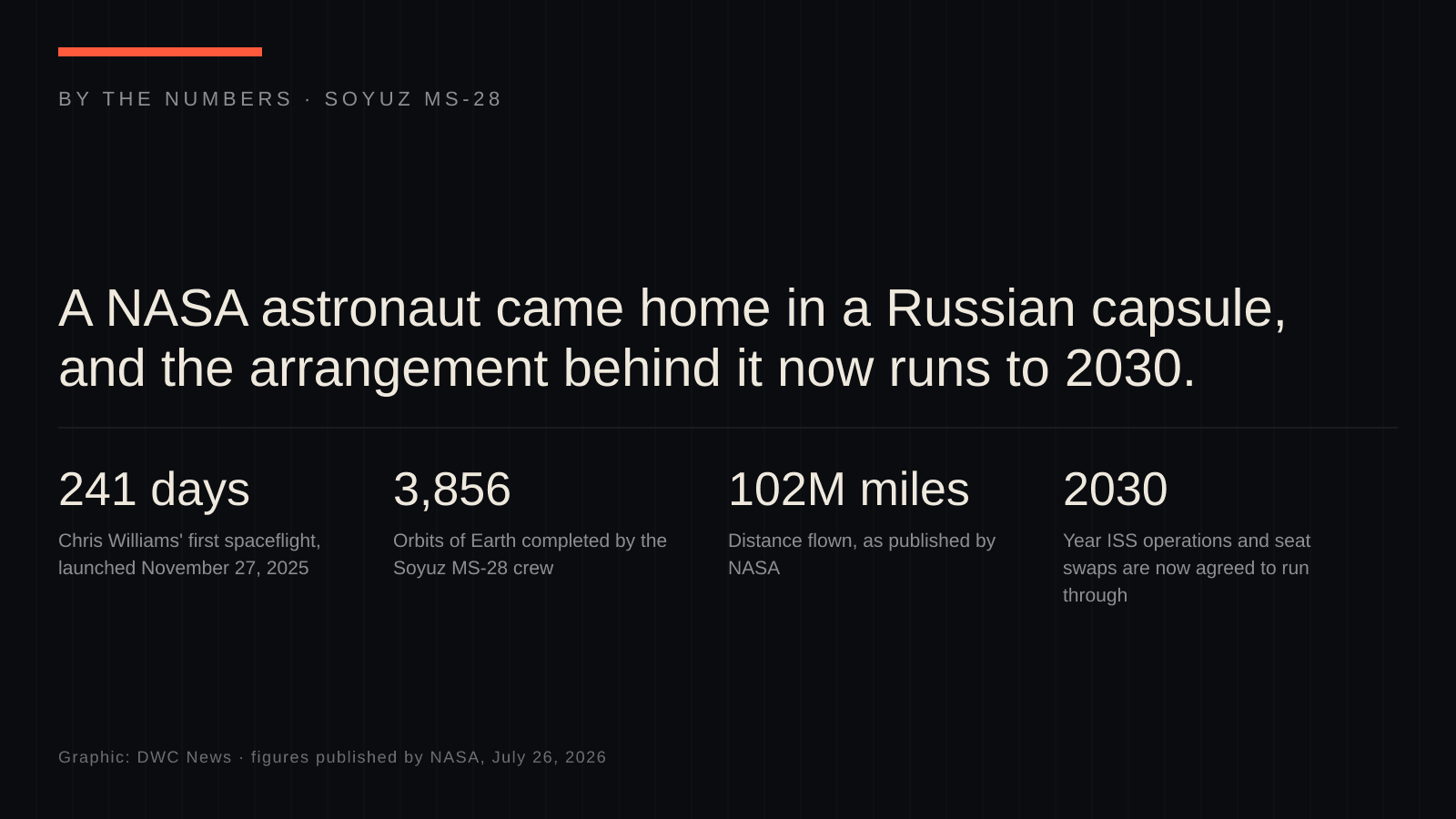
Chris Williams, Sergey Kud-Sverchkov and Sergei Mikaev touched down southeast of Dzhezkazgan at 5:27 a.m. CDT after 241 days aboard the International Space Station — 3,856 orbits and more than 102 million miles.

By David Weaver
Publisher & Editor
Published July 26, 2026, 6:05 PM ET
A Soyuz capsule came down on the Kazakh steppe on Sunday morning with an American physicist and two Russian cosmonauts inside it. It was, in NASA's description, a safe, parachute-assisted landing — and three people who had not felt their own weight since November were back under gravity.
Soyuz MS-28 undocked from the International Space Station at 2:03 a.m. CDT and touched down southeast of Dzhezkazgan at 5:27 a.m. CDT — 3:27 p.m. in Kazakhstan. On board were NASA astronaut Chris Williams and Roscosmos cosmonauts Sergey Kud-Sverchkov and Sergei Mikaev, ending a 241-day mission that began on November 27, 2025.
NASA's own accounting of the flight: 3,856 orbits of Earth and more than 102 million miles.
The part that is easy to miss
An American astronaut rode home in a Russian spacecraft, launched in a Russian spacecraft eight months ago, and lived for that entire period in a facility jointly operated by both countries. That happened on Sunday and produced almost no comment, which is itself the story.
It runs on what NASA calls the integrated crew agreement — a seat barter rather than a purchase. Americans fly on Soyuz; cosmonauts fly on U.S. spacecraft. No money changes hands for the seats. The point of the arrangement is redundancy: if one country's vehicle is grounded, both countries still have someone aboard who can operate their own segment of the station.
And in July, Russia agreed with the other station partners to keep the ISS operating — and the seat swaps running — through 2030. That is the piece of news underneath the landing. The arrangement did not merely survive another year; it was extended to the end of the station's planned life.
Whatever else is happening between Washington and Moscow, two agencies have now committed on paper to putting each other's people in each other's spacecraft for four more years.
Who came home
Chris Williams was on his first spaceflight, and his route to it is not the usual one. He took a physics degree at Stanford in 2005 and a doctorate in astrophysics at MIT in 2012, working on the Murchison Widefield Array — a low-frequency radio telescope built to study the early universe. He then became a board-certified medical physicist, trained at Harvard Medical School, and led work on MRI-guided radiation therapy for cancer patients at Brigham and Women's Hospital and the Dana-Farber Cancer Institute. NASA selected him as an astronaut candidate in December 2021.
He served as a flight engineer on Expedition 74. It was also a first flight for Sergei Mikaev, and a second for Sergey Kud-Sverchkov.
After landing, the crew went through the standard post-flight medical checks in a field tent, were flown by helicopter to Karaganda, and Williams boarded a NASA aircraft for Johnson Space Center in Houston.
What 241 days actually means
The three numbers NASA published — 241 days, 3,856 orbits, 102 million miles — get reprinted constantly and explained almost never. They are not mysterious. They are geometry.
The station circles Earth about once every 90 minutes, which is 16 laps every 24 hours. Multiply by 241 and you get 3,856. Each lap traces a circle roughly 42,669 kilometres around — Earth's mean radius plus about 420 kilometres of altitude — and 3,856 of those comes to about 102 million miles.
The tool below does that arithmetic for any mission length. It is built so that entering 241 returns NASA's own published figures: if the model did not land on the agency's numbers, you would be able to see it fail.
Do the Mission Math
Mission math: what a stay on the International Space Station actually adds up to
Enter any mission length and get the orbits, distance, sunrises and Moon-trip equivalents that go with it — calibrated so a 241-day stay reproduces NASA's published totals for Soyuz MS-28.
Uses: Days in space · Distance in
Example — adjust the inputs above for your situation
241 days in orbit is about 3,856 laps of Earth and roughly 102.2 million miles.
At the altitude the International Space Station flies, one lap takes about 90 minutes, so a crew completes about 16 of them every 24 hours. Multiply that by 241 days and you get 3,856 orbits. Each orbit traces a circle roughly 42,669 km around — Earth's mean radius of 6,371 km plus about 420 km of altitude — which is where the distance comes from. Nothing here is measured telemetry; it is the geometry of the orbit applied to the length of the stay.
- Days in space
- 241
- Orbits of Earth
- 3,856
- Distance flown (miles)
- about 102.2 million
- Sunrises and sunsets seen
- 3,856 each
- Hours off the planet
- 5,784
- Equivalent round trips to the Moon
- 214
- ※ The orbital period genuinely varies — roughly 90 to 93 minutes — and changes as the station is reboosted to a higher altitude, so treat every figure as approximate.
- ※ Sunrise and sunset counts assume one of each per orbit, which is how crews describe it; the exact count varies with the angle between the orbit and the Sun.
- ※ Calibration check: for a 241-day stay this returns 3,856 orbits and about 102.2 million miles. NASA published 3,856 orbits and more than 102 million miles for Soyuz MS-28.
How this is calculated
The International Space Station orbits at roughly 400 to 420 kilometres, completing a lap about every 90 minutes — 16 orbits in each 24 hours. Orbits are days multiplied by 16, rounded to the nearest whole orbit. Distance is orbits multiplied by the circumference of that orbital path: 2π times Earth's mean radius (6,371 km) plus 420 km of altitude, which comes to about 42,669 km per lap. Miles are converted at 1.609344 km per mile. Sunrise and sunset counts assume one of each per orbit, which is how crews describe it. Moon equivalents divide the distance flown by twice the mean Earth–Moon distance of 384,400 km. The 420 km altitude is not a free parameter: it is the value that reproduces NASA's own published distance for a mission the agency has already reported in full, which is the calibration check the result prints.
Data as of July 25, 2026 · verified July 25, 2026 · v1
Assumptions, limitations & sources
Assumptions
- · A ~90-minute orbital period, giving 16 orbits per day. The true period varies between about 90 and 93 minutes with altitude.
- · A circular orbit at a representative 420 km altitude. The station's real orbit is slightly elliptical and its altitude changes with each reboost.
- · One sunrise and one sunset per orbit.
Limitations
- · These are geometric estimates, not telemetry. The station's logged ground track is the authority for any specific mission.
- · The result is only as good as the altitude assumption. A mission flown consistently lower or higher would cover a slightly different distance for the same number of days.
- · Nothing here models the human side of a long-duration flight. Bone density, muscle loss, fluid shifts and vision changes are individual medical matters and are deliberately absent.
- · The tool does not know which mission you have in mind. It converts a duration; it does not look anything up.
Sources
- NASA Astronaut Chris Williams, Crewmates Return from Space Station — NASA, checked July 25, 2026 · Used as the calibration target: 241 days, 3,856 orbits, more than 102 million miles.
- Expedition 74 Trio Returns to Earth Inside Soyuz — NASA, checked July 25, 2026
- NASA astronaut, 2 cosmonauts return to Earth after 241 days on space station — Space.com, checked July 25, 2026
- International Space Station — mission overview and orbital parameters — NASA, checked July 25, 2026 · Orbital altitude and period used as the model's constants.
This is what modern SEO looks like: not just an article, but a useful resource people can return to, cite, and share. See how this newsroom is growing · See DavidWeaver's SEO packages
The questions readers are asking
Why does an American fly on a Russian rocket in 2026? Because both agencies want a person from each country aboard the station at all times, and the cheapest insurance against one vehicle being grounded is to fly on each other's. It is a barter, not a ticket purchase.
Where exactly did they land? On the steppe southeast of Dzhezkazgan, Kazakhstan — the standard Soyuz recovery zone, chosen because it is flat, empty and enormous.
Why does the capsule land instead of splashing down? Soyuz has always been designed for ground landing, using parachutes and a burst of retro-rockets a metre or so above the surface. American capsules splash down. Neither is more advanced; they are different design traditions that both work.
How long until they can walk normally? Readaptation to gravity takes time and varies by person, which is why crews are carried from the capsule and checked on the spot. NASA does not publish individual medical timelines, and anyone quoting a specific number of days for a specific astronaut is guessing.
Is the space station being retired? Operations are committed through 2030. The partners reaffirmed that this year, and Russia's July agreement covers the same horizon.
Is anyone still on board? Yes. Crew rotations are staggered precisely so the station is never empty; a departing Soyuz does not leave the place unstaffed.
Was this a record? No. It is a long mission, not a record one. The longest single spaceflight remains 437 days, set on Mir in the 1990s. Try that figure in the calculator to see what it comes to.
What happens next
Two things worth watching. The first is whether the 2030 commitment holds through the budget cycles between here and there. A Government Accountability Office review of NASA's major projects published on July 23 found the agency cut about 4,000 civil-service positions — close to 22% of that workforce — during 2025, and that 25 of 36 projects it examined had reported effects from the reduced staffing.
The second is quieter. Every crew that comes home on a Soyuz is a data point in an arrangement that has outlasted every prediction about it. Sunday's landing was routine. The fact that it was routine is the interesting part.
Sources
- NASA Astronaut Chris Williams, Crewmates Return from Space Station — NASA · primary source
- Expedition 74 Trio Returns to Earth Inside Soyuz — NASA · primary source
- Expedition 74 Crew Undocks in Soyuz for Return to Earth — NASA · primary source
- NASA astronaut, 2 cosmonauts return to Earth after 241 days on space station — Space.com
- Soyuz MS-28 back home after 8 months on ISS — SpacePolicyOnline
- Russia agrees to ISS operations, seat-swaps, through 2030 — SpacePolicyOnline
- Bound for the stars: Chris Williams PhD '12 set for ISS launch — MIT Kavli Institute for Astrophysics and Space Research
- NASA: Assessments of Major Projects (GAO-26-108556) — U.S. Government Accountability Office · primary source