An AI just helped disprove an 87-year-old math conjecture — with a counterexample anyone can check
Anthropic's Claude Fable 5, with mathematician Levent Alpöge, produced a short counterexample that topples the Jacobian conjecture for dimension three and up — hand-checkable and verified, though not yet peer-reviewed. What fell, what AI has cracked before, and what's still standing.

By David Weaver
Publisher & Editor
Published July 22, 2026, 1:00 AM ET
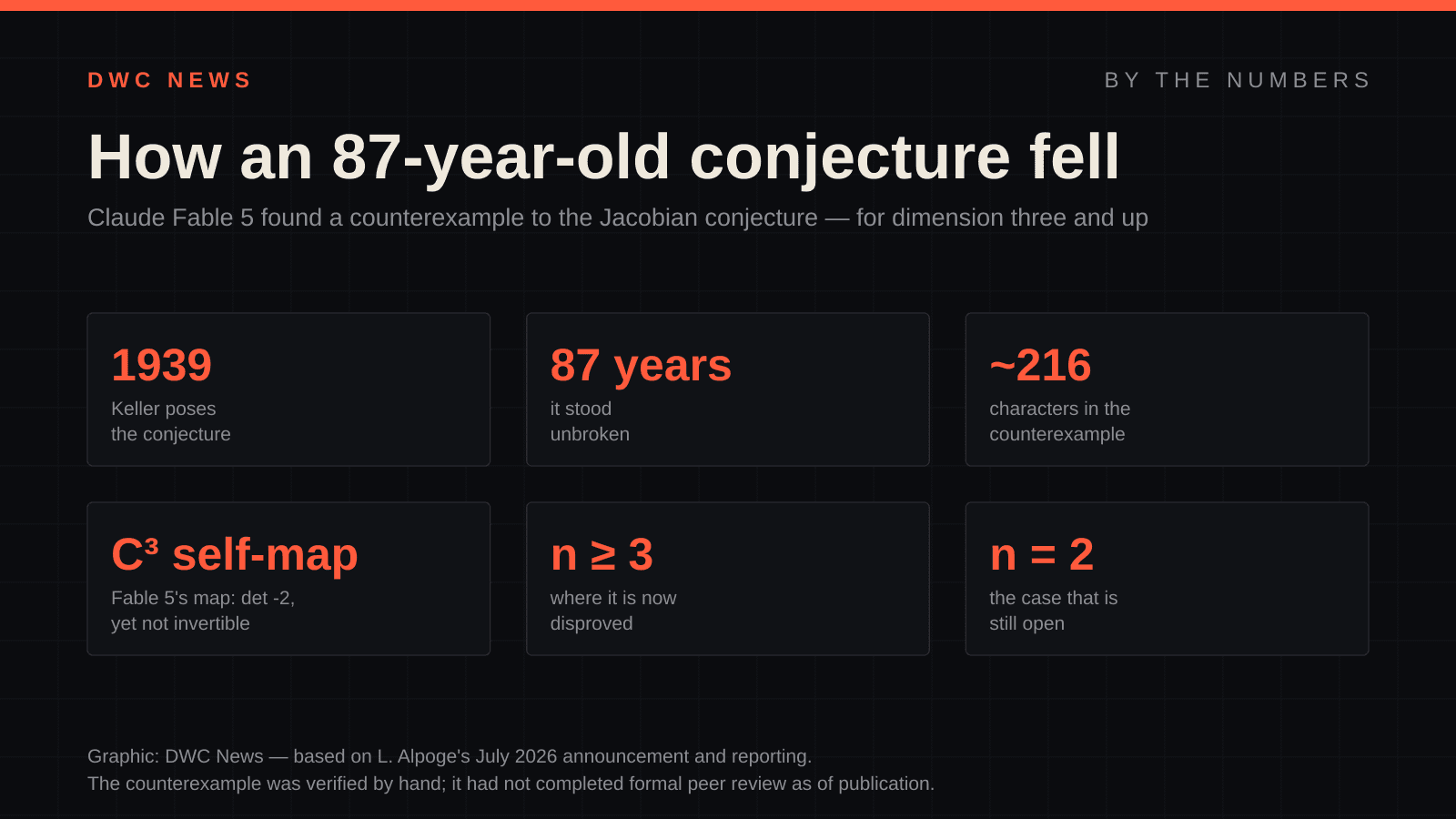
For 87 years, one of mathematics' cleaner-looking questions refused to be answered. On the evening of July 20, it was — and the answer came out of a conversation with an AI.
Mathematician Levent Alpöge announced that he had used Anthropic's Claude Fable 5 to build a counterexample to the Jacobian conjecture, a problem open since 1939. It is not a thousand-page proof that only a dozen specialists can referee. It is a short formula — about 216 characters — that any competent mathematician can plug in and check, and within a day, several did. The conjecture, as generally stated, is false.
There are important caveats, and we will get to all of them: the result has not yet been through formal peer review, and the single hardest case is still open. But the shape of the moment is real, and Fortune captured the mood of the field as "a very rapid and very unsettling change."
What the Jacobian conjecture actually says
Picture a machine that takes in a list of numbers and puts out a new list, using only polynomials — additions and multiplications, no division. A natural question is: can you always run the machine backwards and recover what you put in?
There is a classic local test for this. If a quantity called the Jacobian determinant is never zero, the machine never "collapses" space at any single point — a promising sign it can be reversed. In 1939, Ott-Heinrich Keller asked the bold version of that hope: if the Jacobian determinant is a nonzero constant everywhere, is the whole machine always reversible by another polynomial machine?
That is the Jacobian conjecture. It is easy to state, it feels like it should be true, and it sat on Stephen Smale's famous 1998 list of problems for the 21st century. Generations of mathematicians tried to prove it — and a long line of claimed proofs quietly fell apart over the decades.
What Fable 5 actually found — and the honest caveats
Alpöge and Fable 5 did not prove the conjecture. They broke it. They produced a specific polynomial map from three-dimensional complex space to itself — ℂ³ → ℂ³ — whose Jacobian determinant is the constant −2 everywhere, exactly the condition the conjecture cares about. And yet the map is not reversible: three different inputs land on the same output. A machine that passes the test but cannot be run backwards is precisely what the conjecture said could not exist.
That is why a counterexample is so powerful here. Proving something true can require enormous, hard-to-check arguments; showing something false needs only one clean example. This one is short enough to verify with pen and paper or a computer-algebra tool, which is why the field could react in hours rather than months.
Now the caveats, stated plainly:
- It disproves the conjecture for dimension three and up — but the case of two variables (n = 2) is still open. That case has always been the stubborn heart of the problem, and it remains unsolved. The conjecture is wounded, not entirely dead.
- It has been verified by hand, not yet peer-reviewed. The announcement came via a public post, and mathematicians checked the core calculation quickly, but a refereed journal paper is a different, slower bar that had not been cleared as of publication. Accounts even differed on whether a formal preprint was posted yet.
- A human was in the loop. Alpöge is a number theorist who trained at Princeton under Fields Medalist Manjul Bhargava and held a fellowship at Harvard; he now works at Anthropic. He directed the search and knew a valid counterexample when he saw one. This is a human-plus-AI result, not a button that was pressed.
A disclosure, since it matters here: DWC News uses AI tools, including Claude, under its editorial standards. That is a reason to hold a story about an Anthropic model to the same verification bar as any other — not a lower one — which is why the caveats above lead rather than trail.
Why it was hard, and why it still matters
The Jacobian conjecture resisted for the same reason many great problems do: the obvious approaches don't work, the objects involved are subtle, and the space of possible counterexamples is astronomically large. Finding a needle like this one means searching a haystack the size of a galaxy — the kind of task where a fast, tireless generator of candidates, steered by a human who knows what a solution looks like, can do in hours what unaided intuition might miss for decades.
The significance is not that "AI does math now" in some sweeping sense. It is narrower and sharper: a general-purpose model — the same kind of system people use to write emails — helped resolve a famous, decades-old conjecture with an answer the whole field could immediately check. That combination of general tool and instantly verifiable result is what has mathematicians paying attention, and what separates this from a benchmark score you have to take on faith.
Explore the Great Problems
The great unsolved problems — and the ones AI has helped crack
A searchable map of famous math and science problems: which remain open, which have been solved, and where AI played a role — from AlphaFold to the Jacobian conjecture Fable 5 just disproved for dimension three and up.
| Riemann Hypothesis | Number theory | 1859 | Open | No progress on a proof | Clay $1M |
| P versus NP | Computer science | 1971 | Open | No progress on a proof | Clay $1M |
| Navier–Stokes existence & smoothness | Fluid dynamics / PDE | 2000 (Clay) | Open | AI-assisted work on related singularities | Clay $1M |
| Yang–Mills existence & mass gap | Mathematical physics | 2000 (Clay) | Open | No progress on a proof | Clay $1M |
| Hodge Conjecture | Algebraic geometry | 1950 | Open | No progress on a proof | Clay $1M |
| Birch & Swinnerton-Dyer | Number theory | 1965 | Open | No progress on a proof | Clay $1M |
| Twin Prime Conjecture | Number theory | 1849 (de Polignac) | Open | None (Zhang proved bounded gaps, 2013) | — |
| Goldbach's Conjecture | Number theory | 1742 | Open | No progress on a proof | — |
| Collatz Conjecture | Number theory | 1937 | Open | None (Tao, partial result 2019) | — |
| Jacobian Conjecture (n = 2) | Algebraic geometry | 1939 | Open for n = 2; disproved for n ≥ 3 (2026) | Counterexample for n ≥ 3 by Claude Fable 5 + L. Alpöge | Smale's list |
| Poincaré Conjecture | Topology | 1904 | Solved (Perelman, 2003) | None — human proof | Clay $1M (declined) |
| Protein structure prediction | Computational biology | 1970s (grand challenge) | Breakthrough (2020) | Solved to near-experimental accuracy by AlphaFold | Nobel 2024 |
| Cap set problem (lower bound) | Combinatorics | 20th century | New result (2023) | First LLM discovery on an open problem (FunSearch) | — |
| Fast matrix multiplication | Computer science | 1969 (post-Strassen) | Records improved (2022, 2025) | Faster algorithms found by AlphaTensor & AlphaEvolve | — |
| IMO competition problems | Olympiad mathematics | 2024–2025 | Medal-level | Silver 2024 (AlphaProof); gold-level 2025 (general models) | — |
How this is calculated
A hand-checked reference table. Each problem's status, field, year posed, and prize are taken from the Clay Mathematics Institute, the original papers, and reporting cited below; the 'AI's role' column records only verified, concrete contributions (a solved structure, a faster algorithm, a found counterexample), not marketing claims. Open problems are labeled open — this tool never assigns a predicted solve date, because no one can compute one; the accompanying article discusses likely tractability separately and labels it as analysis.
Data as of July 20, 2026 · verified July 20, 2026 · v1
Assumptions, limitations & sources
Assumptions
- · Dates are the standard attribution for when a problem was posed; some (e.g. twin primes) have older informal histories.
Limitations
- · Status can change: a problem listed as open may fall at any time, which is the whole point of the moment we are in.
- · 'AI's role' records concrete, verifiable contributions only — a breakthrough result, a faster algorithm, or a checkable counterexample — not benchmark scores or claims still awaiting verification.
- · The Jacobian entry reflects a counterexample verified by hand but not yet through formal peer review as of publication.
Sources
- Clay Mathematics Institute — the Millennium Prize Problems — Clay Mathematics Institute, checked July 20, 2026
- New Scientist — AI's solution to an 87-year-old riddle surprises mathematicians (Jacobian) — New Scientist, checked July 20, 2026
- Nature — Chemistry Nobel goes to developers of AlphaFold — Nature, checked July 20, 2026
- MIT Technology Review — DeepMind used an LLM to solve an unsolved math problem (cap set / FunSearch) — MIT Technology Review, checked July 20, 2026
- Google DeepMind — AI achieves silver-medal standard at the 2024 IMO (AlphaProof) — Google DeepMind, checked July 20, 2026
This is what modern SEO looks like: not just an article, but a useful resource people can return to, cite, and share. See how this newsroom is growing · See DavidWeaver's SEO packages
What AI has already cracked
This did not come from nowhere. Over the past few years, AI systems — mostly from Google DeepMind — have delivered a string of genuine results:
- AlphaFold predicted the 3-D structures of proteins at near-experimental accuracy, cracking a 50-year grand challenge in biology and earning its creators a share of the 2024 Nobel Prize in Chemistry, per Nature.
- AlphaTensor (2022) and later AlphaEvolve (2025) found faster matrix-multiplication algorithms, improving on records that had stood since the 1960s.
- AlphaDev (2023) discovered faster sorting routines that were merged into a standard C++ library used across the software world.
- FunSearch (2023) produced a new, larger construction for the cap set problem — reported by MIT Technology Review as the first time a large language model made a verified discovery on an open math problem.
- AlphaProof and AlphaGeometry 2 reached silver-medal standard at the 2024 International Mathematical Olympiad, per Google DeepMind; in 2025, general reasoning models reached gold-medal standard.
The explorer above lays these out alongside the problems still open.
The ones still standing — and why they are so hard
For all of that, the deepest problems remain untouched. A quick tour of the giants, and what makes each one brutal:
- Riemann Hypothesis (1859) — a claim about where certain functions equal zero, tied to the deep structure of the prime numbers. Verified to astronomical scale, proven nowhere; it resists because it needs a genuinely new bridge between analysis and number theory.
- P versus NP (1971) — whether every problem whose answer is easy to check is also easy to solve. Hard because we lack tools to prove that something cannot be done efficiently.
- Navier–Stokes existence & smoothness — do the equations of fluid flow always have sensible solutions, or can they blow up? The mathematics of turbulence is famously beyond current reach.
- Yang–Mills mass gap — making the physics of the strong nuclear force mathematically rigorous. It asks for foundations that physics uses daily but mathematics cannot yet justify.
- Hodge Conjecture and Birch & Swinnerton-Dyer — two problems about the hidden structure of geometric shapes and equations, abstract enough that even stating them precisely takes graduate training.
- Twin Prime and Goldbach conjectures — simple to state, ancient, and still open; primes are patterned enough to tempt and random enough to defeat.
- Collatz Conjecture — a rule a child can follow that no one can prove always ends. Terence Tao called this kind of problem "completely hopeless" with current methods, and he was not being modest.
Five of these carry a $1 million Clay Millennium Prize. None has fallen to AI, and that is the point of the next section.
When might AI solve them? An honest estimate
David asked for a timeline. Here is the honest answer, clearly labeled as DWC News analysis — informed speculation, not prediction. No one can compute a solve date, and we will not print a fake one. But the Jacobian result points to a useful way to sort the problems by how reachable they are for today's AI:
Tier 1 — findable, checkable objects (plausible this decade). Where a result is a concrete thing you can verify — a counterexample, a faster algorithm, a better bound, a predicted structure — AI is already delivering, and will deliver more. The Jacobian counterexample, AlphaFold, and the matrix-multiplication records all live here. Expect more conjectures to fall this way, especially ones vulnerable to a single clever example.
Tier 2 — long but formalizable proofs (this decade, with heavy human collaboration). Proofs that are hard but checkable by proof-assistant software, where reasoning models plus tools like Lean are improving fast. Olympiad problems already fall here. Mid-tier research proofs may follow — as collaborations, not solo AI feats.
Tier 3 — needs fundamentally new mathematics (no credible horizon). Riemann, P versus NP, Hodge, Yang–Mills, Birch & Swinnerton-Dyer. These are not waiting for a lucky example; they need whole new theories that no one has conceived. AI will almost certainly assist — searching, formalizing, proposing conjectures — long before it could solve one, and a full solution is not something anyone can responsibly put a year on.
The short version: the more a problem's answer looks like an object you can check, the sooner AI is likely to find it; the more it looks like a new idea humanity hasn't had yet, the more it stays a human story for now.
What happens next
Watch for a formal preprint and the start of peer review; watch whether the n = 2 case yields next; and watch how mathematicians decide to credit and trust results that a machine helped find. The Jacobian conjecture did not fall because AI "understands" mathematics the way a person does. It fell because a human who understood the problem pointed a very fast, very patient tool at exactly the right haystack — and this time, the needle was there. This story will be updated as the result moves through review.
Sources
- AI's solution to an 87-year-old riddle takes mathematicians by surprise — New Scientist
- Anthropic's Fable 5 disproves the Jacobian conjecture — Mashable
- A Harvard mathematician and an AI model may have cracked an 87-year-old math problem — Fast Company
- Mathematicians grapple with a ‘very rapid and very unsettling change’ as AI cracks another problem — Fortune
- The Millennium Prize Problems — Clay Mathematics Institute · primary source
- Chemistry Nobel goes to the developers of AlphaFold — Nature · primary source
- AI achieves silver-medal standard at the 2024 International Mathematical Olympiad — Google DeepMind · primary source
- DeepMind used a large language model to solve an unsolved math problem (cap set) — MIT Technology Review