Cracker Barrel sells Maple Street Biscuit Company to Biscuit Belly, closing the 16 stores left behind
Cracker Barrel is offloading the Jacksonville-born biscuit chain it bought for $36 million in 2019 — selling the brand and dozens of restaurants to Louisville-based Biscuit Belly and closing the 16 left behind. The sale price wasn't disclosed. Here's what's confirmed and what isn't.

By David Weaver
Publisher & Editor
Published July 22, 2026, 10:00 AM ET
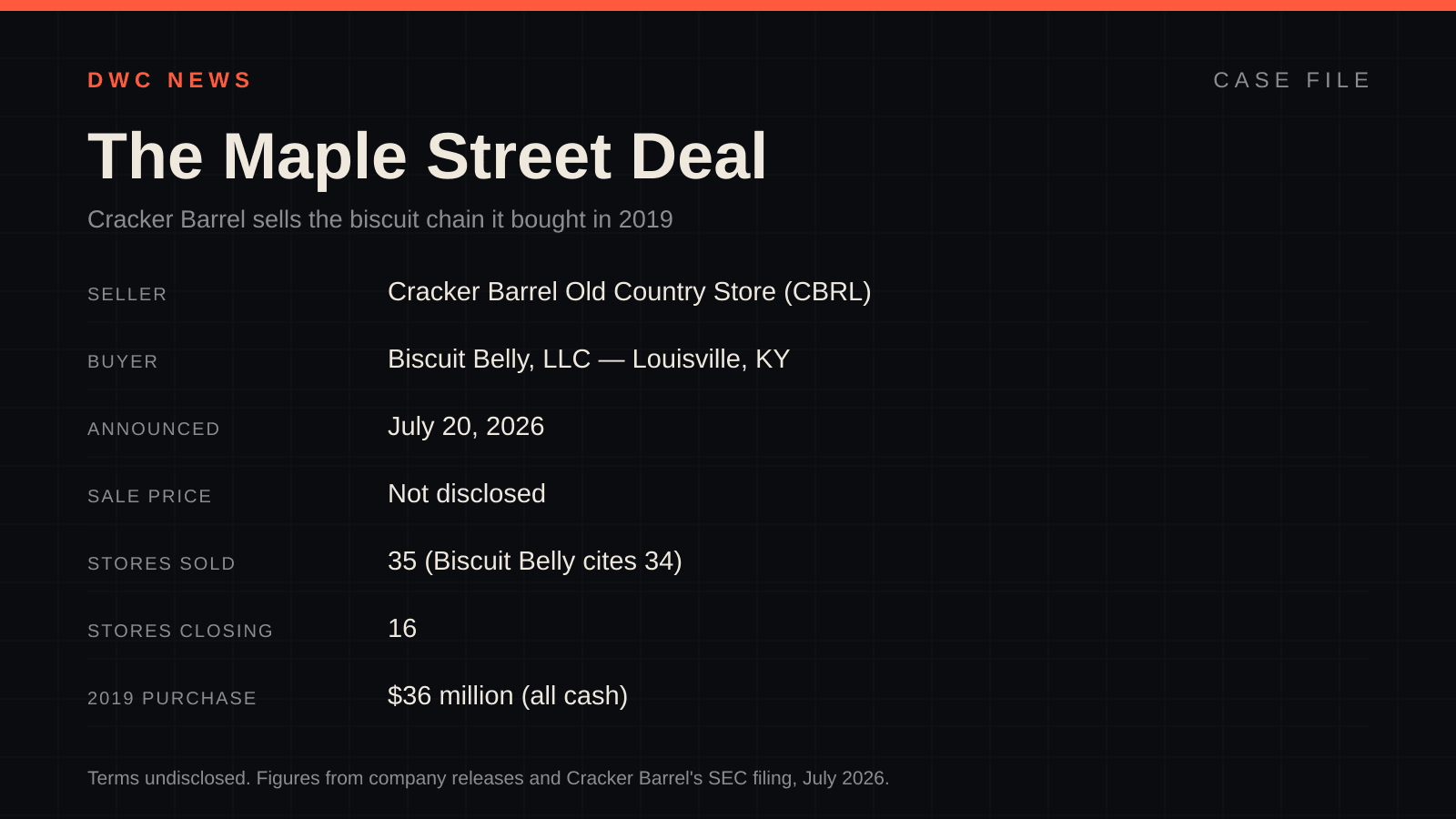
Cracker Barrel is getting out of the biscuit-sandwich business. On Monday, July 20, 2026, the company announced that it had sold the Maple Street Biscuit Company brand and the assets of a batch of its restaurants to Biscuit Belly, a fast-growing chain out of Louisville, Kentucky — and that the Maple Street locations left out of the deal would close.
It is a quiet ending for a chain with a loud origin story. Maple Street was founded in Jacksonville, Florida, in 2012 by former Winn-Dixie executive Scott Moore and co-founder Gus Evans, both of whom had just lost their corporate jobs. Cracker Barrel bought it in 2019 as a bet on fast-casual breakfast. Seven years later, it is handing the brand to someone else.
What Cracker Barrel actually sold
According to Cracker Barrel's own announcement and its filing with the U.S. Securities and Exchange Commission, it sold the Maple Street trademark and the assets tied to 35 restaurants to Biscuit Belly, LLC. The 16 Maple Street locations not included in the sale are closing. Together that is Maple Street's full remaining footprint of 51 restaurants — a chain that, by industry accounts, had grown to roughly 70 locations in early 2025 before Cracker Barrel began shrinking it.
One number to watch: the counts don't perfectly line up. Cracker Barrel's filing describes assets used in 35 locations, while Biscuit Belly's announcement and several outlets, including The Lane Report, put the number Biscuit Belly is taking on at 34. We're flagging that gap rather than papering over it.
The price was not disclosed. Neither company put a dollar figure on the Maple Street sale, and any specific number circulating is not a company figure. For scale, Cracker Barrel paid $36 million in cash for Maple Street back in 2019, when the chain had 33 restaurants across seven states.
What's Confirmed, Contested, and Unknown
The Maple Street sale: confirmed vs. reported vs. unknown
A claim-by-claim map of the Cracker Barrel–Biscuit Belly Maple Street Biscuit Company deal: what the companies and the SEC filing confirm, what the numbers disagree on, and what was never disclosed.
Cracker Barrel sold the Maple Street Biscuit Company brand and restaurant assets to Biscuit Belly.
ConfirmedAnnounced July 20, 2026. Cracker Barrel's release and its SEC Form 8-K say it sold the Maple Street trademark and restaurant assets to Biscuit Belly, LLC, and Biscuit Belly announced the same acquisition.
Cracker Barrel Announces Strategic Actions ↗Biscuit Belly acquisition announcement ↗
How many restaurants changed hands in the sale.
DisputedCracker Barrel's SEC filing describes the assets of 35 Maple Street locations. Biscuit Belly's announcement and several outlets, including The Lane Report, put the number Biscuit Belly is taking on at 34. The one-store gap is unresolved.
Cracker Barrel Form 8-K, Exhibit 99.1 (SEC) ↗The Lane Report — 34 locations ↗
The 16 Maple Street locations not included in the sale are closing.
ConfirmedCracker Barrel said the remaining 16 Maple Street restaurants would close with the sale. Local reporting confirmed some had already shut, including two in St. Johns County, Florida within a day of the announcement.
Fox Business — 16 locations to close ↗First Coast News — 16 locations to close ↗
The price Biscuit Belly paid for Maple Street.
UnknownNeither Cracker Barrel nor Biscuit Belly disclosed the sale price or terms. Biscuit Belly is privately held, and Maple Street was too small a piece of Cracker Barrel's revenue to require a breakout. Any specific figure circulating is not a company number.
Cracker Barrel Announces Strategic Actions ↗Biscuit Belly acquisition announcement ↗
Cracker Barrel paid $36 million for Maple Street in 2019.
ConfirmedCracker Barrel acquired Maple Street in an all-cash deal announced in October 2019, when the chain had 33 restaurants (28 company-owned and 5 franchised) across seven states.
Cracker Barrel Acquires Maple Street Biscuit Company (2019) ↗Cracker Barrel buys Maple Street in $36 million deal ↗
Cracker Barrel completed a separate sale-leaseback of 26 stores for about $77 million.
ConfirmedIn the same July 20, 2026 announcement, Cracker Barrel said it completed a sale-leaseback of 26 company-owned stores generating roughly $77 million in net proceeds, to be used for debt reduction.
Cracker Barrel Announces Strategic Actions ↗Restaurant Dive — sale-leaseback and divestiture ↗
Cracker Barrel expects charges tied to exiting Maple Street.
ConfirmedCracker Barrel said it expects non-cash charges of about $37 million to $39 million in the fourth quarter of fiscal 2026, plus additional cash charges of roughly $6 million to $8 million to exit the business. Maple Street was less than 2% of annual revenue.
Cracker Barrel Form 8-K, Exhibit 99.1 (SEC) ↗Cracker Barrel Announces Strategic Actions ↗
Biscuit Belly will convert the acquired stores to its own brand over 18 to 24 months.
ConfirmedBiscuit Belly said conversions begin immediately, starting in the greater Cincinnati area and Richmond, Virginia, and that the acquisition should help it reach more than 60 locations by the end of 2028.
Biscuit Belly acquisition announcement ↗The Lane Report — conversion plans ↗
What happens to Maple Street gift cards and loyalty rewards.
UnknownNeither company addressed the fate of Maple Street gift cards or rewards accounts during the handoff to a different brand. Until official guidance is issued, customers should use any balance soon and ask at the location.
Cracker Barrel Announces Strategic Actions ↗Biscuit Belly acquisition announcement ↗
What happens to employees at the closing stores and to any franchisees.
UnknownThe number of jobs affected by the 16 closures was not disclosed, and neither company detailed staffing at the acquired stores. Maple Street had franchised locations as of 2019, but how any remaining franchise agreements are handled was not addressed.
Cracker Barrel Announces Strategic Actions ↗Cracker Barrel Acquires Maple Street Biscuit Company (2019, franchise count) ↗
How this is calculated
Each claim is sorted into confirmed (stated by Cracker Barrel's or Biscuit Belly's own announcements or Cracker Barrel's SEC Form 8-K), disputed (independent sources give different figures), or unknown (no company or primary source has disclosed it). Because direct page fetches — including SEC.gov — were blocked, each claim was verified by cross-referencing multiple independent search-result summaries of these same primary releases and secondary outlets rather than by opening each URL directly.
Data as of July 21, 2026 · verified July 21, 2026 · v1
Assumptions, limitations & sources
Assumptions
- · Cracker Barrel's SEC filing and press release accurately describe the transaction it completed.
- · Biscuit Belly's own announcement accurately describes what it acquired and its conversion plans.
- · The reported 2019 acquisition price of $36 million reflects the all-cash deal announced that October.
Limitations
- · The Maple Street sale price and terms were not disclosed; no figure should be inferred.
- · Cracker Barrel's filing cites 35 restaurants sold while Biscuit Belly and some outlets say 34; the exact count is unsettled.
- · The fate of Maple Street gift cards, loyalty accounts, employees, and any franchise agreements was not addressed by either company.
- · This is a developing story — closings and brand conversions are ongoing over 18 to 24 months, so details may change.
- · A separate late-2025 round of Maple Street closures (about 14 stores) is a different event and is not mapped here.
Sources
- Cracker Barrel Announces Strategic Actions (company release) — Cracker Barrel Old Country Store, Inc. via PR Newswire, checked July 21, 2026
- Cracker Barrel Old Country Store, Inc. — Form 8-K, Exhibit 99.1 — U.S. Securities and Exchange Commission, checked July 21, 2026
- Biscuit Belly Positions for Next Phase of Growth with Acquisition of Maple Street Biscuit Company — Biscuit Belly via PR Newswire, checked July 21, 2026
- Cracker Barrel Acquires Maple Street Biscuit Company (2019 release) — Cracker Barrel Old Country Store, Inc. via PR Newswire, checked July 21, 2026
- Biscuit Belly acquires 34 locations from Maple Street Biscuit Company — The Lane Report, checked July 21, 2026
- Cracker Barrel unloads Maple Street chain as it works to cut debt — Fox Business, checked July 21, 2026
- Cracker Barrel sells Maple Street Biscuit Co.; 16 locations to close — First Coast News, checked July 21, 2026
This is what modern SEO looks like: not just an article, but a useful resource people can return to, cite, and share. See how this newsroom is growing · See DavidWeaver's SEO packages
Why Cracker Barrel is walking away
The Lebanon, Tennessee-based company (Nasdaq: CBRL) is in the middle of a turnaround under CEO Julie Felss Masino, and this was framed as a balance-sheet move. Cracker Barrel said Maple Street contributed less than 2% of its annual revenue, and that shedding it "sharpens focus on the core Cracker Barrel brand" and should improve profitability — the divestiture is expected to add to adjusted earnings starting in fiscal 2027.
The Maple Street news came packaged with a second move: Cracker Barrel also completed a sale-leaseback of 26 company-owned stores for roughly $77 million in net proceeds, money it said it would put toward reducing debt. On the same day, it raised its profit outlook for the fiscal year ending in July 2026. In short, Cracker Barrel is selling off pieces to pay down what it owes and concentrate on its namesake restaurants.
The exit isn't free. Cracker Barrel said it expects to record non-cash charges of about $37 million to $39 million in the current quarter tied to the divestiture, plus cash charges of roughly $6 million to $8 million to exit the business.
Who is buying it
Biscuit Belly was founded in 2019 in Louisville by husband-and-wife team Chad and Lauren Coulter — both former pharmacists — and centers its menu on scratch-made biscuit sandwiches and brunch. Before this deal it operated around 15 restaurants across the Southeast. Buying Maple Street more than triples its footprint overnight, and the company says it expects to reach more than 60 locations by the end of 2028.
Biscuit Belly says it will convert the acquired Maple Street restaurants to the Biscuit Belly brand over the next 18 to 24 months, beginning with the greater Cincinnati area and Richmond, Virginia. In its announcement, co-founder and CEO Chad Coulter said acquiring "an iconic brand like Maple Street, one of the original gourmet biscuit sandwich concepts, was not on my 2026 bingo card."
The questions readers are asking
Is my local Maple Street closing, or turning into a Biscuit Belly? It depends on the location. Of Maple Street's 51 restaurants, the ones whose assets Biscuit Belly bought are slated to keep operating and eventually re-brand as Biscuit Belly — a process starting near Cincinnati and in Richmond and rolling out over 18 to 24 months. The 16 not in the sale are closing, some immediately: local reporting confirmed two St. Johns County, Florida stores (in Julington Creek and St. Augustine) had already shut within a day of the announcement. Cracker Barrel and local outlets, not this article, are the place to confirm a specific address; neither company published a single official master list of which stores fall in which bucket.
What happens to my Maple Street gift card or rewards? Here's an honest answer: neither company has said. The announcements covered the brand, the real estate, and the finances, but were silent on Maple Street gift cards and loyalty accounts during the handoff to a different company's brand. Until Maple Street or Biscuit Belly says otherwise, the safe move is to use a gift card or rewards balance sooner rather than later and to ask at the specific location. We'll update this piece if either company issues guidance.
How much did Biscuit Belly pay? It isn't public. Cracker Barrel didn't disclose the price or terms, and Biscuit Belly is privately held, so there's no filing that spells it out. Because Maple Street was such a small slice of Cracker Barrel's revenue, the company wasn't required to break out the figure. We are not going to print a guess.
What does this mean for the people who work there? Also not spelled out. The restaurants Biscuit Belly is taking over are expected to keep running (and later re-brand), which generally means continued operation, but neither company detailed staffing at either the acquired stores or the 16 that are closing. The number of jobs affected by the closures has not been disclosed. (Note: an earlier round of Maple Street closures in late 2025 — about 14 stores — is a separate event from this sale; be careful not to conflate the two.)
Was Maple Street franchised, and what about franchisees? When Cracker Barrel bought it in 2019, Maple Street had a handful of franchised locations alongside its company-owned stores. The current deal is described in terms of the trademark and restaurant assets, and the companies did not lay out how any remaining franchise agreements are handled. We're marking that unknown rather than assuming.
Why it matters and what's next
For a mid-size chain, this is a clean illustration of a bigger restaurant-industry pattern: a large operator that bought a trendy concept during an expansion phase now unwinding it to cut debt and refocus. For Biscuit Belly, it's a bet that it can absorb and re-brand dozens of restaurants without stumbling — a hard thing to do well.
The real test plays out over the next two years, as conversions move market by market and the 16 closures finish. The load-bearing facts here — buyer, seller, the 16 closings, the undisclosed price, the $36 million Cracker Barrel paid in 2019 — are confirmed by the companies and the SEC filing. The store-count gap, gift-card handling, employee impact, and franchise details are not, and we've labeled them that way. The tool above lays out exactly which is which.
Sources
- Cracker Barrel Announces Strategic Actions (company release) — Cracker Barrel Old Country Store, Inc. via PR Newswire · primary source
- Cracker Barrel Old Country Store, Inc. — Form 8-K, Exhibit 99.1 — U.S. Securities and Exchange Commission · primary source
- Biscuit Belly Positions for Next Phase of Growth with Acquisition of Maple Street Biscuit Company — Biscuit Belly via PR Newswire · primary source
- Cracker Barrel Acquires Maple Street Biscuit Company (2019 release) — Cracker Barrel Old Country Store, Inc. via PR Newswire · primary source
- Cracker Barrel sells Maple Street Biscuit Company to Biscuit Belly, completes sale-leaseback — Restaurant Dive
- Biscuit Belly acquires 34 locations from Maple Street Biscuit Company — The Lane Report
- Cracker Barrel unloads Maple Street chain as it works to cut debt — Fox Business
- Cracker Barrel sells Maple Street Biscuit Co.; 16 locations to close — First Coast News