Tesla posts record $28.24B revenue in Q2 2026, but profit misses badly and the stock slips about 4%
Tesla's Q2 2026 results, out after the close July 22, set records for revenue ($28.24B, +26%) and deliveries — yet adjusted profit missed, operating income fell 57%, margins compressed and free cash flow went negative. Here's the beat-and-miss, and why the stock fell.

By David Weaver
Publisher & Editor
Published July 22, 2026, 6:30 PM ET
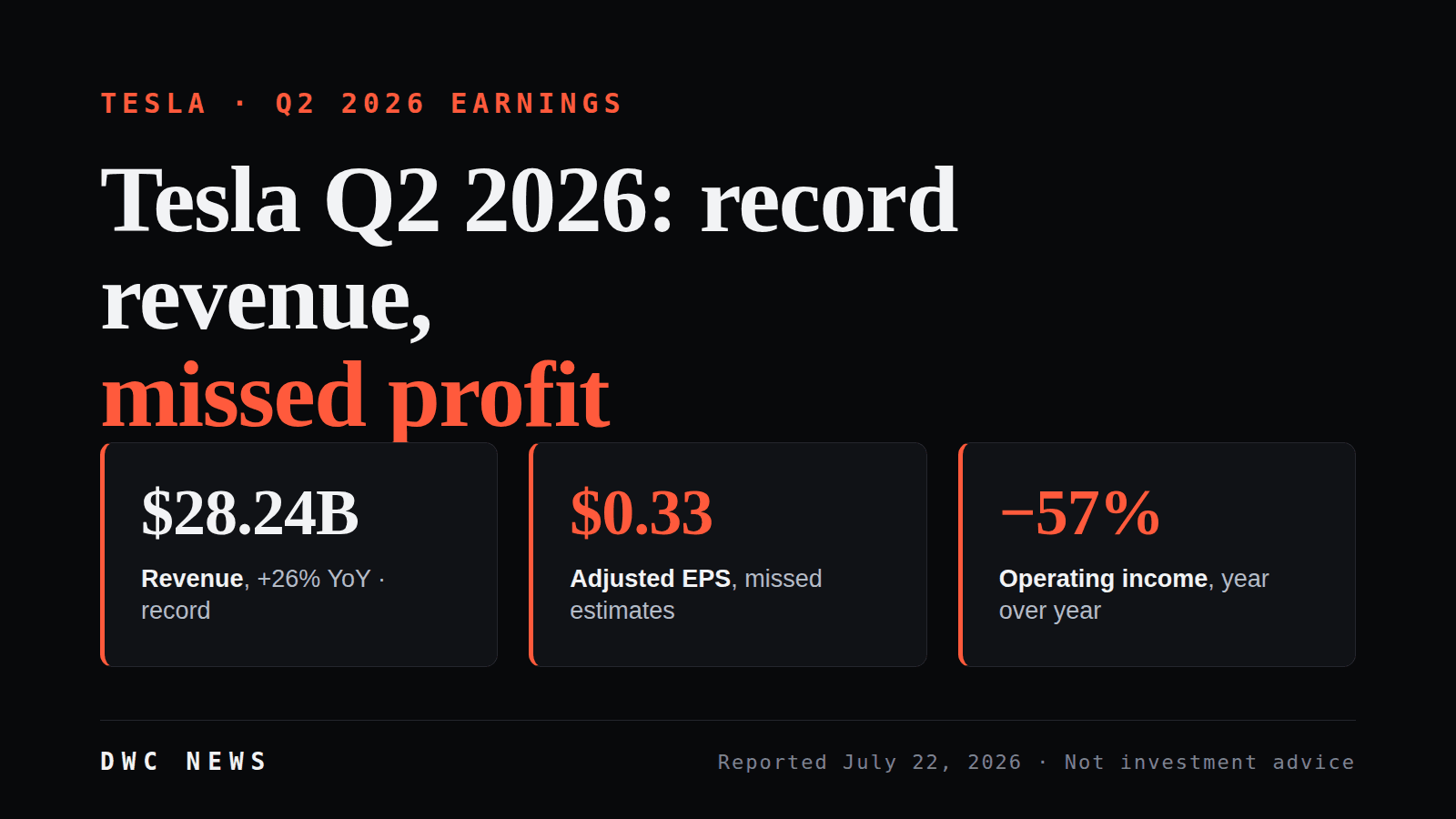
Tesla reported its second-quarter 2026 results after the market closed on Wednesday, July 22, and the headline number was the best the company has ever posted: $28.24 billion in revenue, up 26% from a year earlier and comfortably ahead of the roughly $26 billion Wall Street was expecting. It was enough to push Tesla past $100 billion in trailing-12-month revenue for the first time.
And yet the stock fell about 4% in after-hours trading — call it a 3% to 5% move depending on the minute — to around $358, after closing the regular session at $374.01, itself down 1.30% on the day. So the obvious question is the one this story is built to answer: did Tesla beat or miss — and why would the shares drop on a record?
The short answer: Tesla beat on revenue and missed on profit
Both things are true at once, which is exactly why the reaction looks contradictory. On the top line, Tesla beat. On the bottom line, it missed — and not by a little.
- Revenue: a beat. $28.24 billion, +26% year over year, versus estimates near $26 billion.
- Adjusted (non-GAAP) earnings per share: a miss. Tesla reported $0.33 against an analyst range of roughly $0.51 to $0.53 — the number most of the headlines fixated on.
- GAAP earnings per share: $0.32.
- GAAP net income: $1.11 billion, down 5% from a year ago.
Records elsewhere reinforced the "the business is growing" half of the story. Tesla delivered 480,126 vehicles, a Q2 record and up 25% year over year, on production of 451,758. Its energy business kept climbing, too, with 13.5 GWh of battery storage deployed — up 53% sequentially.
So demand and volume are not the problem. The problem is what happened between that record revenue and the profit line.
Why the stock fell despite a record: margins, not sales
The market did not react to how much Tesla sold. It reacted to how little of that made it to profit. Nearly every profitability measure moved the wrong way:
- GAAP operating income fell 57% to $398 million.
- Operating margin collapsed to 1.4%, from 4.1% a year earlier.
- Total GAAP gross margin slipped to 16.8%, down from 21.1% in the first quarter of 2026. Automotive gross margin was 16.9%.
- Regulatory-credit revenue — high-margin money Tesla earns selling emissions credits to other automakers — collapsed to $146 million, from $439 million a year ago. That is nearly $300 million of almost-pure profit that simply was not there this quarter.
- Operating expenses jumped about 47% to roughly $4.35 billion.
- Free cash flow turned negative, at -$1.09 billion, a sharp reversal from +$146 million a year earlier, as capital spending hit $5.79 billion.
Put plainly: Tesla sold more cars than ever and made less money doing it, because the price of each sale is lower, the easy regulatory-credit profit has shrunk, and the company is spending heavily. A record top line sitting on a 1.4% operating margin is why a "record quarter" can still send the stock down.
The scorecard below lays the beats and misses side by side — revenue, adjusted EPS, net income, margins, deliveries, regulatory credits and free cash flow — so you can see at a glance which lines beat and which ones dragged.
Tesla Q2 2026: The Beat-and-Miss Scorecard
Tesla's Q2 2026 earnings, line by line: what beat and what missed
A line-by-line scorecard of Tesla's reported second-quarter 2026 results — revenue, adjusted EPS, GAAP net income, margins, deliveries, regulatory credits and free cash flow — each set against its estimate or year-ago figure with a plain verdict. Reported figures only; no live prices.
This scorecard shows Tesla's reported second-quarter 2026 financial figures for information only. It is not investment advice and does not show live stock prices, which change constantly. Estimates are approximate consensus figures; verify any number against Tesla's official SEC filings before acting on it.
| Revenue | $28.24B (+26% YoY) | Est. ~$26B | Beat — record revenue |
| Adjusted (non-GAAP) EPS | $0.33 | Est. $0.51-$0.53 | Miss |
| GAAP net income | $1.11B | -5% YoY | Down |
| GAAP operating income | $398M | -57% YoY | Down sharply |
| Operating margin | 1.4% | 4.1% a year ago | Down |
| Automotive gross margin | 16.9% | Total gross margin 16.8% vs 21.1% in Q1 2026 | Down |
| Deliveries | 480,126 (+25% YoY) | Production 451,758 | Beat — record Q2 |
| Regulatory credits | $146M | $439M a year ago | Down — collapsed |
| Free cash flow | -$1.09B | +$146M a year ago (capex $5.79B) | Down — negative |
How this is calculated
Figures are Tesla's reported second-quarter 2026 results, released after the market close on July 22, 2026, as summarized by the cited outlets (CNBC, Electrek, StockTitan) and Tesla's Form 8-K quarterly update filed with the SEC. Revenue, GAAP net income, GAAP operating income, operating margin, gross margins, deliveries, production, regulatory-credit revenue, capital expenditure and free cash flow are as reported. Adjusted EPS is Tesla's non-GAAP diluted figure; the analyst estimate is shown as a consensus range ($0.51-$0.53). The revenue estimate (~$26B) is an approximate consensus. Year-over-year and sequential changes are as reported by Tesla or computed from the reported figures and rounded. The 'Result' column is an editorial plain-English verdict, not a rating.
Data as of July 21, 2026 · verified July 21, 2026 · v1
Assumptions, limitations & sources
Assumptions
- · Adjusted EPS is Tesla's reported non-GAAP diluted earnings per share; GAAP EPS was $0.32.
- · The analyst EPS figure is a consensus range ($0.51-$0.53) and the ~$26B revenue figure is an approximate consensus, not an official Tesla number.
- · Year-ago comparisons refer to the second quarter of 2025 unless the row states otherwise.
Limitations
- · This is a single quarter (Q2 2026), not a trend; one quarter's margins do not define the business.
- · The 'Result' column is a plain-language verdict for context, not investment advice or a recommendation.
- · Estimates are approximate consensus figures that vary by data provider; verify against Tesla's official filing.
- · Stock price, market value and after-hours moves change constantly and are deliberately not part of this table.
Sources
- Tesla (TSLA) Q2 2026 earnings report — CNBC, checked July 21, 2026
- Tesla (TSLA) Q2 2026 financial results — Electrek, checked July 21, 2026
- Tesla Releases Second Quarter 2026 Financial Results — StockTitan, checked July 21, 2026
- Tesla, Inc. Form 8-K — Second Quarter 2026 update (SEC EDGAR filing list) — U.S. Securities and Exchange Commission, checked July 21, 2026
This is what modern SEO looks like: not just an article, but a useful resource people can return to, cite, and share. See how this newsroom is growing · See DavidWeaver's SEO packages
What Tesla is spending all that money on
The compressed margins are not an accident; they are a choice. Tesla is redirecting the company's cash toward its artificial-intelligence, robotaxi and humanoid-robot ambitions, and the quarter is what that transition looks like on the income statement.
On the earnings call, Chief Executive Elon Musk framed the current results as the cost of building toward autonomy and robotics rather than the state of a finished business, arguing in substance that Tesla's value increasingly rests on self-driving and Optimus rather than on this quarter's car margins. Chief Financial Officer Vaibhav Taneja, for his part, pointed to the heavy investment and the fading regulatory-credit revenue as the reasons profitability fell even as deliveries hit a record. (Those remarks are paraphrased from the company's commentary and secondary summaries of the call, not quoted verbatim.)
The spending plans behind that pitch are concrete:
- Tesla guided 2026 capital expenditure to "more than $25 billion."
- Its robotaxi service is now described as live in seven US metro areas, running on a build of its FSD v15 software.
- Active Full Self-Driving (FSD) subscriptions reached 1.48 million, up 56% year over year — a recurring-software line the company wants investors to weigh against thinning hardware margins.
- Optimus, Tesla's humanoid robot, is targeted for production "later this year," though the company has produced zero units to date — so it is a promise on the roadmap, not revenue on the books.
The risks Tesla flagged, in plain language
Two cautions belong next to the growth story. First, Tesla referenced an active investigation by the National Highway Traffic Safety Administration (NHTSA) into its FSD system — the same software the robotaxi rollout depends on, which makes the probe material to the part of the business the company is leaning on hardest. Second, the negative free cash flow means that, this quarter, Tesla spent more cash than its operations generated; that is sustainable for a company with Tesla's balance sheet, but it is a real change from a year ago and worth watching if it persists.
The bottom line
Read as a snapshot of today's car business, Q2 2026 was mixed-to-weak: record volume, but the thinnest operating margin in years and negative free cash flow. Read as a down payment on autonomy and robotics, it was expensive by design. The stock's roughly 4% drop says the market, at least on the night, weighed the missed profit more heavily than the record revenue and the AI promises attached to it.
Which reading proves right depends on things that have not happened yet — the robotaxi expansion, whether FSD subscriptions keep compounding, whether Optimus ships, and how the NHTSA probe resolves. Those are the lines to watch in the quarters ahead.
This article is for information only and is not investment advice. The figures above are Tesla's reported second-quarter 2026 results; stock prices and market values change constantly. Verify any number against Tesla's official SEC filings before acting on it.
Sources
- Tesla (TSLA) Q2 2026 earnings report — CNBC
- Tesla (TSLA) Q2 2026 financial results — Electrek
- Tesla Releases Second Quarter 2026 Financial Results — StockTitan
- Tesla, Inc. Form 8-K — Second Quarter 2026 update (SEC EDGAR filing list) — U.S. Securities and Exchange Commission · primary source