Brown bullhead catfish tumors in Lake Memphremagog are a contagious cancer, study finds
A Nature study finds the black skin growths on brown bullhead catfish in Lake Memphremagog, on the Vermont–Quebec border, are a transmissible melanoma — a single cancer lineage spreading from fish to fish. It is the first contagious cancer known in any fish, and the fourth in the animal kingdom.

By David Weaver
Publisher & Editor
Published July 23, 2026, 5:43 PM ET
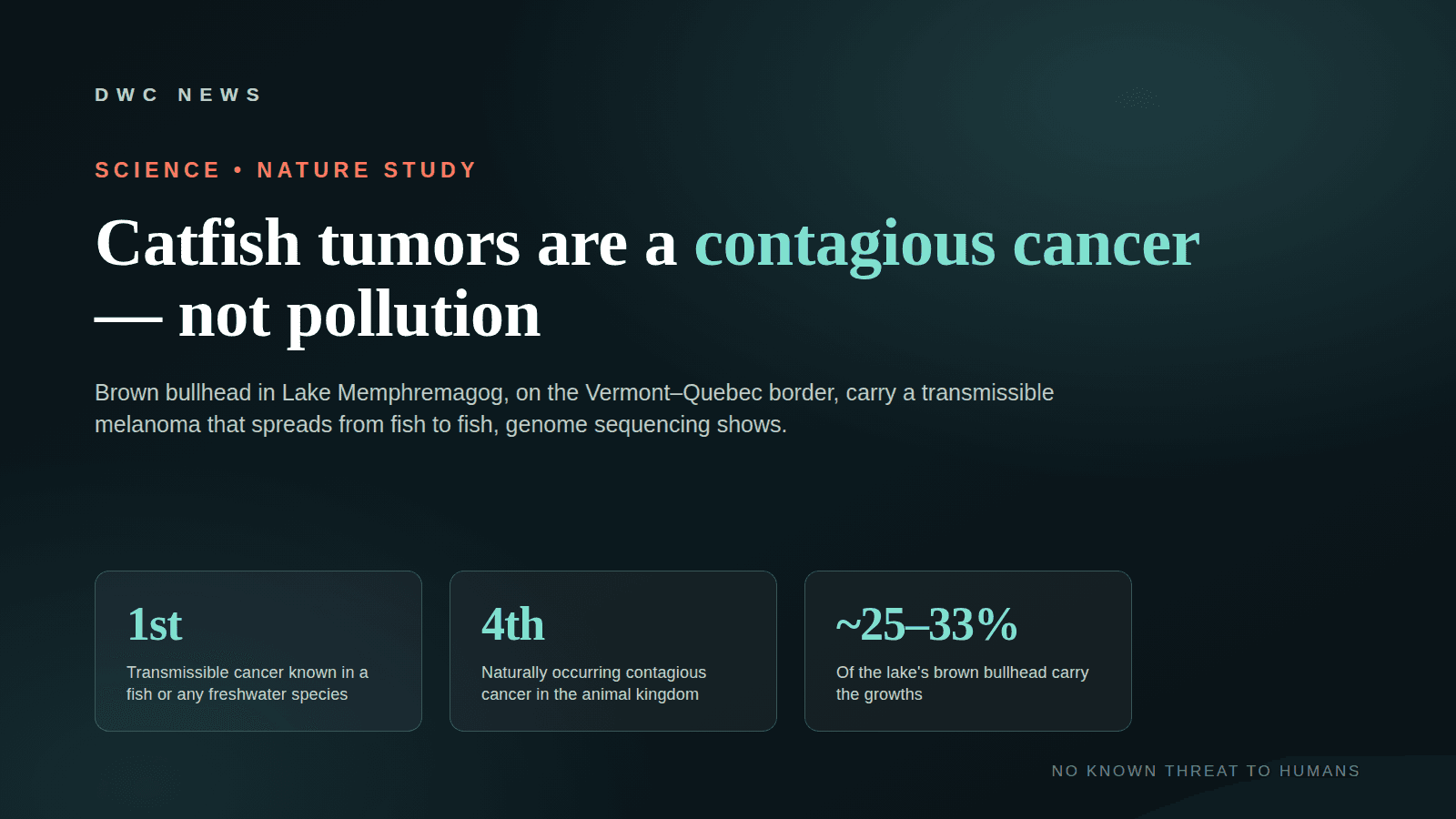
If you saw the headline about tumor-covered catfish in a lake on the Vermont–Quebec border and assumed “pollution,” you are reading the wrong story. The correction that makes this news is the whole point: the black skin growths on brown bullhead in Lake Memphremagog are not classic pollution tumors. According to a study published in Nature, they are a transmissible cancer — living cancer cells that spread from one fish to the next.
What the study actually found
The paper, “Brown bullhead catfish melanoma represents a novel transmissible cancer”, was led by Julie Dragon of the University of Vermont, working with the Vermont Fish and Wildlife Department and the U.S. Geological Survey. It reports that the dark melanoma lesions on brown bullhead (Ameiurus nebulosus) in the lake are a single clonal cancer lineage passing between individual fish — the cancer cells themselves jumping host to host, rather than each fish independently developing a tumor from a shared exposure.
That makes it, by the researchers’ account, the first transmissible cancer ever documented in a fish — or in any freshwater species — and only the fourth naturally occurring transmissible cancer known in the animal kingdom.
The evidence is genomic. When the team sequenced both the fish and their tumors, the tumors turned out to be far more genetically similar to each other than to the fish carrying them, sharing hundreds of thousands of the same mutations. That pattern is the signature of one lineage transmitted between animals, not many tumors arising separately. The cancer appears to have entered the population around 2012, and — reported here as an approximate range pending the paper’s exact per-year figures — roughly a quarter to a third of the lake’s brown bullhead now carry the growths.
Why everyone (including the scientists) first thought “pollution”
The instinct to blame pollution is not naive — it is decades of good science, and it is worth keeping clearly separate from today’s finding. Brown bullhead are bottom-dwellers that have long been used as a pollution sentinel: because they live in and feed off sediment, tumor rates in bullhead have been used to gauge contamination. PAH-contaminated sediment (polycyclic aromatic hydrocarbons) is associated with liver and skin tumors in the species; in one well-known case on Ohio’s Black River, bullhead tumor rates fell after a nearby coking plant closed.
So when unusual lesions showed up in Lake Memphremagog — including after runoff from Tropical Storm Irene — a contaminant or a virus was the team’s first hypothesis. The genomics ruled that out. This melanoma is a different phenomenon from the classic pollution tumors, which is exactly why the “toxic lake” framing misses it.
The other three contagious cancers
Transmissible cancers are vanishingly rare, which is what makes a fourth one notable. The three established before this are canine transmissible venereal tumour (CTVT) in dogs, devil facial tumour disease (DFTD) in Tasmanian devils — which wiped out an estimated 80–90% of some devil populations — and bivalve transmissible neoplasia, a leukaemia-like cancer that spreads through seawater among clams, mussels, and cockles. The table below places the new catfish finding alongside those three: the host, the cancer, how the cells spread, and what each has done to its population, each row tied to the study that established it.
The Four Known Contagious Cancers in Nature
Transmissible cancers in the animal kingdom: the four known cases
A searchable table of the four naturally occurring transmissible cancers known in animals — in dogs, Tasmanian devils, bivalves, and now brown bullhead catfish — showing the host, the cancer, how the cancer cells spread, and the population impact, each row sourced to the study that established it.
| Domestic dog | Canine transmissible venereal tumour (CTVT) | Living cancer cells physically transfer between dogs, chiefly during mating. | The oldest known cancer lineage, thousands of years old; found in free-roaming dogs worldwide. Tumors are usually non-fatal and often regress. | Murchison et al., Science (2014) |
| Tasmanian devil | Devil facial tumour disease (DFTD) | Cancer cells pass through bites to the face during fighting and feeding. | Drove some local populations down by roughly 80–90% since the 1990s. A second, independent lineage (DFT2) was later found. | Pearse & Swift, Nature (2006) |
| Bivalves (clams, mussels, cockles) | Bivalve transmissible neoplasia (a leukaemia-like cancer) | Free cancer cells travel through seawater and are taken up by other filter-feeding bivalves. | Documented across several bivalve species and oceans; some lineages have jumped between species. | Metzger et al., Cell (2015) |
| Brown bullhead catfish (Ameiurus nebulosus) | Transmissible melanoma, Lake Memphremagog (Vermont–Quebec) | Cancer cells pass between individual fish as a single clonal lineage; the exact route is still under study. | About a quarter to a third of the lake's brown bullhead carry the growths; the lineage appears to have entered the population around 2012. First known in any fish; the fourth case overall. | Dragon et al., Nature (2026) |
How this is calculated
The table lists the four naturally occurring transmissible cancers documented in the scientific literature as of July 2026. Each row summarizes the host species, the cancer, the accepted route by which living cancer cells pass between individuals, and the reported population impact, drawn from the landmark peer-reviewed study for that disease (named in the Source column and listed with URLs below). The brown bullhead row summarizes the July 2026 Nature paper by Dragon and colleagues. Prevalence and dates are reported as ranges or approximate figures where the underlying sources do the same.
Data as of July 22, 2026 · verified July 22, 2026 · v1
Assumptions, limitations & sources
Assumptions
- · ‘Transmissible cancer’ means the cancer cells themselves pass from one individual to another as a living clonal lineage, rather than a cancer caused by an infectious virus (such as HPV) or by a shared environmental exposure.
- · The four cases shown are those established in the peer-reviewed literature; the count reflects distinct host systems, though some hosts (Tasmanian devils, several bivalves) carry more than one independent transmissible lineage.
Limitations
- · Prevalence and origin dates are approximate. The share of Lake Memphremagog brown bullhead carrying growths is reported as a range (about a quarter to a third) and the lineage is estimated to have entered the population around 2012.
- · The exact mechanism by which the catfish melanoma passes between fish is still under study; the genomic evidence for a single transmitted lineage is the paper's central finding.
- · This table is background science, not health guidance. None of these cancers is known to be transmissible to humans.
Sources
- Brown bullhead catfish melanoma represents a novel transmissible cancer (Dragon et al.) — Nature, checked July 22, 2026
- A contagious cancer is spreading through catfish (news feature) — Nature, checked July 22, 2026
- More than parasites and tumors: Vermont scientists discover transmissible cancer in catfish — University of Vermont, checked July 22, 2026
- Scientists discover a transmissible cancer in catfish — a first for fish — NPR, checked July 22, 2026
- Fish found with a contagious cancer for the first time — CBC News, checked July 22, 2026
This is what modern SEO looks like: not just an article, but a useful resource people can return to, cite, and share. See how this newsroom is growing · See DavidWeaver's SEO packages
What it means for people: no known threat
This is the part to state plainly and not to inflate. The researchers stress the catfish cancer poses no known threat to humans. Lake Memphremagog supplies drinking water to more than 175,000 people, and the finding does not change that: there is no known risk to the water supply. The only guidance is common-sense — the Vermont Fish and Wildlife Department suggests not eating bullhead from the lake that have visible skin lesions — and, importantly, there is no formal fish-consumption advisory tied to this discovery. There is no “toxic fish” warning here, and nothing in the study supports one.
What to keep an eye on
This remains a developing story, and a couple of specifics are worth verifying before repeating them as precise. Coverage has carried slightly different publication dates — roughly July 22 or 23, 2026 — around the embargo, so “published in late July 2026” is the honest phrasing. And the prevalence figures are best read as the approximate range above until the paper’s exact numbers are pinned down. What is firm is the core claim, and it is the one that reframes the whole story: this is a contagious cancer in a fish, established by genome sequencing — not another chapter in the pollution-tumor file.
Sources
- Brown bullhead catfish melanoma represents a novel transmissible cancer (Dragon et al.) — Nature · primary source
- A contagious cancer is spreading through catfish (news feature) — Nature
- More than parasites and tumors: Vermont scientists discover transmissible cancer in catfish — University of Vermont
- Scientists discover a transmissible cancer in catfish — a first for fish — NPR
- Fish found with a contagious cancer for the first time — CBC News