Starship Flight 13 met every mission goal — and for the first time, the ship came home intact
SpaceX launched Flight 13 on July 24 after two scrubs, deployed all 20 next-generation Starlink V3 satellites, relit a Raptor in space, and set the ship down in the Indian Ocean so gently it tipped over and floated — still transmitting video. It did not explode. That has never happened before.

By David Weaver
Publisher & Editor
Published July 24, 2026, 7:35 PM ET
Updated July 24, 2026, 9:05 PM ET
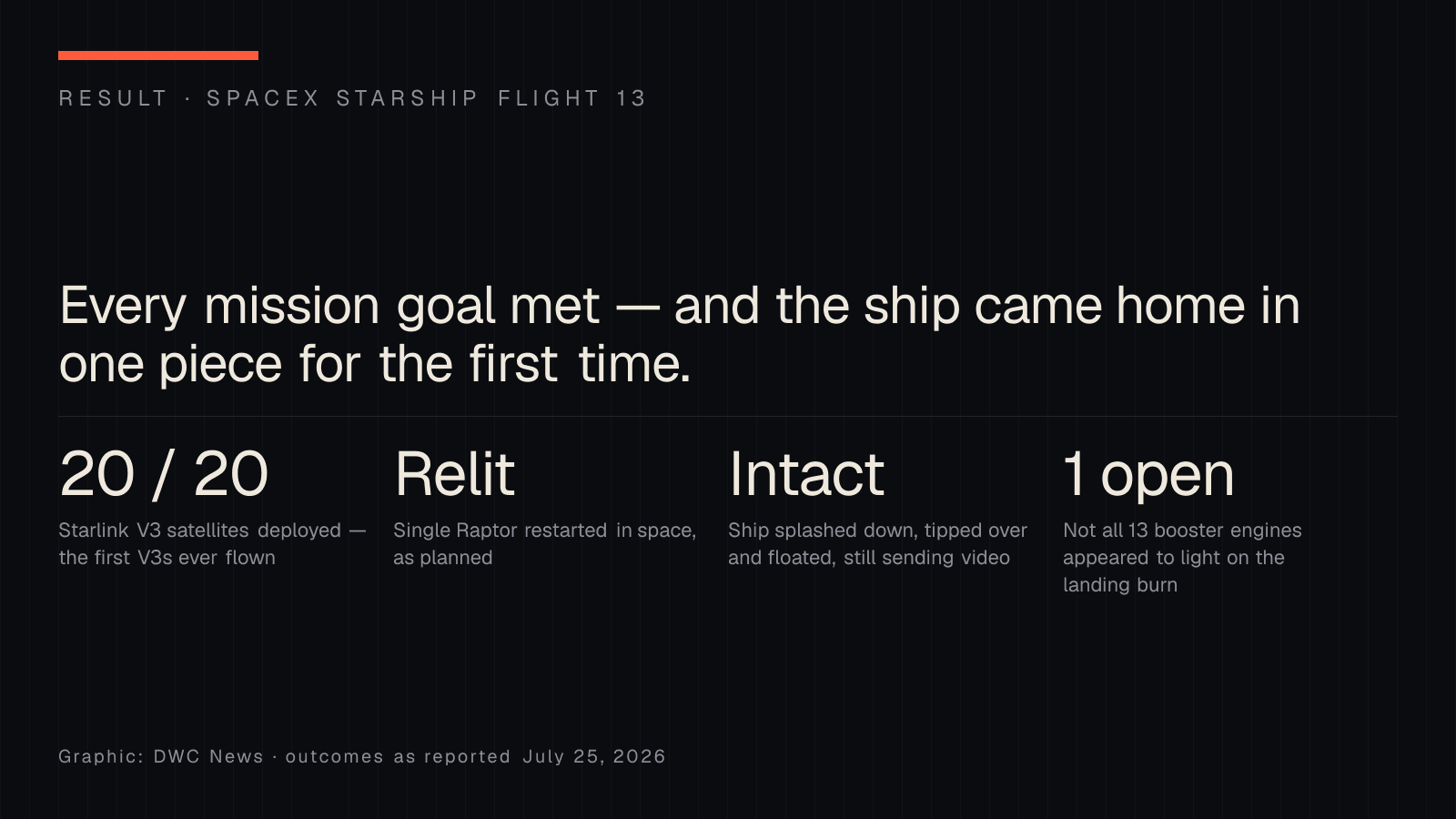
Update, July 25: The three objectives this story first listed as unconfirmed have now been reported, and they went SpaceX's way. The relight worked. The ship came down intact. The section below has been rewritten accordingly.
SpaceX launched Starship Flight 13 on Friday, July 24, 2026, from Starbase in Boca Chica, Texas — on the third attempt, after two false starts. It deployed the first Starlink V3 satellites ever flown.
Then it did something no Starship had done before: it came home in one piece.
The ship flew a controlled reentry, executed its landing flip, relit its engines and set down in the Indian Ocean west of Australia — and instead of breaking up or exploding, it tipped over and floated, still transmitting live video, with orange flames flickering around a singed hull. SpaceX's Dan Huot called it the "softest splashdown we have ever had with a Starship." Local coverage from Brownsville reported the flight met all its mission goals.
What Flight 13 actually confirmed
It lifted off. After the July 16 attempt aborted at roughly T-0 — about four of the booster's 33 Raptor engines failed to ignite — and the July 23 attempt was scrubbed by weather tied to Tropical Storm Bertha, the vehicle flew Friday evening from Orbital Launch Pad 2.
All 20 Starlink V3 satellites deployed. This was the mission's point. Flight 13 was the first operational deployment of Starlink's third-generation satellites. Six of the 20 carried cameras, and after release they turned back to scan Starship's heat shield and beam high-resolution imagery to the ground — the satellites were, in part, instruments pointed at the rocket that carried them.
The in-space Raptor relight worked. Restarting an engine in vacuum is a prerequisite for anything Starship eventually does beyond a suborbital hop, and SpaceX reported the single-engine relight as a success.
The ship survived reentry. It pushed through the region of peak heating and the phase of maximum dynamic pressure, completed the landing flip, relit its engines in sequence, and touched down in the Indian Ocean. SpaceX and Elon Musk both pointed to a significant improvement in heat-shield performance on reentry as the flight's headline result.
The booster came down under control in the Gulf. Super Heavy separated about two minutes into flight and splashed down off Boca Chica. Worth stating plainly, because it gets misread every flight: there was no tower catch attempt on Flight 13. A water landing was the plan, not a failure to catch.
Why "it floated" is the real headline
A splashdown is not a landing, and it is easy to under-read what happened here.
Every previous Starship that made it to the Indian Ocean ended the same way: whatever survived reentry came apart on or shortly after contact with the water. Flight 13's ship did not. It sat there. It kept transmitting.
That matters for one reason above all others — the heat shield is the thing standing between Starship and reusability. A vehicle that has to be substantially rebuilt after every flight is an expensive rocket, not a reusable one, and tile attachment has been the long pole in the program for years. A ship that comes through reentry structurally sound, and then survives long enough to keep sending data from the water, produces exactly the evidence the engineering problem needs. Huot's phrasing was blunt about it: "This is a dream scenario for this team that's trying to get this heat shield data."
This flight was engineered to generate that evidence. It carried modified tiles, alternative attachment methods on the aft flaps and skirt, and load-sensing tiles measuring stress during an ascent deliberately flown at higher dynamic pressure than previous flights — which is also why SpaceX waited for clear skies on July 23 rather than launching into cloud. The cameras on the satellites were part of the same experiment.
The one asterisk
Launch-day coverage noted that it appeared not all 13 engines lit for the booster's landing burn.
That is not a trivial footnote for this vehicle. Flight 12, on May 22, 2026, landed its ship but lost its booster when several Raptor engines failed shortly after the boostback burn — and that failure is why the FAA required a mishap investigation and why Flight 13 was a return-to-flight at all. An engine-out followed by a controlled splashdown is a far better outcome than Flight 12's. It is not the same thing as a clean one, and the tool below still grades it disputed rather than resolved.
The tool lists every published Flight 13 objective and grades it confirmed, disputed, or unknown, with the source for each — updated as the outcomes came in, so you can see what is actually established rather than reading a flight plan as a scoreboard.
What Flight 13 Actually Confirmed
Starship Flight 13, objective by objective: what is confirmed and what is not
Every published objective of Starship Flight 13, graded against the record: confirmed, disputed, or still unknown — with the source for each, and a change log showing which verdicts moved as the outcomes came in.
Starship Flight 13 lifted off from Starbase, Texas on July 24, 2026.
ConfirmedAfter an engine-ignition abort on July 16 and a weather scrub on July 23, the vehicle flew on the third attempt from Orbital Launch Pad 2 at Starbase. Live coverage reported liftoff.
Space.com — Flight 13 launch updates, July 24 ↗CNN — Starship megarocket launches on 13th test flight ↗
All 20 Starlink V3 satellites were deployed — the first V3s ever flown.
ConfirmedThe flight carried and released 20 next-generation Starlink V3 satellites, the first of that generation to reach space. Reporting describes the satellites deploying solar panels and antennas after release.
Space.com — Flight 13 launch updates, July 24 ↗Starship flight test 13 — flight record ↗
The Super Heavy booster made a controlled splashdown in the Gulf.
ConfirmedThe booster separated about two minutes into flight and came down under control in the Gulf off Boca Chica. This flight did not attempt a tower catch — a water landing was the plan.
Space.com — Flight 13 launch updates, July 24 ↗Space.com — Flight 13 mission preview (planned booster profile) ↗
Every engine lit on the booster's landing burn.
DisputedThe splashdown itself is reported as controlled, but coverage notes it appeared that not all 13 engines lit for the landing burn. Engine-out behaviour on the landing burn is exactly what the previous flight's booster failure turned on, so the detail matters — and it is not settled here.
The ship completed its controlled splashdown in the Indian Ocean — and stayed intact.
ConfirmedShip 40 pushed through peak heating and maximum dynamic pressure, executed its landing flip, relit its engines in sequence and set down in the Indian Ocean west of Australia. It then tipped over and floated, still transmitting live video, with flames around a singed hull. It did not break up — a first for a Starship reaching the Indian Ocean. SpaceX's Dan Huot called it the softest Starship splashdown yet.
Space.com — Starship makes the 'softest splashdown' ever ↗TASS — Starship completes test flight, splashing down in the Indian Ocean ↗MyRGV — all mission goals met, Starship makes soft splashdown ↗
The in-space Raptor relight test succeeded.
ConfirmedSpaceX reported the single-Raptor relight during the coast phase as a success. Restarting an engine in vacuum is a prerequisite for any Starship mission that goes beyond a suborbital profile, which is why it was on the objective list at all.
Space.com — Flight 13 launch updates, July 24 ↗Universe Today — Starship deploys Starlink satellites and splashes down intact ↗
The heat-shield experiments returned usable data.
ConfirmedSix of the deployed V3 satellites turned back after release and scanned Starship's heat shield, beaming high-resolution imagery to the ground. SpaceX and Elon Musk both pointed to a significant improvement in heat-shield performance on reentry, and the ship surviving intact in the water is itself the evidence. The underlying tile data has not been published — 'usable data was returned' is confirmed; 'here is what it shows' is not.
Space.com — Starship makes the 'softest splashdown' ever ↗Universe Today — in-orbit heat-shield inspection by camera-equipped satellites ↗
Flight 13 closes out the FAA mishap investigation opened after Flight 12.
UnknownFlight 12 in May 2026 lost its booster on landing and drew an FAA-required mishap investigation. A successful return-to-flight is not the same thing as a closed investigation, and no closure has been announced.
Spaceflight Now — post-abort engine work and return-to-flight context ↗
How this is calculated
Each row is one publicly stated Flight 13 objective. A claim is marked CONFIRMED only where coverage reports it as having happened; DISPUTED where accounts differ or the outcome is partial; and UNKNOWN where the plan is public but no outcome has been reported at the time of the last verification. Nothing is graded from the flight plan alone — an objective that was scheduled but not reported on stays UNKNOWN, which was the honest answer for three rows in the first hours after this flight and is no longer the answer now that they have been reported. Verdict changes are logged in the change history rather than silently applied. Timestamps are the publication times of the cited coverage, not telemetry.
Data as of July 24, 2026 · verified July 24, 2026 · v2
Assumptions, limitations & sources
Assumptions
- · Objectives are taken from SpaceX's published mission profile as described in pre-launch coverage.
- · Launch-day live blogs are treated as reporting of record for events they describe as having occurred.
Limitations
- · SpaceX's full post-flight summary had not been published when this was last verified, so the confirmations here rest on launch-day and next-day reporting rather than on released telemetry.
- · Live-blog reporting is fast and occasionally revised. Where an outcome is partial or accounts differ, the row says so instead of picking a side.
- · Nothing here is telemetry. This is a map of the public record, not an engineering assessment of the vehicle.
Sources
- Starship Flight 13 launch updates, July 24, 2026 (live coverage) — Space.com, checked July 23, 2026
- SpaceX Starship megarocket launches on 13th test flight — CNN, checked July 23, 2026
- Starship Flight 13 mission preview: 20 Starlink V3 satellites, relight and splashdowns — Space.com, checked July 23, 2026
- Starship flight test 13 — flight record — Wikipedia, checked July 23, 2026
- Live coverage: SpaceX ready for second attempt following post-abort engine work — Spaceflight Now, checked July 23, 2026
This is what modern SEO looks like: not just an article, but a useful resource people can return to, cite, and share. See how this newsroom is growing · See DavidWeaver's SEO packages
Why the V3 satellites are the business case
Starship gets the attention, but the payload is the reason it exists.
Starlink's third-generation satellites are roughly 2,000 kilograms each — more than triple a V2 Mini, and far too heavy to fly economically on a Falcon 9. SpaceX has said each V3 is designed to deliver on the order of 1 terabit per second of downlink and more than 200 gigabits per second up, against roughly 80 gigabits per second downlink on a V2 Mini, with a full Starship load adding about 60 terabits per second to the network. (Those are SpaceX's own figures, reported through secondary coverage; treat them as design targets, not measured performance.)
Put together, that is the argument for the whole vehicle: Starship is not just a bigger rocket, it is the only way SpaceX's own next-generation constellation reaches orbit at a price that works. Flight 13 is the first time that theory carried real satellites and got them there.
The questions readers are asking
Did SpaceX launch, and did it work? Yes to both. Flight 13 lifted off July 24, 2026, deployed all 20 satellites, relit an engine in space and put the ship in the Indian Ocean intact. Brownsville's local paper reported all mission goals met.
Is this the most successful Starship flight yet? By the measures SpaceX set for it, yes — and the intact splashdown is a genuine first. Be careful with "most successful ever" as a blanket claim, though: different flights tested different things, and a booster engine-out is still an open item on this one.
Did the ship land? No — it splashed down. There is no landing leg, no pad and no tower catch in this profile. The ship is deliberately expended in the ocean; what is new is that it stayed in one piece while doing it.
Why does floating matter? Because it is evidence the heat shield and the structure came through reentry without catastrophic damage, and because a vehicle that keeps transmitting from the water hands engineers data a fireball does not.
Why did it take three attempts? Two unrelated problems. July 16 was hardware: an automatic abort at about T-0 when roughly four of 33 Raptor engines did not ignite. SpaceX replaced and tested engines and static-fired all 33. July 23 was weather — and specifically, SpaceX wanted clear skies to photograph the heat shield during the high-stress part of ascent.
Why didn't they catch the booster with the tower? Because this flight was not supposed to. The published profile called for a boostback burn and a controlled water landing in the Gulf. Not every flight attempts a catch.
Does this close the FAA mishap investigation from Flight 12? No. A successful return-to-flight and a closed investigation are separate things, and no closure has been announced.
When is the next one? SpaceX has not announced a Flight 14 date. What the recovered heat-shield data shows will shape it.
What happens next
The interesting reading has moved from the video to the telemetry. Two things to watch: SpaceX's post-flight summary, which is where any anomalies in the booster's landing burn will show up if they are going to; and what the load-sensing tiles and the satellite imagery actually recorded.
Starship's economics depend on a heat shield that survives reentry without a rebuild. For the first time, SpaceX has a ship that came through and stuck around long enough to be asked about it.
Sources
- Starship Flight 13 launch updates: SpaceX 'over the moon' after Starship launch — Space.com · primary source
- Starship megarocket makes the 'softest splashdown' ever after launching next-gen Starlink satellites — Space.com · primary source
- Flight 13 launches: all mission goals met, Starship makes soft splashdown — The Brownsville Herald / MyRGV
- SpaceX Starship megarocket hits key milestones in 'Lucky 13' test flight as big hurdles loom — CNN
- Starship deploys Starlink satellites and splashes down intact — Universe Today
- Starship completes test flight, successfully splashing down in the Indian Ocean — TASS
- Starship Flight 13 mission preview: 20 Starlink V3 satellites, relight and splashdowns — Space.com
- Starship flight test 13 — flight record — Wikipedia
- FAA requires mishap investigation into latest Starship launch (Flight 12) — SpaceNews