Kentavious Caldwell-Pope intends to follow LeBron James to Philadelphia — what still has to happen
Hours after LeBron James signed with the 76ers, reports had Kentavious Caldwell-Pope negotiating a buyout with Memphis and intending to join him. It is a report, not a signing — and the sequence between the two has rules worth knowing.

By David Weaver
Publisher & Editor
Published July 24, 2026, 9:42 PM ET
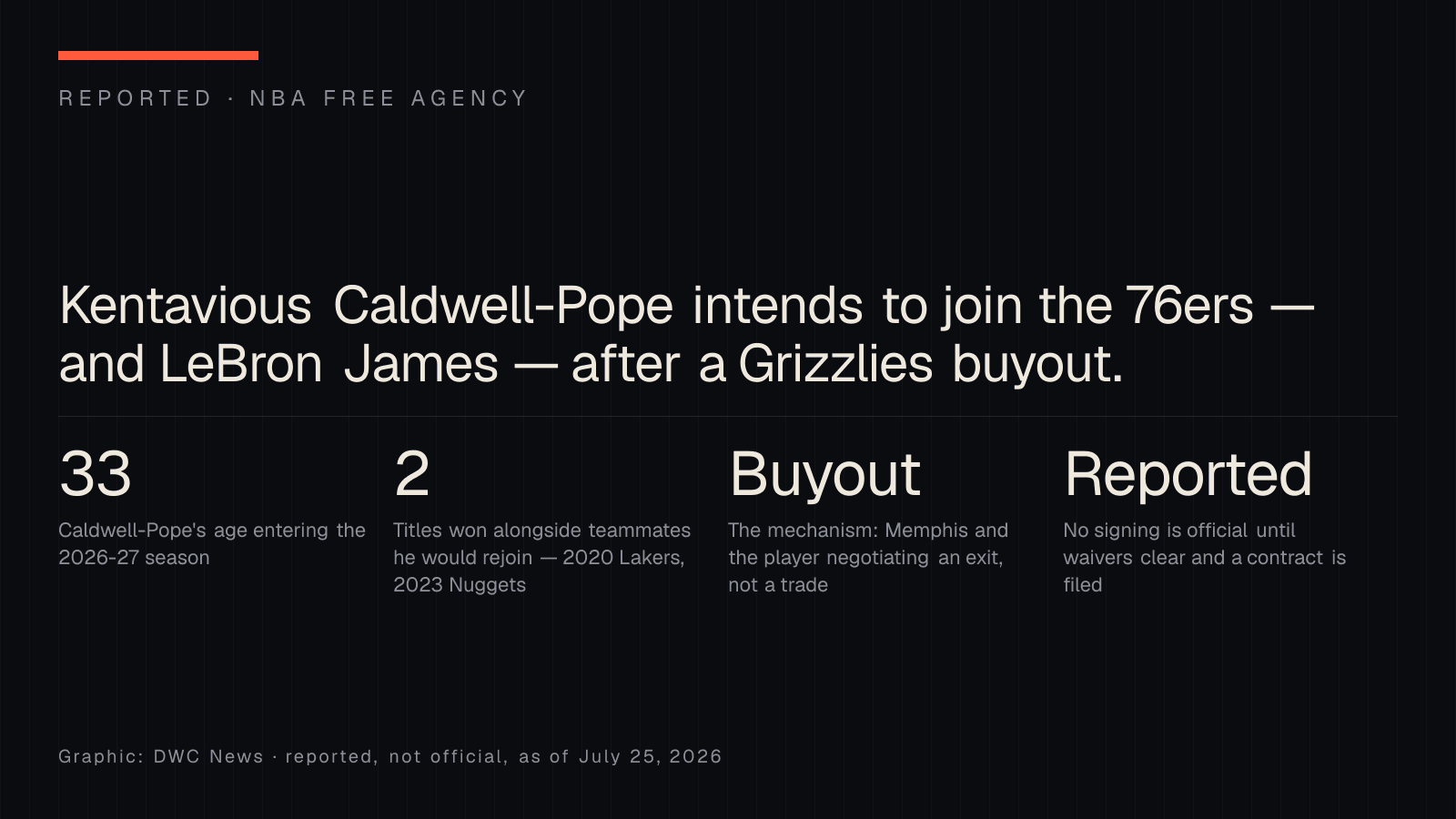
Hours after LeBron James ended the longest star free agency of the century by signing with the Philadelphia 76ers, the next name arrived: Kentavious Caldwell-Pope, who is reported to be negotiating a buyout with the Memphis Grizzlies and intends to join him.
Two things are worth separating immediately, because almost nothing in NBA transaction coverage separates them.
What is reported: Caldwell-Pope and Memphis are working toward a buyout, and he intends to sign with Philadelphia.
What is official: nothing. As of this writing there is no completed buyout, no waiver, and no contract. "Intends to" is doing real work in that sentence.
That gap is not pedantry — it is a specific sequence with specific rules, and the checklist below walks it. But first, the basketball.
Why Philadelphia wants him
Caldwell-Pope is 33 and has spent his career being exactly one thing, extremely well: a 3-and-D guard — a wing who can hit a corner three and guard the other team's best perimeter player without needing plays run for him.
That is the archetype every LeBron James team has been built to include, and Caldwell-Pope has filled it on two championship rosters:
- 2020 Los Angeles Lakers — the bubble title, alongside James.
- 2023 Denver Nuggets — a key rotation piece on Denver's first championship.
Pairing a high-usage playmaker with low-usage shooters who defend is not a complicated theory. It is the whole design. A 42-year-old James on a two-year deal needs shooters who do not require the ball and defenders who let him conserve energy on that end. Caldwell-Pope has been that guy, for that guy, before.
The counter-argument is age and mileage. Thirty-three is not old for a role player, but 3-and-D wings age through their legs, and the value of the archetype collapses quickly when the defense goes. Philadelphia would be betting on the shooting holding up longer than the athleticism fades.
Why a buyout, and why now
A buyout means Memphis and the player are negotiating his exit rather than trading him — which itself tells you something. Teams trade players they can get value for. Buyouts happen when the contract is harder to move than the player is good, and when the player has enough standing to negotiate his own release.
Reports have described Memphis and Caldwell-Pope as likely to part ways, with the buyout as the mechanism.
The rule most people will reach for here is the one from the 2023 CBA that stops teams over the tax aprons from signing bought-out players whose pre-waiver salary was above the non-taxpayer mid-level exception. It was written to stop contenders from hoovering up every veteran who hit the market.
It does not apply here — because it is a rule about in-season signings, and this is July. The offseason carve-out is real and it is routinely dropped from explanations of the rule, which is how you end up with confident posts about what a team "legally cannot" do that are describing February.
The checklist below has that distinction in it, along with the rest of the sequence.
Track What Still Has To Happen
NBA buyouts, step by step: what has to happen before a reported signing is real
The sequence a bought-out NBA player actually goes through — negotiated buyout, waivers, clearing, signing — with the salary-cap rules that decide who is allowed to sign him, and the ones commentary usually gets wrong.
0 of 13 done
How this is calculated
A process checklist built from the rules of the 2023 NBA Collective Bargaining Agreement as documented by Hoops Rumors' glossary entries and CBA reporting. Steps run in the order the transaction actually occurs, not the order it gets reported. Each rule item states the rule and, where commentary routinely overstates it, states the limit of the rule too. Dollar figures are the published exception amounts for the season named. No item here reports the status of any particular player — this is the mechanism, and the article supplies the facts of the specific case.
Data as of July 24, 2026 · verified July 24, 2026 · v1
Assumptions, limitations & sources
Assumptions
- · The rules described are those of the 2023 CBA as in effect for the 2026 offseason.
- · The mid-level exception figure cited is the published non-taxpayer amount for the season named.
Limitations
- · This is the standard sequence. Individual deals carry negotiated terms — how much salary a player gives back, set-off arrangements, and no-trade or option clauses — that are private until reported.
- · Exception amounts change every season with the salary cap; check the current figure before applying the apron rule to a specific signing.
- · Nothing here is a report on any particular transaction's status. Reported does not mean official, and this tool cannot tell you which stage a given move has reached.
Sources
- Clarifying the NBA's rule on post-buyout signings (apron restriction and its limits) — Hoops Rumors, checked July 24, 2026
- Hoops Rumors glossary: tax aprons — Hoops Rumors, checked July 24, 2026
- Hoops Rumors glossary: mid-level exception — Hoops Rumors, checked July 24, 2026
- The revitalization of the NBA buyout market as a consequence of the CBA — CBS Sports, checked July 24, 2026
- CBA 101: highlights of the Collective Bargaining Agreement — National Basketball Association, checked July 24, 2026
This is what modern SEO looks like: not just an article, but a useful resource people can return to, cite, and share. See how this newsroom is growing · See DavidWeaver's SEO packages
The questions readers are asking
Is Caldwell-Pope a Sixer? Not yet. He is reported to intend to sign there. The buyout has to be completed, he has to be waived, and he has to clear a 48-hour waiver window first.
Could another team claim him on waivers? Technically yes — a claiming team assumes his existing contract in full. In practice claims on bought-out veterans are rare, because the contract is the thing Memphis is trying to shed.
Has he played with LeBron before? Yes. They won the 2020 championship together with the Lakers. He also won in 2023 with Denver, in the same role.
How much would Philadelphia pay him? Not announced. Post-buyout veterans typically sign minimum contracts, and a player who has given back part of his old salary in a buyout is often still collecting most of his money from his previous team — so a small new number does not mean a small season's pay.
Why would he leave Memphis? Memphis appears to want the contract off its books, and the player gets to choose a destination rather than be traded to one. Both sides get something a trade would not have given them.
Does the March 1 rule matter? No, not for a July move. The March 1 deadline governs playoff-roster eligibility and is what drives the in-season buyout rush. In the offseason it is not a factor.
Is this the 76ers building a contender? One veteran role player does not settle that. What it does show is that James's signing has a gravitational effect on the rest of the market, which is the part of the story worth following.
What happens next
Three things, in order, and each one is checkable: a completed buyout reported by Memphis, a waiver transaction, and a signed contract in Philadelphia. Until the third one, this is a plan.
We are tracking it in the same cluster as our LeBron James free agency coverage, and the checklist above is built to be useful for the next buyout too — in February, when the rules are different, and the deadline is real.
Sources
- Report: Kentavious Caldwell-Pope 'intends to' join the Sixers, reunite with LeBron James — PhillyVoice
- Grizzlies and Kentavious Caldwell-Pope likely to part ways — Hoops Rumors
- Caldwell-Pope to join LeBron James after a Grizzlies buyout — ClutchPoints
- LeBron James announces he is signing with the 76ers — NBA.com · primary source
- Clarifying the NBA's rule on post-buyout signings — Hoops Rumors
- Hoops Rumors glossary: tax aprons — Hoops Rumors
- Kentavious Caldwell-Pope — career statistics and team history — ESPN · primary source