Anthropic ships Claude Opus 5 at half the price of its flagship — and puts a cost dial in the API
Claude Opus 5 arrived July 24 at $5 per million input tokens and $25 per million output — half what Fable 5 costs — with a 1M-token context window and five effort levels that let you trade capability for token spend. Here is what changes, what does not, and what it costs for your own workload.

By David Weaver
Publisher & Editor
Published July 24, 2026, 7:38 PM ET
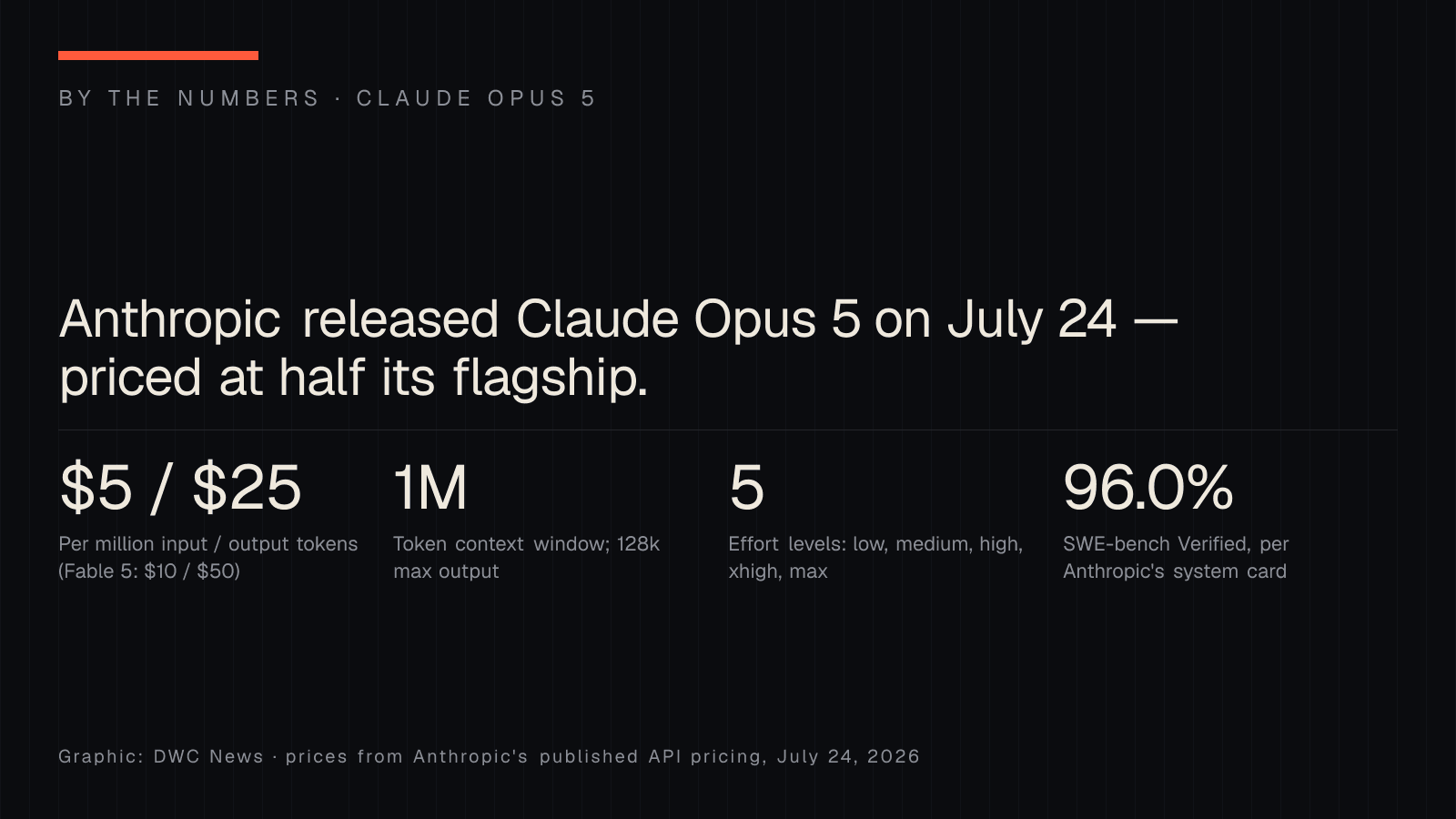
Anthropic released Claude Opus 5 on Friday, July 24, 2026. The pitch is unusually simple for an AI launch: near-flagship capability at half the flagship's price, with a dial that lets you turn the price down further.
It is available immediately as claude-opus-5 on the Claude API, Amazon Bedrock,
Google Cloud, Microsoft Foundry, claude.ai, Claude Code and Cowork.
Disclosure: DWC News is produced with Claude tooling. That does not earn Anthropic a softer story — every number below is checked against Anthropic's own published documentation, and the places where the primary source is not public are marked.
The number that matters
$5 per million input tokens, $25 per million output. That is the whole commercial argument, and it lands against a specific comparison: Claude Fable 5, Anthropic's most capable widely released model, costs $10 and $50.
Two things are worth noticing that the launch coverage mostly skipped.
First, Opus 5 did not get cheaper than Opus 4.8 — it costs exactly the same as the model it replaces, and the same as every Opus release back to 4.5. The "half price" framing is true against Fable 5, not against last quarter's Opus. What Anthropic has done is push more capability into an existing price tier.
Second, the cheap seats are cheaper than the headline suggests. Claude Sonnet 5 is running at introductory pricing of $2 / $10 per million tokens through August 31, 2026, after which it moves to $3 / $15. Haiku 4.5 is $1 / $5. If your workload is not intelligence-limited, Opus 5 is not the cost story on this price sheet — it is the middle of it.
Here is the full published list, per Anthropic's pricing page:
| Model | Input / MTok | Output / MTok | Cache hit | Batch | | --- | --- | --- | --- | --- | | Claude Fable 5 | $10 | $50 | $1 | 50% off | | Claude Opus 5 | $5 | $25 | $0.50 | 50% off | | Claude Sonnet 5 (through Aug 31) | $2 | $10 | $0.20 | 50% off | | Claude Sonnet 5 (from Sept 1) | $3 | $15 | $0.30 | 50% off | | Claude Haiku 4.5 | $1 | $5 | $0.10 | 50% off |
The effort dial, explained without the marketing
The feature getting the most attention is the effort parameter — Fortune
described it as a toggle between cost and capability, which is close enough.
There are five levels: low, medium, high, xhigh, max.
What it actually controls is how many tokens Claude spends on a response — all of them, not just visible thinking. Per Anthropic's documentation, lower effort means fewer tool calls, less preamble, and terser work; higher effort means more exploration and more tokens. Because you pay per token, effort is a cost control with a capability price attached.
The defaults and recommendations are more specific than "pick a number":
- The API default is
high. Settingeffort: "high"is identical to omitting the parameter. - Anthropic recommends starting at
xhighfor coding and agentic work on Opus 5, andhighfor most other intelligence-sensitive workloads. lowandmediumare meaningfully stronger on Opus 5 than on earlier Opus models, and Anthropic explicitly tells developers to use them as the primary cost lever where evals show quality holds — and to re-run an effort sweep rather than carrying old settings across.- One hard constraint: on Opus 5 thinking cannot be disabled at
xhighormax. Sendingthinking: {"type": "disabled"}at those levels returns a 400 error. - Effort is not a length control. Anthropic notes that on Opus 5, changing effort does not reliably shorten the visible response — prompt for that instead.
There is also a caching wrinkle worth budgeting for: changing effort mid-session invalidates your prompt cache, because effort shapes the rendered prompt. Vary it across workloads, not within one cached conversation.
Specifications, from the model card
| | Claude Opus 5 |
| --- | --- |
| API model ID | claude-opus-5 |
| Context window | 1,000,000 tokens |
| Maximum output | 128k tokens (up to 300k via the Batch API beta header) |
| Reliable knowledge cutoff | May 2026 |
| Adaptive thinking | Yes |
| Extended thinking (thinking.type: "enabled") | No |
| Effort levels | low, medium, high, xhigh, max |
| Comparative latency | Moderate |
That May 2026 knowledge cutoff is the newest in the lineup — newer than Fable 5's January 2026. For anything that depends on recent facts, the cheaper model is the better-informed one, which is not the usual shape of a price tier.
The calculator below turns all of this into a number for your own application: enter your monthly request volume and typical prompt and response sizes, and it prices the same workload on every current Claude model at the published rates, including prompt-cache reads and the Batch API discount.
Price Your Own Workload
Claude API cost calculator: what Opus 5, Fable 5, Sonnet 5 and Haiku 4.5 cost for your volume
Enter your monthly request volume and typical prompt and response sizes. This prices the same workload on every current Claude model using Anthropic's published per-million-token rates, including prompt-cache reads and the Batch API discount.
Uses: Model · API requests per month · Average input tokens per request · Average output tokens per request · Share of input served from prompt cache · Use the Batch API (50% off, asynchronous)
A planning estimate using published list prices, not a quote and not a bill. Cache writes, server-side tool charges, fast mode and data-residency multipliers are excluded, and list prices change — confirm against Anthropic's pricing page and your own console usage before budgeting.
Example — adjust the inputs above for your situation
About $9,750 a month on Claude Opus 5.
At 100,000 requests a month averaging 12,000 input and 1,500 output tokens, that is $9,750 a month less than Claude Fable 5 — about 50% of the flagship's price for this mix. The cheapest option shown is Claude Haiku 4.5 at $1,950.
- Claude Opus 5 — estimated monthly cost
- $9,750
- Cost per 1,000 requests
- $97.50
- Same workload on Claude Fable 5
- $19,500
- Same workload on Claude Sonnet 5 (introductory rate)
- $3,900
- Same workload on Claude Sonnet 5 (from September 1, 2026)
- $5,850
- Same workload on Claude Haiku 4.5
- $1,950
- Tokens per month (input / output)
- 1,200,000,000 / 150,000,000
- ※ Rates are Anthropic's published per-million-token prices as of July 24, 2026. Prices change; check the pricing page before budgeting against this.
- ※ Cache WRITE cost is not included — a cached prefix is charged at 1.25× (5-minute) or 2× (1-hour) base input the first time it is stored. Long-running agents amortise that; short sessions do not.
- ※ Server-side tools are extra: web search is billed at $10 per 1,000 searches, and Claude Managed Agents adds $0.08 per session-hour of runtime.
How this is calculated
Pure arithmetic against published list prices. For each model the tool computes monthly cost as: requests × [ input tokens × ((1 − cache share) × base input rate + cache share × cache-hit rate) + output tokens × output rate ] ÷ 1,000,000, then halves the total when the Batch API is selected. Base input, output and cache-hit rates are transcribed directly from Anthropic's pricing page (retrieved July 24, 2026); the cache-hit rate is 0.1× base input, and the Batch API is a flat 50% discount on input and output. Sonnet 5 appears twice because its introductory $2/$10 rate is scheduled to become $3/$15 on September 1, 2026. No token counting, estimating or modelling happens anywhere — the tool multiplies your numbers by their numbers.
Data as of July 23, 2026 · verified July 23, 2026 · v1
Assumptions, limitations & sources
Assumptions
- · Rates are Anthropic first-party Claude API list prices in USD as published on July 24, 2026, with no negotiated or enterprise discount applied.
- · Cache share means the percentage of input tokens served as cache hits, billed at 0.1× the base input rate.
- · The Batch API discount is applied as a flat 50% to both input and output, matching the published batch price table.
- · One request is one Messages API call; agentic loops that make many calls per user task should be entered as many requests.
Limitations
- · Cache WRITE cost is not modelled. Storing a cached prefix costs 1.25× base input for the 5-minute cache or 2× for the 1-hour cache, charged the first time. Steady-state agents amortise that away; short-lived sessions do not.
- · Server-side tool charges are excluded: web search is billed separately at $10 per 1,000 searches, and Claude Managed Agents adds $0.08 per session-hour of runtime.
- · The fast-mode premium ($10/$50 per MTok on Opus 5) and the 1.1× US-only data-residency multiplier are not applied.
- · Claude 4.7-generation models and later use a newer tokenizer that produces roughly 30% more tokens for the same text — so a token count measured on an older model understates cost here.
- · List prices change. This is a planning estimate, not a quote or a bill.
Sources
- Claude platform pricing — per-model input, output, cache and batch rates — Anthropic, checked July 23, 2026 · Rates transcribed verbatim; no conversion or rounding applied to the inputs.
- Claude models overview — context windows, max output, model IDs and pricing summary — Anthropic, checked July 23, 2026
- Effort parameter documentation — the five effort levels and their token-cost tradeoff — Anthropic, checked July 23, 2026
This is what modern SEO looks like: not just an article, but a useful resource people can return to, cite, and share. See how this newsroom is growing · See DavidWeaver's SEO packages
The benchmark picture, honestly labeled
Anthropic's own framing, reported across launch coverage, is that Opus 5 scores higher than Opus 4.8 on agentic coding, novel problem solving, knowledge work, computer use and multidisciplinary reasoning, is a meaningful step up for scientific research, and beats Fable 5 on coding and knowledge work specifically.
The most-quoted figure is 96.0% on SWE-bench Verified, averaged over five trials. That number is attributed to Anthropic's system card by benchmark trackers; DWC News could not retrieve the system card directly to confirm it, so treat it as reported rather than independently verified. The same caveat applies to the associated figures circulating for SWE-bench Pro, SWE-bench Multilingual and DeepSWE.
The more interesting disclosures are the ones that cut the other way, and Anthropic made them itself:
- Opus 5 trails Mythos 5 — the invitation-only model in Anthropic's Project Glasswing security program — on cybersecurity and biology. On OSS-Fuzz it finds vulnerabilities about as well as Mythos 5, but is described as far behind on exploit development.
- VentureBeat reported that an OpenAI-family model still leads one agentic coding benchmark.
A vendor publishing where its new model loses is not nothing. It is also not a substitute for independent evaluation, which has not happened yet — the model is hours old.
The token-count trap nobody mentions
One caveat that will surprise anyone migrating from an older model, buried in Anthropic's pricing documentation:
Claude 4.7-generation models and later use a new tokenizer that produces roughly 30% more tokens for the same text. Opus 5 and Fable 5 both use it; Sonnet 4.6 and earlier do not.
So a workload measured on Sonnet 4.6 at, say, 10,000 tokens per request may land closer to 13,000 on Opus 5 — before you have changed a single prompt. The per-token price is what it says, but the token count moves under you. When you price a migration, price it on measured Opus 5 tokens, not last quarter's numbers.
The questions readers are asking
Is Opus 5 better than Fable 5? Depends on the job, and the honest answer is that we do not know yet independently. Anthropic says Opus 5 beats Fable 5 on coding and knowledge work while approaching it elsewhere, and Anthropic's own docs still route "highest available capability" to Fable 5. Opus 5's knowledge cutoff is four months fresher.
Should I switch? If you are on Opus 4.8, the price is identical, so the question is purely whether it performs better on your evals. If you are on Fable 5 for cost-insensitive work, run the comparison — half price is a large number at volume. If you are on Sonnet 5 or Haiku 4.5 for throughput, Opus 5 is 2.5× to 5× the price; do not upgrade reflexively.
What is xhigh and why not just use max? xhigh is aimed at long-horizon
agentic work — tasks running over 30 minutes with token budgets in the millions.
max removes constraints entirely, which Anthropic warns can mean significant
extra cost for small quality gains, and occasional overthinking on structured
output. Start at xhigh for coding, and reserve max for problems where your
evals show headroom.
Does a 1M context window mean I should stuff 1M tokens in? You can — long context is billed at standard rates, and a 900k-token request costs the same per token as a 9k one. That is exactly why you should not: at $5 per million input tokens, a single 900k-token call is about $4.50 in input alone, every time you make it. Prompt caching exists for this, and cache hits cost $0.50 per million.
What about the free and subscription tiers? Opus 5 is reported to be the new default on Claude Max and the strongest model available on Claude Pro.
Where does Mythos 5 fit? It shares Fable 5's specs and pricing but is not generally available — it is limited to approved customers in Anthropic's invitation-only Project Glasswing for defensive cybersecurity work. You cannot simply buy it.
What to watch
Two things. The first is independent benchmarking: vendor-reported scores set the agenda for about a week, and third-party evaluations decide whether the claim holds. The second is what the effort dial does to real bills. A pricing tier that ships with an explicit "spend fewer tokens" control is a bet that customers will use it — and the first honest read on that will come from developers publishing their own before-and-after invoices, not from a launch post.
Sources
- Claude platform pricing — per-model input, output, cache and batch rates — Anthropic · primary source
- Claude models overview — context windows, max output, model IDs, knowledge cutoffs — Anthropic · primary source
- Effort parameter documentation — the five levels and per-model guidance — Anthropic · primary source
- Anthropic launches Claude Opus 5, a cheaper AI model for coding, agents and enterprise workflows — VentureBeat
- Anthropic's Claude Opus 5 AI model rivals Fable 5 and is cheaper — CNBC
- Anthropic debuts Claude Opus 5 with a feature that lets users toggle between cost and capability — Fortune
- Anthropic claims Opus 5 delivers near-Fable 5 performance at half the token price — The Decoder