Why data centers disconnect from the grid — and what Northern Virginia's 3 GW drop revealed
On July 22, 2026, a transmission fault in Northern Virginia knocked more than 3 GW of data-center demand off the PJM grid in seconds — no blackout, but a loud warning. Here's how data centers strain the grid, why they self-disconnect, and what regulators are doing about it.

By David Weaver
Publisher & Editor
Published July 24, 2026, 10:18 AM ET
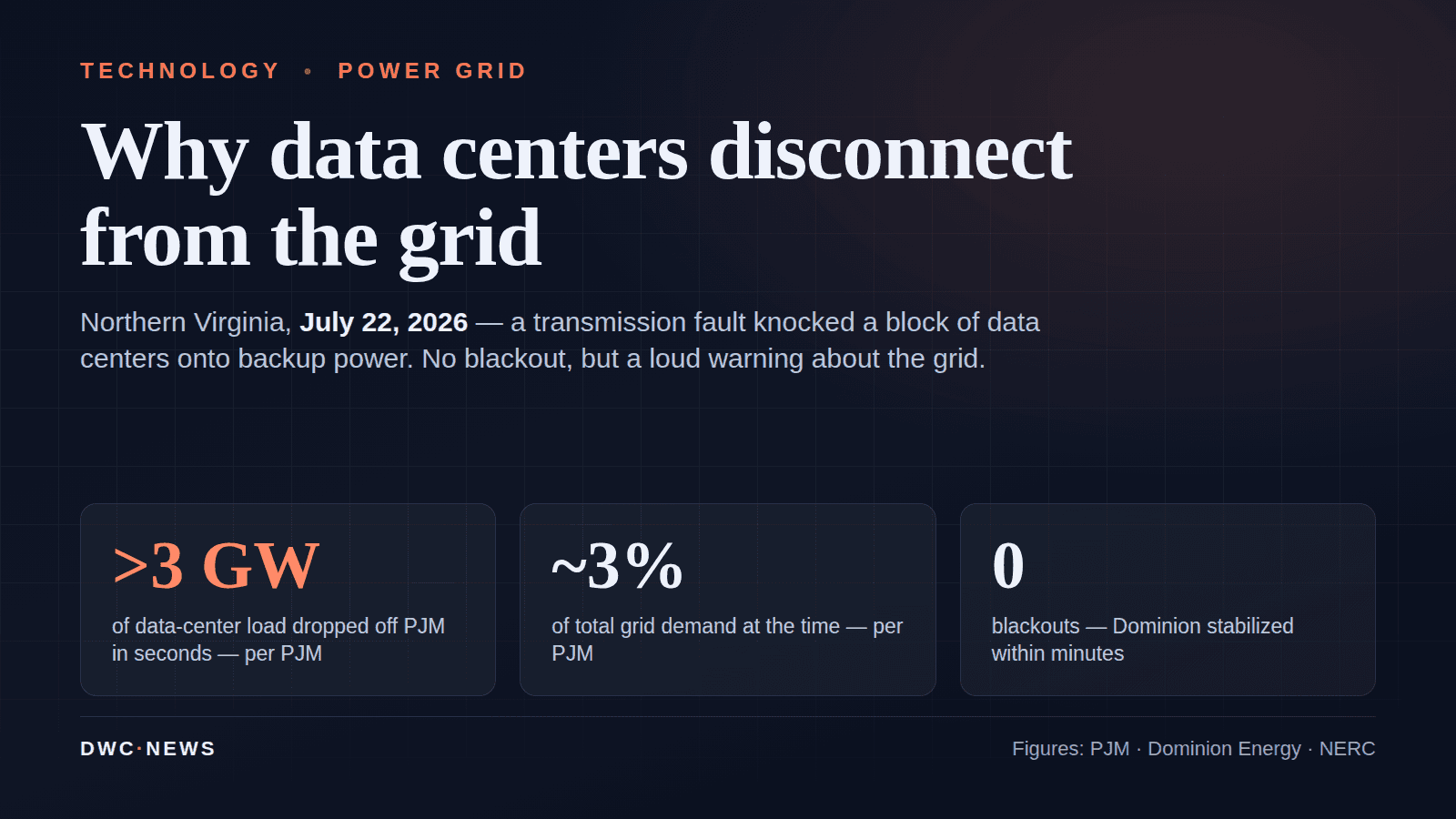
A single transmission line in Northern Virginia went out of service on the morning of Wednesday, July 22, 2026. Within seconds, a large block of data centers did something that sounds backwards: they unplugged themselves. More than 3 gigawatts of electricity demand — about 3% of the entire grid at that moment — vanished off PJM Interconnection, the largest power grid in the United States, according to PJM.
There was no blackout. But the event is worth understanding well beyond this week, because it is not really about one line fault. It is about a structural tension between the way modern data centers protect themselves and the way a power grid stays balanced. That tension is why this keeps happening — and why regulators have started treating it as one of the grid’s top reliability risks.
First, what actually happened on July 22
When the line tripped, voltage on the local network wobbled. Data centers run banks of sensitive computing and power equipment, and they are built to defend that equipment: when their protective systems sense a disturbance on the grid-supplied power, they can automatically disconnect and switch the facility onto backup power. That is exactly what a cluster of Northern Virginia data centers did — the trip-to-backup mechanism described by Dominion Energy, the utility that serves them.
The result was a voltage disturbance reportedly felt well outside Virginia. Customers described flickering lights and odd noises from air conditioners and refrigerators — "power quality took a big hit" — but the lights stayed on. Dominion stabilized the grid within minutes (reporting put it at roughly ten minutes, far longer than the usual millisecond-scale response), and Virginia narrowly avoided power cuts.
One clarification, because the timing confuses people: the spike in searches on July 24 is a follow-up analysis wave, not a second event. It reflects the after-action coverage — an RTO Insider autopsy of the July 22 disconnect and a July 23 FERC technical conference on large loads. The grid event itself was July 22.
A caveat on numbers, too. The exact count of facilities that tripped on July 22, and any specific frequency (Hz) or voltage figures for that event, are not yet public — they await NERC and PJM event analysis. Some early coverage borrowed figures from an earlier incident; this piece keeps the July 22 specifics marked as pending rather than guessing.
Why data centers disconnect from the grid
Here is the durable part — the mechanism that will still matter long after this news cycle.
A power grid is a constant, real-time balancing act between supply and demand. A data center is an unusually large, unusually concentrated block of that demand. When a facility’s protection system detects a voltage or frequency disturbance, its default instinct is self-protection: drop off the grid and ride on backup power (batteries, then generators) until conditions look clean again. For one building, that is prudent engineering. For thousands of megawatts wired into the same corner of the grid, all reacting to the same disturbance at once, it becomes a grid problem.
And it destabilizes in both directions:
- When gigawatts drop off at once, the grid suddenly has far more generation than load. Frequency and voltage rise, and operators have to shed generation fast to bring the system back into balance.
- When that load reconnects, the reverse happens — a large block of demand slams back on, and the system has to absorb it just as quickly.
The fix regulators are pushing is to make big facilities ride through brief disturbances instead of instantly self-protecting — engineered as fault ride-through (FRT) and voltage ride-through (VRT) requirements, so a data center stays connected through a momentary dip rather than yanking gigawatts off the system. The whole debate now is where to draw the line between protecting the servers and protecting the grid.
Data Center Alley, by the numbers
The reason Northern Virginia keeps being the setting is density. Loudoun County — Ashburn in particular — is "Data Center Alley," the densest cluster of data centers in the world: on the order of 6,000 MW of active capacity across roughly 200 facilities. When one disturbance can reach that many large loads at once, local events scale into grid-wide ones.
You will often see the claim that Data Center Alley carries "70% of the world’s internet traffic." Treat that as contested and likely overstated — a figure closer to ~35% is more defensible, and even that is a rough estimate. The density is real; the specific 70% number is not a fact to lean on.
The table below is the evergreen core of this story: a cited log of the major U.S. events where data-center load dropped off the grid at once. Every cell names its source, and the July 22, 2026 specifics that aren’t confirmed yet are marked pending.
Major U.S. Grid Data-Center Load-Loss Events
Grid load-loss events: when data centers drop off the U.S. power grid
A searchable, sourced log of the biggest events in which a block of data-center load unplugged from the U.S. grid at once — date, location, megawatts dropped, cause, grid impact and confirmation status. A 'Data Center Alley by the numbers' note frames the scale: Loudoun County/Ashburn, Virginia is the world's densest data-center cluster — roughly 6,000 MW of active capacity across about 200 facilities. Reference table only; not a live grid feed.
| Jul 10, 2024 | Fairfax County, Northern Virginia | ~1,500 MW | Lightning-arrestor failure on a 230 kV line; ~60 points across ~25 substations tripped data-center load to backup at once. | Frequency rose to 60.047 Hz (settling in ~4 min) and voltage to 1.07 pu; no blackout, but PJM/Dominion had to shed generation. | NERC incident review | Confirmed (NERC) |
| Feb 2025 | PJM region (per NERC) | ~1,800 MW | Uninterruptible power supply (UPS) trip; the largest single event in the documented 2025 series. | Large-load loss within seconds; cited by NERC among the events behind its Level 3 alert. | NERC Level 3 alert | Confirmed (NERC) |
| Feb 2025 | PJM region (per NERC) | 428 MW | Computational-load loss (as reported in NERC's 2025 series). | One of a run of sub-second/seconds-scale large-load losses NERC flagged as a reliability concern. | NERC Level 3 alert | As reported (NERC) |
| Mar 2025 | PJM region (per NERC) | 227 MW | Computational-load loss (as reported in NERC's 2025 series). | One of a run of sub-second/seconds-scale large-load losses NERC flagged as a reliability concern. | NERC Level 3 alert | As reported (NERC) |
| May 2025 | PJM region (per NERC) | 540 MW | Computational-load loss (as reported in NERC's 2025 series). | One of a run of sub-second/seconds-scale large-load losses NERC flagged as a reliability concern. | NERC Level 3 alert | As reported (NERC) |
| Jun 2025 | PJM region (per NERC) | 1,300 MW | Computational-load loss (as reported in NERC's 2025 series). | A gigawatt-scale drop; part of the pattern that led NERC to escalate to a Level 3 alert. | NERC Level 3 alert | As reported (NERC) |
| Jul 22, 2026 | Northern Virginia (Data Center Alley) | >3,000 MW (>3 GW) | A transmission line went out of service; data centers' voltage-sensitive protection systems automatically unplugged and switched to backup power. | About 3% of grid demand dropped in seconds (PJM); no blackout — Dominion stabilized within minutes. Facility count and Hz/voltage pending NERC/PJM analysis. | PJM / Dominion via Reuters, RTO Insider | As reported (pending NERC/PJM analysis) |
How this is calculated
Each row is a discrete event in which a large block of data-center (computational) load disconnected from the U.S. bulk power system at once. Megawatt figures, and any frequency (Hz) or voltage (per-unit) values, are quoted as reported by the source named in that row's Source cell — NERC's incident review and its May 2026 Level 3 alert for the 2024-2025 events, and PJM and Dominion Energy via Reuters and RTO Insider for the July 22, 2026 event. A figure with '~' is approximate as published; '>' means at least that amount. Where an official event analysis is still pending — the July 22, 2026 event — the number of facilities that tripped and any frequency/voltage figures are marked 'pending NERC/PJM analysis' rather than estimated. Nothing here is a live grid measurement.
Data as of July 23, 2026 · verified July 23, 2026 · v1
Assumptions, limitations & sources
Assumptions
- · 'Load dropped' is the block of demand that disconnected in the event, not any single facility's total capacity.
- · 2024 and 2025 figures follow NERC's published incident review and Level 3 alert; the July 22, 2026 figures follow PJM's and Dominion's statements as relayed by Reuters and RTO Insider, pending NERC's own analysis.
- · Frequency (Hz) and voltage (per-unit) are grid-wide measurements from the cited event review, not readings at any single site.
Limitations
- · The exact number of facilities that tripped on July 22, 2026, and any frequency or voltage figures for that event, are not yet public — NERC/PJM event analysis is pending — so those cells are marked pending rather than estimated.
- · The 2025 series entries come from NERC's aggregate reporting and may not capture every event, or a precise location for each.
- · This is a reference table for understanding a pattern, not an official grid-reliability record. Verify any figure against the cited source before relying on it.
Sources
- Incident Review: loss of ~1,500 MW of large load in Northern Virginia, July 10, 2024 (frequency 60.047 Hz, ~60 points / 25 substations) — North American Electric Reliability Corporation, checked July 23, 2026
- NERC issues rare Level 3 'Essential Actions' alert over data-center load losses (May 4, 2026; 1,000+ MW blocks; seven actions due Aug 3, 2026) — Utility Dive, checked July 23, 2026
- Line fault causes 3 GW in data-center load to drop in Virginia (July 22, 2026) — RTO Insider, checked July 23, 2026
- Massive disconnect of power roils largest US electric grid (PJM: more than 3 GW, ~3% of demand; Dominion stabilized in minutes) — Reuters (via U.S. News & World Report), checked July 23, 2026
- Virginia narrowly avoided power cuts when data centers dropped off the grid at once — DataCenterDynamics, checked July 23, 2026
This is what modern SEO looks like: not just an article, but a useful resource people can return to, cite, and share. See how this newsroom is growing · See DavidWeaver's SEO packages
Has this happened before?
Yes — and the clearest precedent is well documented. On July 10, 2024, around 7 p.m. in Fairfax County, a lightning-arrestor failure on a 230 kV line caused roughly 1,500 MW of data-center load — spread across about 60 points at 25 substations — to trip to backup simultaneously, per NERC’s incident review. Frequency rose to 60.047 Hz (settling in about four minutes) and voltage to 1.07 pu. There was no blackout, but PJM and Dominion had to shed generation to rebalance. NERC reportedly called it a "five-alarm fire" and stood up a Large Loads Task Force.
Through 2025, the pattern repeated as a documented series of large-load losses — up to about 1,800 MW in February 2025 — which is what pushed the issue from "emerging risk" to formal obligation.
Is the grid at risk from data centers?
Regulators clearly think the risk is real enough to act on.
- NERC’s rare Level 3 alert. On May 4, 2026, the North American Electric Reliability Corporation issued a Level 3 "Essential Actions" alert — its highest urgency tier — after repeated events in which 1,000+ MW blocks dropped off the system in seconds, leaving little room for a real-time response. It comes with seven required actions, with responses due August 3, 2026, as Utility Dive reported.
- Federal warning. The Department of Energy’s July 2025 grid-reliability report warned that most U.S. regions face reliability risks within five years as demand climbs.
- The demand curve. PJM’s 2025 forecast projects roughly 30 GW of peak growth through 2030, driven largely by data centers, and Dominion has about 40 GW of data-center capacity under contract. The load that disconnects on a bad day is only getting bigger.
None of this means a blackout is imminent — the July 22 event specifically caused none. It means the grid is being asked to absorb larger and faster swings than it was designed for, and the rules are being rewritten to keep up.
Questions people are asking
What happened with the Northern Virginia data centers?
On July 22, 2026, a transmission line in Northern Virginia went out of service, and a large group of data centers automatically switched to backup power, dropping more than 3 GW of demand off the PJM grid in seconds (per PJM). There was a noticeable voltage disturbance but no blackout.
Why did they disconnect from the grid?
To protect their own equipment. When a data center’s protection systems sense a voltage or frequency disturbance, they can automatically unplug the facility from the grid and run it on backup power — self-protection that, at this scale and concentration, destabilizes the grid it just left.
Did it cause a blackout?
No. Dominion Energy stabilized the grid within minutes, and Virginia narrowly avoided power cuts. Customers reported flickering lights and appliance noises, but the power stayed on.
How much power dropped off?
More than 3 gigawatts — about 3% of the grid’s total demand at the time, according to PJM.
Has this happened before?
Yes. NERC documented a July 10, 2024 event in Fairfax County where a 230 kV lightning-arrestor failure tripped roughly 1,500 MW of data-center load to backup at once, and a series of large-load losses continued through 2025 (up to about 1,800 MW in February 2025).
Is the U.S. grid at risk from data centers?
Regulators are treating it seriously. NERC issued a rare Level 3 "Essential Actions" alert on May 4, 2026, and the DOE’s July 2025 report warned most regions face reliability risks within five years. The concern is sudden, gigawatt-scale swings, not a specific predicted blackout.
What is Data Center Alley?
It is Loudoun County, Virginia — especially Ashburn — the world’s densest cluster of data centers, on the order of 6,000 MW across roughly 200 facilities. (The popular claim that it carries "70% of global internet traffic" is likely overstated; a figure nearer 35% is more defensible.)
What is being done about it?
NERC’s Level 3 alert carries seven required actions with responses due August 3, 2026, and regulators held a FERC technical conference on July 23, 2026. The main technical fix under discussion is fault and voltage ride-through requirements, so large facilities stay connected through brief disturbances instead of dropping off en masse.
The bottom line
The July 22 disconnect was not a freak accident and not a blackout — it was the grid’s structural tension with hyperscale data centers showing up in one loud, survivable moment. Data centers unplug to protect themselves; the grid needs them to stay connected through the small stuff; and Northern Virginia is where those two facts collide first because that is where the density is. The megawatts keep climbing, the analysis is still coming, and the rules are being rewritten in real time. That is the story worth following — not the single Wednesday it happened on.
Sources
- Massive disconnect of power roils largest US electric grid — Reuters (via U.S. News & World Report) · primary source
- Line fault causes 3 GW in data-center load to drop in Virginia — RTO Insider
- Incident Review: loss of large load in Northern Virginia (July 10, 2024) — North American Electric Reliability Corporation · primary source
- NERC issues rare Level 3 alert over data-center load losses — Utility Dive
- Virginia narrowly avoided power cuts when data centers dropped off the grid — DataCenterDynamics