The Nintendo-Palworld lawsuit, explained: it's a patent case, and nobody has won yet
Nintendo and The Pokémon Company sued Palworld maker Pocketpair in Tokyo in September 2024 — over patents on catching, summoning and riding creatures, not copyright. As Palworld hits its 1.0 launch, here's what has actually been decided: nothing yet.

By David Weaver
Publisher & Editor
Published July 23, 2026, 4:10 AM ET
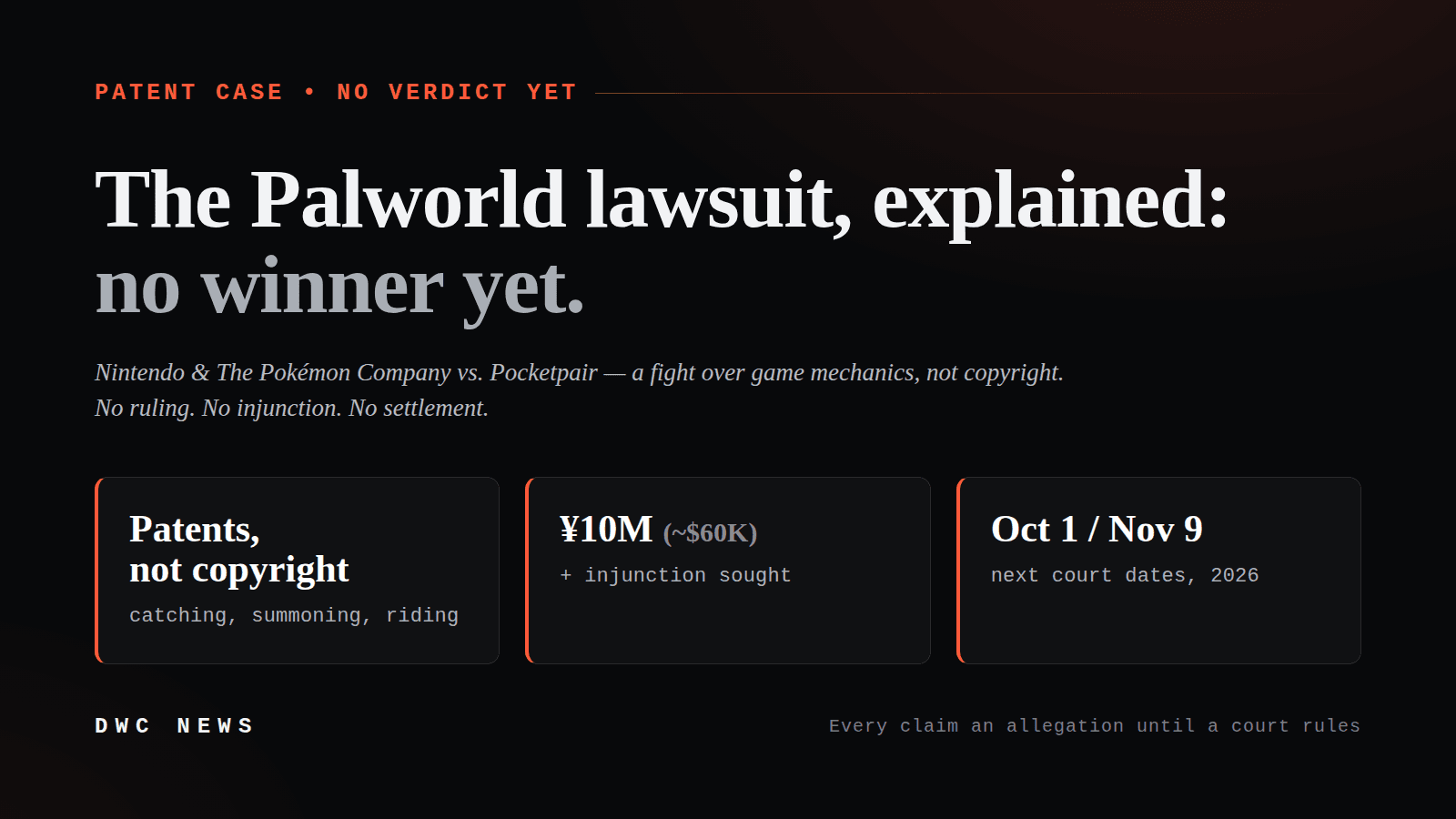
If you have seen "Nintendo Palworld lawsuit" trending and want the two things that actually matter: it is a patent case, not a copyright case, and nobody has won it. As of today there is no ruling on the merits, no injunction, and no settlement. Everything below an official court decision is still an allegation.
What is drawing fresh attention is not a verdict but a cluster of events landing at once. Palworld reached its 1.0 full launch on July 10, 2026, leaving early access with a reported 40 million-plus copies sold. Around the same time, Nintendo's related patents took public setbacks at patent offices in both the United States and Japan. And analysts began framing the lawsuit itself as largely defanged ahead of an autumn hearing. None of that is a win for either side — it is context.
Patent, not copyright — why that distinction is the whole story
When Palworld launched in early access in January 2024, most of the online argument was about copyright: whether its creatures looked too much like Pokémon. That is not what Nintendo and The Pokémon Company actually sued over.
According to the complaint reporting, the two companies filed a patent suit in the Tokyo District Court in September 2024. Copyright protects creative expression — the look of a character, the art, the music. A patent protects an invention or a method. Nintendo's case is built on Japanese patents that describe game mechanics: how you catch a creature, how you summon one to fight, how you ride one. The claim is not "your monsters look like ours." It is "your game performs patented steps that ours does."
That distinction matters because it changes what a win would even mean. A copyright case turns on resemblance; this case turns on whether Palworld's code practices specific, written patent claims — which is exactly the kind of thing a developer can engineer around.
What the three patents cover
The suit was built on a family of Japanese patents originally filed around 2021. As originally asserted, they cover three mechanics:
- JP 7545191 — capturing a creature by throwing an object at it, with an on-screen capture-probability indicator.
- JP 7493117 — summoning or launching a creature to start a battle, plus creature movement and pathfinding.
- JP 7528390 — riding or mounting creatures to travel across land, air, and water.
Per Nintendo Wire, the plaintiffs originally sought an injunction halting Palworld sales plus ¥10 million in total damages — about $60,000 — split between the two companies. The damages figure is small; the injunction was the demand with teeth.
(Some coverage suggests the plaintiffs later narrowed the asserted patents from three to two. That narrowing is unconfirmed, so this article treats all three as originally asserted.)
Pocketpair changed the game — and says it never had to
Pocketpair's position throughout has been that Palworld does not infringe, and that the changes it has made are preventive, not admissions.
Two patches are central. In November 2024, patch v0.3.11 removed the ability to summon a Pal by throwing a Pal Sphere; Pals now simply appear beside the player. In May 2025, patch v0.5.5 replaced gliding on a mounted Pal with an item-based glider — a change the studio publicly called "disappointing." Read against the three patents above, those edits line up neatly with the "throwing to summon" and "riding to travel" claims.
Where the case actually stands
Here is the pivot that reshaped the dispute. In November 2025, the plaintiffs amended the suit so that the infringement claims apply only to older, pre-patch versions of Palworld, according to Automaton West. Commentators read that as effectively conceding that the current game falls outside the asserted claims. It is worth being precise: that is an inference from the amendment. The plaintiffs have not publicly said the current version is in the clear.
The map below sorts each piece of this into what is confirmed, what is genuinely disputed, and what remains unknown — so the procedural facts never get mistaken for a verdict.
Alleged vs. Decided: Where the Palworld Case Stands
Palworld patent lawsuit: what's confirmed, disputed, and undecided
A claim-by-claim map of Nintendo and The Pokémon Company's patent lawsuit against Palworld maker Pocketpair — each point tagged confirmed, disputed, or unknown, with its sources — so procedural facts, live allegations, and analyst opinion never blur together.
Nintendo and The Pokémon Company sued Pocketpair, the maker of Palworld, in the Tokyo District Court in September 2024 — and it is a patent case, not a copyright case.
ConfirmedThe complaint alleges infringement of Japanese patents covering game mechanics; it is not a claim that Palworld copied Pokémon art, characters, or designs. That patent-versus-copyright distinction shapes the entire dispute.
The asserted patents cover three mechanics — catching, summoning, and riding creatures — from a Japanese patent family originally filed around 2021.
ConfirmedJP 7545191 concerns capturing a creature by throwing an object, with a capture-probability indicator; JP 7493117 concerns summoning or launching a creature to start a battle, plus movement and pathfinding; JP 7528390 concerns riding or mounting creatures across land, air, and water. Reports that the plaintiffs later narrowed the case from three patents to two are unconfirmed; these three are presented as originally asserted.
The plaintiffs originally sought an injunction halting Palworld sales plus ¥10 million in total damages — about $60,000 — split between the two companies.
ConfirmedThe damages figure is modest relative to Palworld's reported sales; analysts have noted the injunction, not the money, was the meaningful demand.
Pocketpair changed Palworld twice in ways it describes as preventive, while maintaining the game does not infringe.
ConfirmedPatch v0.3.11 (November 2024) removed summoning a Pal by throwing a Pal Sphere; Pals now appear beside the player. Patch v0.5.5 (May 2025) replaced gliding on a mounted Pal with an item-based glider — a change Pocketpair publicly called 'disappointing.'
In November 2025 the plaintiffs amended the suit so the infringement claims apply only to older, pre-patch versions of Palworld.
ConfirmedCommentators read the amendment as effectively conceding that current versions fall outside the asserted claims; the plaintiffs themselves have not said so publicly.
On a separate US front, the USPTO ordered a rare ex parte reexamination of a related Nintendo patent in November 2025, and around March 2026 an examiner issued a non-final office action rejecting all 26 claims as obvious.
ConfirmedThe examiner cited prior art from Konami, Bandai Namco, and Nintendo itself. The action is non-final — Nintendo can still respond — and this US reexamination is distinct from the Tokyo lawsuit.
Around July 16, 2026, a Japan Patent Office examiner again rejected a Nintendo monster-catching patent application, citing a June 2013 fan-game video as prior art.
ConfirmedThe examiner pointed to the 'Pokémon Generations' YouTube video; an initial rejection came in late April 2026. This concerns a pending patent application, not one of the granted patents asserted in the lawsuit.
The next scheduled steps in Tokyo are a technical hearing on October 1, 2026 and the court's preliminary, non-binding view on November 9, 2026.
ConfirmedPalworld left early access with a 1.0 full launch on July 10, 2026 — reported at more than 40 million sold — which is part of why the case is drawing renewed attention now.
Whether Palworld's older, pre-patch versions actually infringe the asserted patents.
DisputedNintendo and The Pokémon Company allege they do; Pocketpair maintains Palworld does not infringe and describes its patches as preventive. No court has ruled on the question.
The outcome. There is no ruling on the merits, no injunction, and no settlement, and any damages remain undecided.
UnknownAnalyst Florian Mueller (Games Fray) has said Nintendo has 'zero chance' against current versions and might recover roughly $30,000 — that is analyst opinion, not a court finding. The court had not issued even its preliminary view as of publication.
How this is calculated
Each claim is tagged by what the record supports: 'confirmed' means court filings, company statements, or multiple reputable outlets support it; 'disputed' means the parties actively contest it and no court has ruled; 'unknown' means it is officially unresolved. Procedural facts are separated from the parties' allegations, and analyst forecasts are labeled as opinion, not court findings.
Data as of July 22, 2026 · verified July 22, 2026 · v1
Assumptions, limitations & sources
Assumptions
- · Statuses reflect the public record as of the data date and will change as the Tokyo District Court proceeds and the related patent-office actions conclude.
Limitations
- · This is an active case; a claim marked disputed or unknown today may be resolved by the court later.
- · Several source reports rely on secondary coverage of Japanese-language filings; where the plaintiffs have not spoken publicly, the map says so rather than inferring intent.
- · The reported narrowing of the asserted patents from three to two is unconfirmed; this map presents the three patents as originally asserted.
Sources
- NBC News — Nintendo and The Pokémon Company sue Palworld maker Pocketpair — NBC News, checked July 22, 2026
- Nintendo Wire — plaintiffs seek an injunction and ¥10 million in damages — Nintendo Wire, checked July 22, 2026
- Automaton West — lawsuit reportedly narrowed to older versions of Palworld — Automaton West, checked July 22, 2026
- Nintendo Life — Nintendo 'summon character to fight' patent rejected by US Patent Office — Nintendo Life, checked July 22, 2026
- Dexerto — Nintendo Pokémon patent rejected after examiner cites 2013 fan game — Dexerto, checked July 22, 2026
- Techdirt — the Nintendo/Palworld patent suit appears headed for a muted conclusion — Techdirt, checked July 22, 2026
This is what modern SEO looks like: not just an article, but a useful resource people can return to, cite, and share. See how this newsroom is growing · See DavidWeaver's SEO packages
Nintendo's patents are taking hits — in two different places
Separately from the Tokyo lawsuit, the underlying patents have run into trouble at the patent offices themselves.
In the United States, the USPTO ordered a rare ex parte reexamination of a related Nintendo "summon a subcharacter and let it fight" patent in November 2025. Around March 2026, a USPTO examiner issued a non-final office action rejecting all 26 claims as obvious, citing prior art from Konami, Bandai Namco, and Nintendo itself, per Nintendo Life. "Non-final" is doing real work in that sentence: Nintendo can still respond, and nothing is decided. This US matter is also separate from the Japanese lawsuit.
In Japan, around July 16, 2026, a Japan Patent Office examiner again rejected a Nintendo monster-catching patent application — pointing to a June 2013 fan-game video, the "Pokémon Generations" YouTube clip, as prior art, according to Dexerto. An initial rejection had come in late April 2026. Important caveat: this is a pending application, not one of the granted patents Nintendo is asserting in court.
So — did anyone win?
No. Not yet. To be exact about the state of play as of July 23, 2026:
- No ruling on whether Palworld infringes.
- No injunction against Palworld's sale.
- No settlement between the companies.
What is scheduled is a technical hearing on October 1, 2026 and the court's preliminary, non-binding view on November 9, 2026 — a signal of where the judges are leaning, not a judgment.
You will also see a striking prediction quoted around this story: that Nintendo has "zero chance" against the current versions of Palworld and might recover only about $30,000. That comes from analyst Florian Mueller of Games Fray, and Techdirt has framed the suit as "heading for a muted conclusion." Treat that as exactly what it is: informed analyst opinion, not a court finding. The court has not adopted it, and the parties are still litigating.
The bottom line
The Palworld case is a patent fight over catching, summoning, and riding mechanics — not the copyright battle many people assume. It has narrowed to older versions of the game, Nintendo's related patents are under pressure at two patent offices, and analysts expect a quiet ending. But "expect" is not "decided." Until the Tokyo District Court rules, the honest answer to "who won?" is: no one has.
Sources
- Nintendo and The Pokémon Company sue Palworld maker Pocketpair — NBC News · primary source
- Nintendo and The Pokémon Company seek an injunction and ¥10 million in damages — Nintendo Wire
- Palworld lawsuit reportedly narrowed to older versions of the game only — Automaton West
- Nintendo's 'summon character to fight' patent rejected by US Patent Office — Nintendo Life
- Nintendo Pokémon patent rejected after examiner cites 2013 fan game — Dexerto
- The Nintendo/Palworld patent suit appears to be heading for a muted conclusion — Techdirt