Houthis declare a Red Sea blockade of Saudi Arabia at the Bab al-Mandab chokepoint — what's confirmed, what isn't
Yemen's Houthis say ships serving Saudi ports can no longer safely pass the Bab al-Mandab strait. Saudi tankers are turning back and a naval group warns of missiles and drones nearby — but as of July 22 no attacks are confirmed and the strait is not closed. What transits, and what's still unknown.

By David Weaver
Publisher & Editor
Published July 22, 2026, 10:00 AM ET
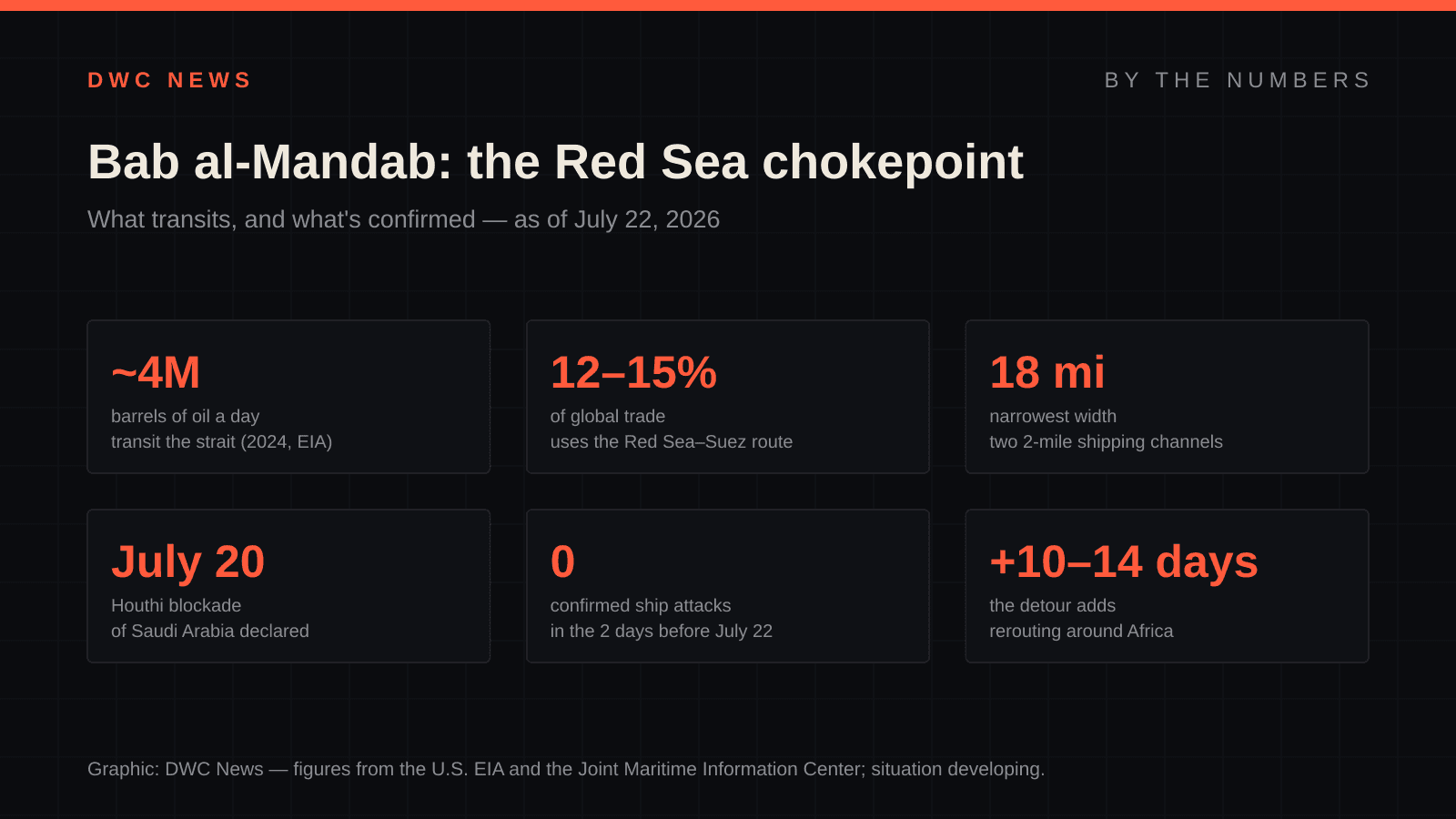
Yemen's Houthis have declared a naval blockade of Saudi Arabia at the Bab al-Mandab strait, the narrow gateway where the Red Sea meets the Gulf of Aden. The declaration, made on Monday, July 20, says vessels calling at Saudi ports will no longer be allowed safe passage through the strait — a threat that, if enforced, would squeeze one of the world's most important shipping arteries at the same moment the Strait of Hormuz is already effectively shut by the wider Iran war.
Two days on, the most important thing to understand is the gap between what has been declared and what has actually happened. As of July 22, the strait is not closed. No attack on a commercial ship has been confirmed in the days since the announcement. What is real, and measurable, is that Saudi-linked tankers have started turning around rather than run the gauntlet.
What the Houthis actually said
Houthi military spokesman Yahya Sarea framed the blockade as retaliation — "an eye for an eye," per Al Jazeera — for what the group calls Saudi sieges on Yemeni ports and, most immediately, a strike on Sanaa's international airport. The group said any ship serving Saudi ports forfeits safe passage through Bab al-Mandab and warned of "complete readiness for all options."
That is a declaration of intent, not a report of a closure. The Houthis control the Yemeni coast along the strait's eastern side and have the missiles, drones and small boats to threaten traffic — but a threat and a physical shutdown are different things, and so far the record shows the former.
What's confirmed — and what isn't
Confirmed:
- The blockade was declared on July 20, and Saudi Arabia rejected it on July 21, vowing to keep the waterway open and calling the threats "acts of maritime piracy," per a Saudi military spokesman quoted by The National and CNBC.
- The Joint Maritime Information Center (JMIC), the multinational naval body that advises merchant shipping, told mariners the Houthis have "completed preparations to attack shipping, including the deployment of missiles and drones positioned near Bab el-Mandeb," and rated the threat "moderate."
- Ships are self-rerouting. Tracking firm Kpler logged a 34% drop in Bab al-Mandab traffic on July 21 versus the day before; multiple Saudi-crude tankers reversed course mid-voyage (The National named two, the Rodos and Xin Long Yang, carrying a combined ~2.8 million barrels loaded at Yanbu); and Saudi oil loadings fell sharply — figures reported by Reuters, CNBC and The National.
Not confirmed / unknown:
- No attack on a commercial vessel has been confirmed in the two days since the declaration; JMIC said commercial traffic was still moving through the southern Red Sea "with no attacks in the past two days." As CNN put it, the Houthis have so far "been unable or unwilling to enforce" the blockade.
- Whether the group can actually close the strait — as opposed to deterring ships and driving up risk — is unknown. Iran's own attempt to shut Hormuz earlier in the war worked more through fear and insurance costs than a literal seal.
- No casualties have been reported from the shipping standoff.
- One widely shared claim — that Houthis "boarded and seized" a transiting ship on July 17 — traces to an unreliable source and is not corroborated. The real July-16/17 incident was different: a pro-government Yemeni force (the Giants Brigades) intercepted a smuggling boat carrying weapons-making components for the Houthis, per The National. We flag it here precisely because it is circulating in a garbled form.
Compare the World's Shipping Chokepoints
The world's maritime chokepoints — what transits Bab al-Mandab, Hormuz, Suez and the rest
Search the world's critical maritime chokepoints — Bab al-Mandab, the Strait of Hormuz, Suez, Malacca and more — by name or region, with how much oil transits, share of global trade, the alternative route, and a plain-English note.
| Bab al-Mandab | Red Sea / Gulf of Aden (Yemen–Djibouti) | ~4M b/d (2024, EIA) | Southern gate to the Red Sea–Suez route, which carries ~12–15% of global trade and ~30% of container traffic | Cape of Good Hope (+10–14 days per Asia–Europe voyage) | About 18 mi wide with two 2-mi channels. Houthis declared a Saudi blockade on July 20, 2026; no ship attack confirmed as of July 22. |
| Strait of Hormuz | Persian Gulf (Iran–Oman/UAE) | ~20M b/d (2024, EIA) | About one-fifth of global oil and LNG; the single most important oil chokepoint | Limited — Saudi East-West pipeline to Yanbu (~7M b/d capacity), UAE's Fujairah line | Shipping collapsed after the Feb 28, 2026 US-Israel-Iran war; crude and LNG flows down sharply (UK Commons Library). |
| Strait of Malacca | Southeast Asia (Malaysia–Indonesia–Singapore) | ~23M b/d (2024, EIA) | Busiest oil chokepoint; the main Asia–Middle East/Europe artery | Sunda or Lombok straits (longer) | Narrows to under 2 mi at the Phillips Channel; congestion and piracy are the standing risks. |
| Suez Canal (with SUMED pipeline) | Egypt (Mediterranean–Red Sea) | ~4.8M b/d (2024, EIA) | ~12% of global trade and ~30% of world container traffic; over 20,000 ships/yr | Cape of Good Hope (same detour as Bab al-Mandab) | Man-made canal with no natural bypass. Traffic fell ~50% after 2024 Houthi attacks (IMF PortWatch). |
| Turkish Straits (Bosporus & Dardanelles) | Türkiye (Black Sea–Mediterranean) | ~3.6M b/d (2024, EIA) | The only maritime outlet from the Black Sea; key for Russian and Caspian crude | None — no sea alternative exists | Transit is governed by the 1936 Montreux Convention. |
| Danish Straits | Denmark (Baltic Sea–North Sea) | ~4.9M b/d (2024, EIA) | Main route for Russian Baltic crude exports | Kiel Canal (smaller vessels only) | Comprises the Great Belt, Øresund and Little Belt. |
| Panama Canal | Panama (Atlantic–Pacific) | Modest — not a headline oil chokepoint | Links the Atlantic and Pacific; roughly 5% of global seaborne trade | Strait of Magellan / Cape Horn (much longer) | Draft and booking limits tighten during droughts. |
How this is calculated
Oil-transit figures are approximate 2024 volumes reported by the U.S. Energy Information Administration's World Oil Transit Chokepoints analysis, shown rounded because volumes shift year to year. Trade-share and container figures come from EIA and IMF/Oxford PortWatch. Widths and channel counts come from EIA. Current-event notes (the July 2026 Bab al-Mandab blockade declaration, Hormuz disruption) are dated and attributed; they describe status, not a prediction.
Data as of July 21, 2026 · verified July 21, 2026 · v1
Assumptions, limitations & sources
Assumptions
- · Oil volumes reflect 2024 EIA estimates and are rounded for readability; actual daily flows vary.
Limitations
- · Not a live feed. Figures are point-in-time estimates; check EIA and IMF PortWatch for the latest.
- · Oil volumes exclude LNG and dry-bulk/container tonnage except where noted in the trade-role column.
- · Panama's oil throughput is modest and not a headline oil chokepoint, so it is described rather than given an oil figure.
- · The 2026 conflict situation is developing; dated notes may age quickly.
Sources
- World Oil Transit Chokepoints — U.S. Energy Information Administration, checked July 21, 2026
- The Bab el-Mandeb Strait is a strategic route for oil and natural gas shipments — U.S. Energy Information Administration, checked July 21, 2026
- PortWatch — Data & Methodology (chokepoint transit trade volumes) — IMF / University of Oxford, checked July 21, 2026
- Houthis deploy missiles and drones to attack ships in southern Red Sea, naval group says — CNBC, checked July 21, 2026
- Israel/US-Iran conflict 2026: Reopening the Strait of Hormuz — UK House of Commons Library, checked July 21, 2026
This is what modern SEO looks like: not just an article, but a useful resource people can return to, cite, and share. See how this newsroom is growing · See DavidWeaver's SEO packages
Why this strait matters
Bab al-Mandab — Arabic for "Gate of Tears" — is only about 18 miles wide at its narrowest, splitting into two roughly two-mile-wide shipping channels (EIA). Everything sailing between Asia and Europe via the Suez Canal has to thread it. That makes it the southern doorway to the Red Sea–Suez corridor, which in normal times carries an estimated 12–15% of global trade and about 30% of the world's container traffic.
On oil specifically, the EIA estimates roughly 4 million barrels a day of crude and petroleum products moved through Bab al-Mandab in 2024 — already down by more than half from its pre-2024 level because of the Houthi shipping campaign that began in late 2023. For Saudi Arabia the stakes are pointed: with Hormuz constrained, the kingdom has been pushing crude west through its East-West "Petroline" to the Red Sea port of Yanbu (pipeline capacity about 7 million barrels a day, per Fortune), and CNN estimates 2.5–3.5 million barrels a day of that Yanbu oil then sails out through Bab al-Mandab. Blockading the strait aims squarely at that escape valve.
The alternative to the strait is the long way around: the Cape of Good Hope, which adds roughly 10 to 14 days to an Asia–Europe voyage and hundreds of thousands of dollars in extra fuel per large ship. It is a real fallback — but a slow, costly one that ties up shipping capacity worldwide.
How we got here
The backdrop is the war that began on February 28, 2026, when the United States and Israel launched strikes on Iran; Iran's supreme leader Ali Khamenei was killed and Iran moved to shut the Strait of Hormuz. Since then, per the UK House of Commons Library, crude and LNG shipments through Hormuz have collapsed and remain far below normal even under a fragile ceasefire.
The Yemen flashpoint is more recent. On July 13, forces loyal to Yemen's Saudi-backed, internationally recognized government struck the runway at Sanaa airport to stop an Iranian Mahan Air flight from landing — a plane carrying a Houthi delegation home from Tehran, where they had attended Khamenei's funeral, per Al Jazeera and Aerotime. The Houthis answered with a missile salvo at Saudi Arabia's Abha airport, and separately, three sources told Reuters that Iran had urged the Houthis to close Bab al-Mandab if the US struck Iran's power grid (Iran has not publicly confirmed this). The July 20 blockade declaration is the next rung on that ladder.
The questions readers are asking
Is Bab al-Mandab closed right now? No. As of July 22 the strait is open and commercial traffic is still passing, though at reduced volume. The blockade is a declaration; enforcement has not been confirmed.
Has a ship been attacked or seized? Not confirmed since the declaration. JMIC reported no attacks in the prior two days. Treat any "seizure" claim skeptically until an official body (JMIC, UKMTO, a flag state, or the shipowner) confirms it.
How much of the world's oil and trade is at risk? Bab al-Mandab itself carries about 4 million barrels of oil a day (EIA) and feeds the Red Sea–Suez route that handles roughly 12–15% of global trade. The sharpest immediate risk is to Saudi crude heading to Asia and to diesel bound for Europe.
Can ships just go around? Yes — around the Cape of Good Hope — but it adds about 10–14 days and significant cost, and most Asia–Europe container lines already rerouted that way back in 2024.
What happens next
Watch three things. First, the JMIC/UKMTO threat level and any confirmed attack — that is the line between a scare and a shooting war on shipping. Second, insurance and freight rates, which price in risk faster than governments react. Third, whether the US or a coalition responds militarily, which CNN notes would open a second maritime front while Hormuz is still contested. For now, the honest summary is narrow and important: the Houthis have declared a blockade, Saudi Arabia has rejected it, ships are voting with their rudders — and no one has fired on a merchant vessel yet.
Sources
- Houthis deploy missiles and drones to attack ships in southern Red Sea, naval group says — CNBC
- A new front is opening in the Iran war. Oil faces 'no way out' — CNN Business
- Yemen's Houthis declare naval blockade of Saudi Arabia: What to know — Al Jazeera
- Yemen's Houthis declare naval blockade on Saudi Arabia, widening threat to global oil supplies — NBC News
- Saudi Arabia rejects Houthi maritime embargo threat and warns of Red Sea escalation — The National
- Saudi oil loadings drop by 36% as Houthi threats disrupt Bab Al Mandeb passage — The National
- Amid U.S.-Iran war, Houthis declare a blockade of another key strait: Bab el-Mandeb — NPR
- Tension rising as Yemen gov't attacks Sanaa airport, Houthis fire missiles — Al Jazeera
- Iran reportedly tells Houthis to close Bab al-Mandeb Strait if US strikes power grid — FDD (citing Reuters)
- Dramatic speedboat raid in Bab Al Mandeb strait halts weapons shipment to Yemen's Houthis — The National
- MSCI 2026-006 — Red Sea, Bab el-Mandeb, Gulf of Aden: Houthi attacks on commercial vessels — U.S. Maritime Administration (MARAD) · primary source
- JMIC Advisory Note, Update 074 (21 July 2026) — UKMTO / Joint Maritime Information Center · primary source
- The Bab el-Mandeb Strait is a strategic route for oil and natural gas shipments — U.S. Energy Information Administration · primary source
- World Oil Transit Chokepoints — U.S. Energy Information Administration · primary source
- PortWatch — Data & Methodology (chokepoint transit trade volumes) — IMF / University of Oxford · primary source
- Israel/US-Iran conflict 2026: Reopening the Strait of Hormuz — UK House of Commons Library · primary source
- Saudi pipeline to bypass Hormuz hits 7 million barrel goal — Fortune