Allergy pills recalled nationwide: cetirizine may be cross-contaminated with a discontinued heartburn drug
Four lots of 5 mg cetirizine — generic Zyrtec — were recalled after a technician spotted red-flecked pills possibly cross-contaminated with ranitidine, which can trigger life-threatening reactions in sensitive people. How to check your bottle, and what we know about the companies.

By David Weaver
Publisher & Editor
Published July 22, 2026, 12:30 AM ET
If you take a generic version of the allergy medicine Zyrtec, this one is worth a two-minute check of your medicine cabinet.
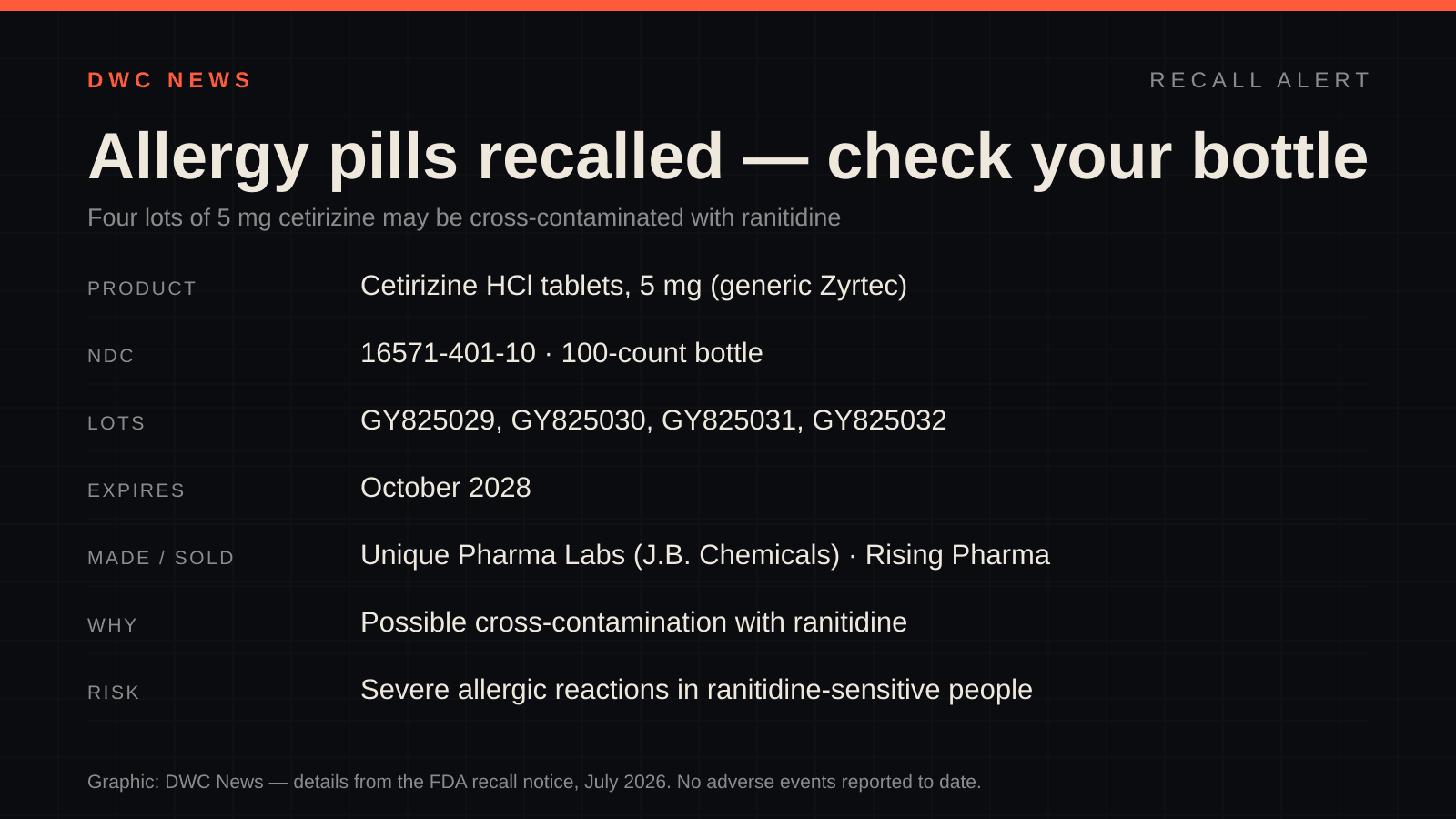
Four lots of Cetirizine Hydrochloride Tablets USP, 5 mg were voluntarily recalled nationwide on July 18, 2026, because they may be cross-contaminated with ranitidine — a heartburn drug that can cause severe, potentially life-threatening allergic reactions in people who are sensitive to it. The recall was issued by Unique Pharmaceutical Laboratories, a division of India's J.B. Chemicals & Pharmaceuticals, and the pills were distributed in the U.S. by Rising Pharma Holdings, per the FDA's recall notice. As of the announcement, no adverse events had been reported.
How to tell if your bottle is affected
The recall is specific. You are looking for:
- NDC 16571-401-10 — a 100-tablet bottle of 5 mg cetirizine.
- Lot numbers GY825029, GY825030, GY825031, or GY825032.
- Expiration date October 2028.
If your bottle doesn't match all of that, it is not part of this recall. If it does — or you're not sure — the checklist below walks through exactly what to do, and it ends where it should: with the official FDA links.
Check Your Medicine
Is your allergy medicine part of the recall? Steps to take
A step-by-step guide to check whether your 5 mg cetirizine is part of the July 2026 recall, what to do if it is, and how to report a problem to the FDA.
This is general safety information, not medical advice. If you have symptoms like difficulty breathing, swelling of the face or throat, or fainting, call 911 or seek emergency care immediately. Confirm recall details with the FDA and talk to your pharmacist or doctor about your specific medication.
0 of 10 done
How this is calculated
The steps mirror the manufacturer's FDA-posted recall notice and the FDA's standard consumer guidance: identify the product by its NDC and lot number, stop use, consult a pharmacist or doctor, return the product, and report problems to MedWatch. No scoring and no model output — the official instructions, in order.
Data as of July 20, 2026 · verified July 20, 2026 · v1
Assumptions, limitations & sources
Assumptions
- · Recall details (lot numbers, NDC) are current as of the data date shown; the FDA notice is the authority.
Limitations
- · This is general safety information, not medical advice or an emergency service.
- · Only the FDA and your healthcare provider can advise on your specific situation, and recall details can change — verify with the FDA.
Sources
- FDA — Unique Pharmaceutical Laboratories voluntary nationwide recall of cetirizine 5 mg — U.S. Food and Drug Administration, checked July 20, 2026
- Drugs.com — FDA alert: cetirizine recall over ranitidine cross-contamination — Drugs.com (FDA alert), checked July 20, 2026
- USA Today — antihistamine cetirizine hydrochloride recalled — USA Today, checked July 20, 2026
This is what modern SEO looks like: not just an article, but a useful resource people can return to, cite, and share. See how this newsroom is growing · See DavidWeaver's SEO packages
The risk, explained — and a twist
Cetirizine is an everyday antihistamine. Ranitidine is something else entirely: an acid reducer once sold as Zantac. The danger here isn't that the two don't mix chemically — it's that some people are genuinely allergic or sensitive to ranitidine, and for them an unexpected dose can bring on hypotension (dangerously low blood pressure), shortness of breath, difficulty swallowing, swelling of the face or throat, hives, or loss of consciousness. The FDA-posted notice describes those reactions as potentially life-threatening.
Here is the twist worth knowing: ranitidine isn't even supposed to be on U.S. shelves. In April 2020, the FDA requested the removal of all ranitidine products from the market after finding they could develop NDMA, a probable human carcinogen, over time. So a discontinued drug turning up as a contaminant in a common allergy pill is its own small alarm — though, to be precise, the recall's stated risk is the allergic reaction, not the cancer concern that drove the 2020 withdrawal.
How the recall was discovered
This one was caught the old-fashioned way: by a person paying attention. According to the recall reporting, a pharmacy technician noticed a red dot on some tablets while counting them, and several pills looked discolored. That prompted a closer look, and the investigation concluded the tablets may have been contaminated with ranitidine during manufacturing. It is a useful reminder that a lot of drug-safety catches still start with a sharp-eyed human at the counter.
Who makes it — and their track record
You asked the accountability questions, so here are the honest answers.
The maker. Unique Pharmaceutical Laboratories is a division of J.B. Chemicals & Pharmaceuticals Ltd., a publicly traded Indian drugmaker (NSE: JBCHEPHARM / BSE: 506943). Its most recent reported figures put annual revenue around ₹4,148 crore (roughly $490 million) and its market value around ₹38,677 crore (roughly $4.6 billion) as of mid-July 2026, per market data aggregators. Its corporate picture is in flux: longtime CEO Nikhil Chopra stepped down at the end of March 2026, and the company has since been absorbed by Torrent Pharmaceuticals, which bought out the controlling stake previously held by the private-equity firm KKR. So the "current owner" is, as of this month, Torrent.
The distributor. Rising Pharma Holdings is a privately held U.S. generics company, so it has no stock ticker and does not publish its revenue or net worth. What it does have is a recent recall history: beyond this cetirizine recall, reporting and FDA records describe a May 2026 recall of a blood-pressure diuretic over failed dissolution testing, a 2025 recall of an antidepressant over failed specifications, and a duloxetine recall tied to a nitrosamine impurity. Its FDA inspection record is public through ProPublica's Rx Inspector.
On lawsuits and payouts: there is no public, aggregated tally of how many times either company has been sued or how much it has paid in settlements, and we are not going to invent one. When a verifiable figure exists, we will add it.
The questions readers are asking
Has the company made a statement? The recall itself is the statement — a voluntary action filed with the FDA. We found no separate press statement beyond the recall notice as of publication.
What happens to people who were affected? So far, no one is known to have been harmed — there are no reported adverse events. Anyone who has the recalled lots should stop use, check with a pharmacist or doctor (especially if they're sensitive to ranitidine), return the product, and report any reaction to the FDA. Those steps are in the checklist above.
Are there lawsuits yet? Any attorney leading the way? No. With no reported injuries and a fast voluntary recall, litigation would be premature, and no suits or lead attorneys have been reported. Product-liability firms often monitor recalls like this, but naming one as "leading the pack" right now would be guesswork — so we won't.
What's the stock doing? J.B. Chemicals trades in India under JBCHEPHARM (and BSE code 506943). Because share prices and volumes move by the second, we won't print a live quote here — check a market data site for the current number, and note that the Torrent takeover reshapes the picture.
What happens next
Watch for the FDA to assign the recall a formal classification (Class I, II, or III), which signals how serious regulators judge the hazard to be; watch whether the recall expands beyond these four lots; and watch for any adverse events to be reported now that the notice is public. This story will be updated as the FDA and the companies confirm more — and, per our standards, we will point you to the official resources rather than ask you to take our word for your health.
Sources
- Allergy medication recalled over potentially 'life-threatening' cross-contamination — The Hill
- Antihistamine cetirizine hydrochloride recalled — USA Today
- Cetirizine hydrochloride recalled after possible ranitidine contamination — Fox Business
- Unique Pharmaceutical Laboratories issues voluntary nationwide recall of cetirizine 5 mg (official notice) — U.S. Food and Drug Administration · primary source
- FDA alert: cetirizine recall over ranitidine cross-contamination — Drugs.com (FDA alert) · primary source
- FDA requests removal of all ranitidine (Zantac) products from the market (2020) — U.S. Food and Drug Administration · primary source
- FDA inspection reports for Rising Pharma Holdings (Rx Inspector) — ProPublica
- J B Chemicals & Pharmaceuticals — company and share data — Screener.in