The FDA approved a Tylenol that contains naproxen — what that means for the bottle already in your cabinet
TYLENOL with Naproxen puts 650 mg of acetaminophen and 220 mg of naproxen sodium in a single over-the-counter dose — the first fixed-dose combination of its kind. It also makes an old question urgent: if one pill now contains both, how do you avoid doubling up?

By David Weaver
Publisher & Editor
Published July 24, 2026, 7:47 PM ET
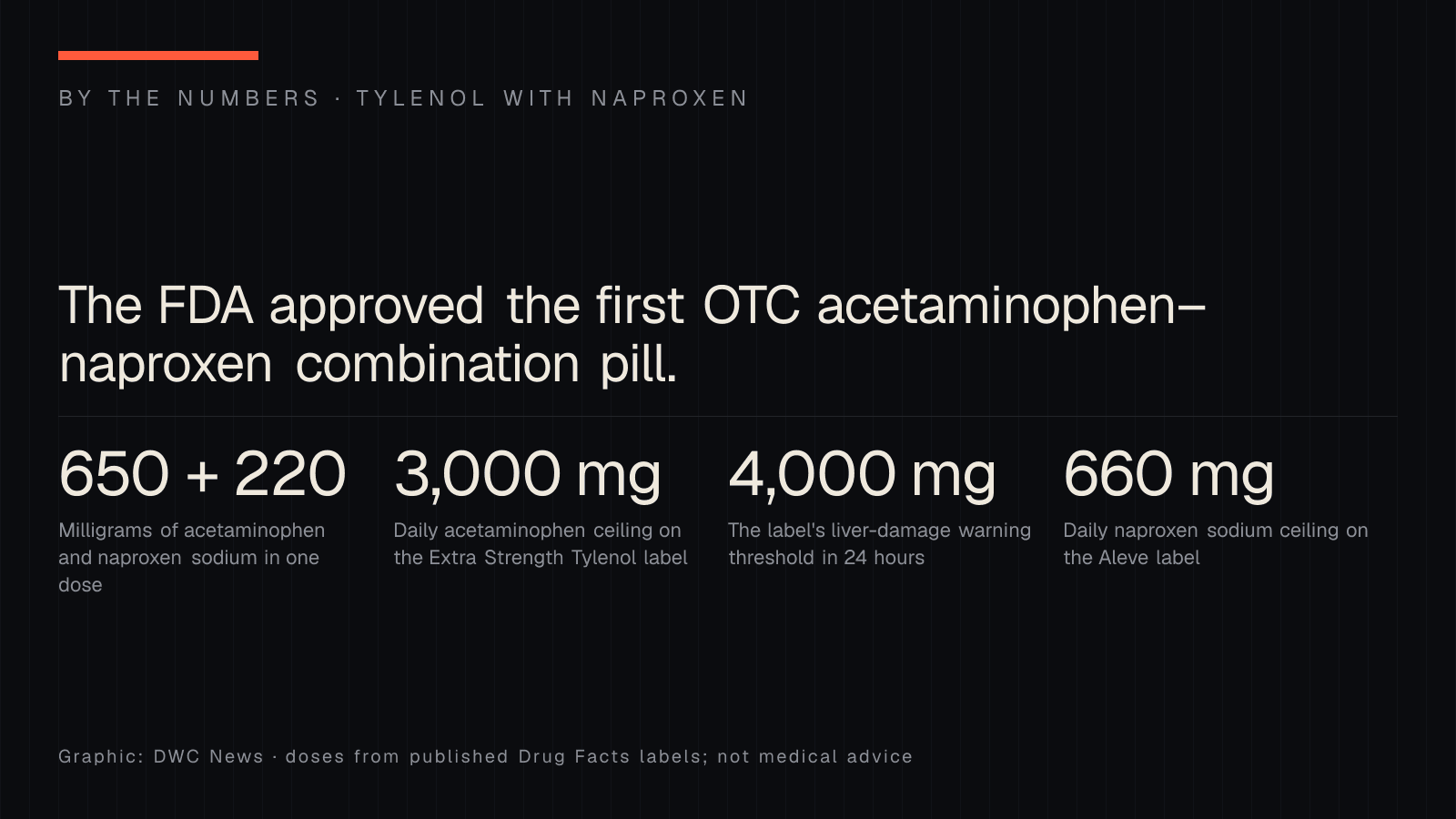
The Food and Drug Administration approved TYLENOL with Naproxen on Thursday, July 24, 2026 — the first and only over-the-counter fixed-dose combination of acetaminophen (650 mg) and naproxen sodium (220 mg), in a single 12-hour dose.
It is a genuinely new kind of product on the American drugstore shelf. It is also, for a lot of households, a new way to take too much of something by accident — and that is the part worth twenty minutes of your attention, because the arithmetic is not hard but the brand name actively hides it.
What was approved
One dose contains two different painkillers that work in different ways:
- Acetaminophen, 650 mg. The active ingredient in Tylenol. Not an anti-inflammatory.
- Naproxen sodium, 220 mg. The active ingredient in Aleve. An NSAID — a non-steroidal anti-inflammatory drug, the same family as ibuprofen.
Kenvue, which owns the Tylenol brand, says the combination begins working in under 30 minutes and provides relief for 12 hours, and that it is supported by eight clinical studies showing better pain relief than acetaminophen alone or naproxen sodium alone. Those are the company's claims from its approval announcement; we have not seen the underlying study data, and the announcement also cites a March 2026 Kenvue-run consumer survey finding that 75% of people with persistent pain are dissatisfied with their options — which is marketing research, not evidence about the drug.
The pharmacological logic is real and predates the product. Doctors have suggested alternating or combining acetaminophen with an NSAID for decades, precisely because they work through different mechanisms and their side-effect profiles do not overlap much. What is new is that the timing and the ratio are now decided by the manufacturer instead of by you at 2 a.m.
What has not been published: the full Drug Facts label, including the product's own maximum number of doses in 24 hours. Availability and price have not been announced either. When the carton reaches shelves, the carton is the authority.
The stacking problem, stated plainly
Here is the safety issue in one sentence: a product called Tylenol now contains an NSAID, and nothing about the name tells you that.
Two specific ways that goes wrong.
Doubling the naproxen. Someone takes TYLENOL with Naproxen for back pain in the morning, then reaches for Aleve in the afternoon because "the Tylenol wore off." Those are the same drug. The Aleve label caps naproxen sodium at 660 mg in 24 hours without a doctor's direction, and two products both contributing 220 mg a dose get there fast.
Doubling the acetaminophen. The same person takes Extra Strength Tylenol at night, not registering that the combination product already delivered 650 mg of acetaminophen twice that day. Acetaminophen labels carry a liver-damage warning at more than 4,000 mg in 24 hours; the Extra Strength carton prints a 3,000 mg daily ceiling.
And the classic third case, which has nothing to do with the new product but sends people to hospitals every winter: acetaminophen is in hundreds of combination cold, flu, sinus, allergy and night-time medicines, and in many prescription pain medicines. Nobody thinks of a nighttime cold liquid as a dose of Tylenol. Their liver does.
The tool below does the arithmetic. Pick up to two over-the-counter pain relievers and the number of label doses of each, and it adds up the acetaminophen, naproxen sodium and ibuprofen and compares the totals to the ceilings printed on the labels — including the two combinations the labels tell you never to make.
Add Up A Day's Doses Against The Label
Pain reliever stacking checker: what two over-the-counter products add up to in 24 hours
Pick up to two over-the-counter pain relievers and how many label doses of each you would take in a day. This adds the acetaminophen, naproxen sodium and ibuprofen and compares the totals to the ceilings printed on the Drug Facts labels.
Uses: First product · Doses of the first product in 24 hours · Second product · Doses of the second product in 24 hours
This is an arithmetic check against published Drug Facts labels, not medical advice, not a dosing instruction, and not a safety clearance. It cannot know what else you take or what conditions you have. Read the label on every product you use, and ask a pharmacist or your doctor before combining pain relievers — especially if you have liver, kidney, heart or stomach conditions, take blood thinners, are pregnant, or drink alcohol regularly. If you think someone has taken too much acetaminophen, call Poison Control at 1-800-222-1222 immediately, even if they seem fine.
Example — adjust the inputs above for your situation
Within the label limits: 3,000 mg acetaminophen, 660 mg naproxen sodium and 0 mg ibuprofen in 24 hours.
Acetaminophen and an NSAID work on pain differently, which is why labels do not forbid taking them in the same day — the danger is quantity, and the totals above are under the published ceilings. That holds only if these are the only products you take: check everything else in the cabinet for the same ingredients.
- Acetaminophen in 24 hours
- 3,000 mg (liver warning above 4,000 mg)
- Naproxen sodium in 24 hours
- 660 mg (label ceiling 660 mg)
- Ibuprofen in 24 hours
- 0 mg (label ceiling 1,200 mg)
- First product
- 3 × 2 caplets (1,000 mg acetaminophen) every 6 hours
- Second product
- 3 × 1 caplet (220 mg naproxen sodium) every 8 to 12 hours
- ※ This tool only counts what you tell it. Acetaminophen is also in many cold, flu, sinus, allergy and night-time products, and prescription pain medicines — check every label for it.
- ※ Label ceilings assume a healthy adult taking the product for a short time. Liver disease, kidney disease, heart disease, stomach ulcers, blood thinners, pregnancy and regular alcohol use all change the arithmetic, and your doctor's directions override the carton.
- ※ Not medical advice and not a dosing instruction. If the number is close to a limit, or you are unsure, ask a pharmacist — they will answer this question for free.
How this is calculated
Straight addition against published Drug Facts labels. Each product contributes a fixed milligram amount per label-directed adult dose: TYLENOL Regular Strength 650 mg acetaminophen per 2-tablet dose, Extra Strength 1,000 mg per 2-caplet dose, 8 HR Arthritis Pain 1,300 mg per 2-caplet dose, TYLENOL with Naproxen 650 mg acetaminophen plus 220 mg naproxen sodium per dose, Aleve 220 mg naproxen sodium per caplet, and Advil 400 mg ibuprofen per 2-tablet dose. Doses are multiplied out, summed by active ingredient, and compared with the labels' own 24-hour ceilings: 4,000 mg is the acetaminophen figure named in the liver-damage warning (3,000 mg is the ceiling on the Extra Strength carton), 660 mg for naproxen sodium and 1,200 mg for ibuprofen without a doctor's direction. Two separate NSAIDs together, and two acetaminophen products together, are flagged regardless of the totals. There is no clinical model here and no personalisation — it counts milligrams.
Data as of July 23, 2026 · verified July 23, 2026 · v1
Assumptions, limitations & sources
Assumptions
- · A healthy adult or child 12 and over taking the products short-term exactly as the label directs.
- · One 'dose' means the label's standard adult dose for that product, shown in the result.
- · Only the two products entered are counted — the tool cannot know about anything else in the medicine cabinet.
- · TYLENOL with Naproxen contributes 650 mg acetaminophen and 220 mg naproxen sodium per dose, per the manufacturer's approval announcement; its own 24-hour ceiling has not been published yet.
Limitations
- · Not medical advice, not a dosing instruction, and no substitute for the Drug Facts label or a pharmacist.
- · Acetaminophen is an ingredient in hundreds of combination cold, flu, sinus, allergy and night-time products and in prescription pain medicines. Those are the doses that push people over the line, and this tool cannot see them.
- · Label ceilings assume no complicating conditions. Liver disease, kidney disease, heart disease, a history of stomach ulcers or bleeding, blood thinners, pregnancy, and regular alcohol use all change what is safe, and a doctor's directions override the carton.
- · NSAID warnings this tool does not weigh: naproxen and ibuprofen carry FDA warnings about heart attack, stroke and gastrointestinal bleeding, and both labels cap continuous use without a doctor at 10 days for pain.
- · The full Drug Facts label for TYLENOL with Naproxen has not been published yet, so its own maximum daily doses cannot be checked here. Follow the carton.
Sources
- FDA approves the first nonprescription fixed-dose combination of acetaminophen and naproxen sodium — U.S. Food and Drug Administration, checked July 23, 2026
- TYLENOL Extra Strength — Drug Facts label (500 mg caplets; 6 caplets in 24 hours) — DailyMed, U.S. National Library of Medicine, checked July 23, 2026
- TYLENOL 8 HR Arthritis Pain — Drug Facts label (650 mg caplets; 6 caplets in 24 hours) — DailyMed, U.S. National Library of Medicine, checked July 23, 2026
- TYLENOL Regular Strength — Drug Facts label (325 mg tablets; 10 tablets in 24 hours) — DailyMed, U.S. National Library of Medicine, checked July 23, 2026
- Aleve caplets — Drug Facts label (220 mg naproxen sodium; 3 caplets in 24 hours) — DailyMed, U.S. National Library of Medicine, checked July 23, 2026
- Ibuprofen tablets 200 mg — FDA-approved OTC labeling (6 tablets in 24 hours) — U.S. Food and Drug Administration, checked July 23, 2026
- FDA — acetaminophen and liver injury: know your dose — U.S. Food and Drug Administration, checked July 23, 2026
This is what modern SEO looks like: not just an article, but a useful resource people can return to, cite, and share. See how this newsroom is growing · See DavidWeaver's SEO packages
What the labels actually say
For reference, from the published Drug Facts labels — these are the ceilings, not recommendations, and a doctor's directions override them:
| Product | One adult dose | Label maximum in 24 hours | | --- | --- | --- | | TYLENOL Regular Strength (325 mg) | 2 tablets (650 mg) every 4–6 hrs | 10 tablets (3,250 mg) | | TYLENOL Extra Strength (500 mg) | 2 caplets (1,000 mg) every 6 hrs | 6 caplets (3,000 mg) | | TYLENOL 8 HR Arthritis Pain (650 mg) | 2 caplets (1,300 mg) every 8 hrs | 6 caplets (3,900 mg) | | Aleve (naproxen sodium 220 mg) | 1 caplet every 8–12 hrs | 3 caplets (660 mg) | | Advil / ibuprofen (200 mg) | 1–2 tablets every 4–6 hrs | 6 tablets (1,200 mg) | | TYLENOL with Naproxen | 650 mg + 220 mg per dose | not yet published |
Two rules that sit underneath all of it. Never take two different NSAIDs together — naproxen and ibuprofen, or either one plus the new combination product. Stacking NSAIDs raises the risk of stomach bleeding and kidney problems without adding pain relief. And NSAID labels cap continuous use without a doctor at 10 days for pain, alongside FDA warnings about heart attack, stroke and gastrointestinal bleeding.
The context Kenvue is launching into
This approval arrives in the middle of a bad stretch for the brand, and the two things are worth keeping separate.
On July 13, 2026, a federal appeals court reversed the dismissal of hundreds of private lawsuits alleging that acetaminophen use during pregnancy is linked to autism and ADHD — reviving litigation that had been thrown out. Texas Attorney General Ken Paxton has separately sued manufacturers over the marketing of Tylenol to pregnant women. In 2025, after a White House press conference, the FDA moved to notify physicians and initiated a label change regarding a possible association; Kenvue formally petitioned the FDA to reject the proposed warnings, and when the company updated the Tylenol label in May 2026, it did not include an autism warning.
On the science: a review published in The Lancet Obstetrics, Gynecology & Women's Health examined 43 studies and concluded that the most rigorous designs — sibling comparisons, which control for the family factors that confound this kind of research — show no clear link between acetaminophen use in pregnancy and autism or ADHD.
Three things follow, and all three are true at once. The allegations in the lawsuits are allegations, not findings. The strongest available evidence does not support the causal claim. And an appeals court has decided the plaintiffs get to make their case, which is a ruling about process, not about whether acetaminophen causes autism.
None of that is about this product. The new combination is an adult pain reliever; the pregnancy question concerns a different population and a different use. Anyone who is pregnant or trying to become pregnant should be having this conversation with their own clinician, not with a headline.
The questions readers are asking
Can I take Tylenol and Aleve together? Under the published labels, taking acetaminophen and an NSAID in the same day is not prohibited — they work differently and the labels do not forbid the combination. The danger is total quantity, plus your own medical history. Run your actual numbers through the tool above, and if you are anywhere near a ceiling, ask a pharmacist.
Is a combination pill safer or more dangerous than taking two products? Neither, inherently. It is more convenient and more consistent, and the ratio is fixed by the manufacturer rather than guessed. The added risk is entirely about awareness — a single pill makes it easier to lose track of what you have taken.
How much acetaminophen is too much? The liver warning on the label names more than 4,000 mg in 24 hours. Extra Strength Tylenol prints a 3,000 mg daily ceiling. Less if you have liver disease or drink regularly — that is a conversation for your doctor, not a number from an article.
Is it available yet, and what does it cost? Not announced. The FDA approval is the news; a shelf date and a price are not public.
Why not just buy Tylenol and Aleve separately? You still can, and it will almost certainly be cheaper. The case for the combination is a single 12-hour dose instead of two schedules to keep straight.
Who should not take this? The NSAID half carries the usual cautions: a history of stomach ulcers or bleeding, kidney disease, heart disease or heart failure, blood thinners, and the third trimester of pregnancy. The acetaminophen half matters most for liver disease and regular alcohol use. If you are in any of those groups, this is a question for a pharmacist before it is a purchase.
What if I think I took too much? Call Poison Control at 1-800-222-1222 immediately, even if you feel fine. Acetaminophen liver injury is treatable when caught early and the early hours often have no symptoms at all — waiting to feel bad is how it becomes serious.
The bottom line
A single OTC pill combining acetaminophen and an NSAID is a reasonable idea that works better than either ingredient alone, according to the manufacturer's studies. The catch is not pharmacology. It is that a bottle labeled Tylenol now contains something that is not only Tylenol, and American medicine cabinets are already full of products whose active ingredients people cannot name.
Read the Drug Facts panel on everything before you combine anything. That is tedious advice. It is also the whole ballgame.
This article is for information only and is not medical advice. Read the Drug Facts label on every product you take, and talk to a pharmacist or your doctor before combining pain relievers — especially if you are pregnant, take other medicines, or have liver, kidney, heart or stomach conditions.
Sources
- FDA approves the first nonprescription fixed-dose combination of acetaminophen and naproxen sodium — U.S. Food and Drug Administration · primary source
- FDA approves TYLENOL with Naproxen — company announcement — Kenvue Inc. via PR Newswire · primary source
- TYLENOL Extra Strength — Drug Facts label — DailyMed, U.S. National Library of Medicine · primary source
- Aleve caplets — Drug Facts label — DailyMed, U.S. National Library of Medicine · primary source
- FDA — acetaminophen information and liver injury guidance — U.S. Food and Drug Administration · primary source
- U.S. appeals court revives hundreds of private lawsuits linking Tylenol to autism and ADHD — U.S. News & World Report
- U.S. appeals court reverses dismissal of Tylenol cases — JURIST
- FDA initiates label change on Tylenol to warn of autism — The Hill