FDA is investigating a new 72-case cyclospora outbreak — and it is not the Taco Bell lettuce one
The FDA said on July 22 it is investigating a new cyclosporiasis outbreak of 72 cases with a source it has not identified. Officials say it is not linked to lettuce and is separate from the earlier iceberg-lettuce outbreak tied to Taylor Farms de Mexico. Here is how to keep the two straight.

By David Weaver
Publisher & Editor
Published July 23, 2026, 5:15 PM ET
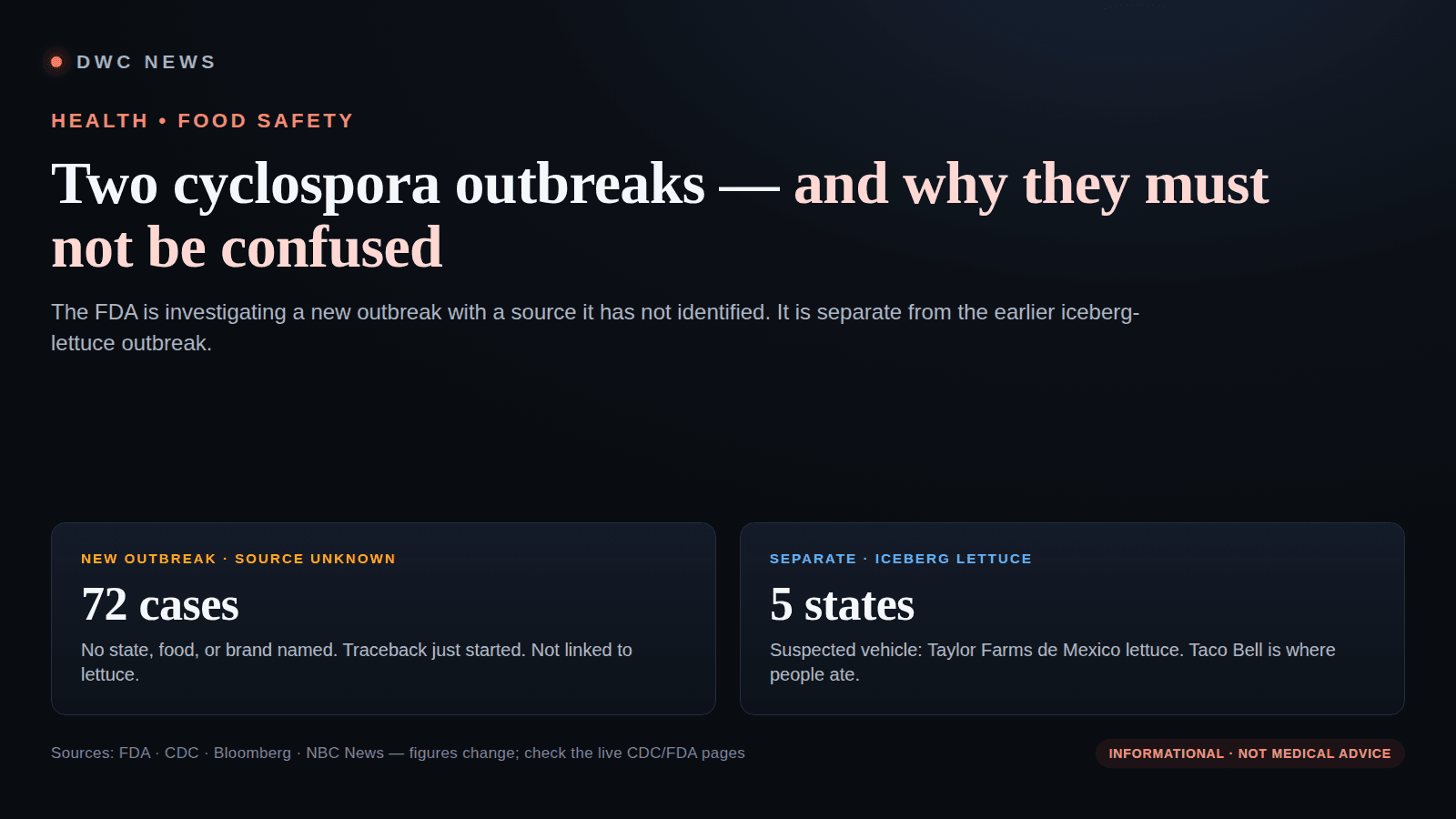
There are two cyclospora outbreaks in the news right now, and the fastest way to get this story wrong is to mash them together. So let us be precise from the first line: the outbreak driving today's searches is a new one, it has 72 cases, and officials have not identified its source. It is not the Taco Bell lettuce story. It is a separate investigation.
Lane A: the new 72-case outbreak with no named source
On July 22, 2026, the FDA disclosed that it is investigating another cyclosporiasis outbreak — 72 illnesses — with a product it describes as not yet identified, as Bloomberg reported. Traceback — the work of following contaminated food back through the supply chain — was just initiated. That means the honest status of this outbreak is narrow and worth stating plainly:
- No state has been named.
- No food has been named.
- No brand, grocer, restaurant, or supplier has been named.
Crucially, the FDA reported that this new outbreak is not linked to lettuce and is separate from the earlier iceberg-lettuce investigation, as The Hill reported. So if you see the number "72" next to a company's name, treat that as an assumption someone added — not something officials have said. The source of these 72 cases is unknown.
A note on a smaller co-trend: some search traffic pairs this news with "taco bell deals." Any connection there is unverified audience behavior — people searching adjacent terms — not a same-day promotion or an official link. We are not reporting a Taco Bell deal tied to this outbreak, because there is nothing on the record to report.
Lane B: the separate, older iceberg-lettuce outbreak
The story people are confusing this with is a different, earlier outbreak across five states — Indiana, Kentucky, Michigan, Ohio, and West Virginia. In that investigation, officials named a suspected vehicle: shredded iceberg lettuce from Taylor Farms de Mexico, served at Taco Bell among other locations, per the FDA's outbreak page.
Read that sentence carefully, because the distinction protects real companies from a false accusation. Taco Bell is a restaurant where exposed people ate. The named vehicle is the lettuce supplier, Taylor Farms de Mexico — and even that is a suspected source, not a proven one. Taco Bell is not being blamed as the point of contamination.
And the lettuce link itself carries an important caveat: it rests on epidemiologic and traceback data — where sick people reported eating — not on a positive product sample. An initial lettuce sample that had tested positive for cyclospora was later retracted as a false positive around July 19–20, 2026, as NBC News reported. Taylor Farms de Mexico voluntarily recalled central-Mexico iceberg lettuce on July 17, an action later expanded to roughly 27 states, including Marketside items sold at Walmart.
About the case numbers: do not add them up
This is where blended reporting goes wrong. Case counts vary by scope and by date, so any single "total" is misleading. Cite each figure with what it counts and when:
- In the 5-state outbreak, the CDC has reported roughly 1,645 people exposed at Taco Bell, about 94 hospitalizations, and no deaths.
- The broader Taylor Farms footprint — the wider recall universe — has been reported as larger than the 5-state count.
- The new outbreak is a separate 72 cases.
Those are three different numbers describing three different scopes. Do not add the 72 to the 1,645, and do not treat the recall footprint as one outbreak total. Because these figures move, treat every number here as a snapshot — figures change; check the live CDC and FDA pages for the current counts.
The tool below keeps the two outbreaks in separate lanes and tags each claim as confirmed or still under investigation, with its source.
Two Outbreaks, Kept Separate
Cyclospora July 2026: two separate outbreaks, claim by claim
A claim-by-claim map that keeps the two July 2026 cyclosporiasis outbreaks apart: the NEW 72-case outbreak with a not-yet-identified source, and the separate iceberg-lettuce outbreak tied to Taylor Farms de Mexico. Each point tagged confirmed or under investigation, with its source.
This is health information, not medical advice, and it does not diagnose or treat any illness. If you have symptoms such as prolonged watery diarrhea, contact a healthcare provider; cyclospora testing often must be specifically requested. Outbreak case counts change frequently and differ by scope and date — check the live CDC and FDA outbreak pages for current figures before acting on any number here.
Lane A — new outbreak: The FDA said on July 22, 2026 that it is investigating a separate cyclosporiasis outbreak of 72 illnesses.
ConfirmedThe FDA disclosed a new investigation with 72 cases; the agency and reporting frame it as distinct from the earlier iceberg-lettuce outbreak.
Lane A — new outbreak: The contaminated product behind the 72-case outbreak has NOT been identified. No state, no food, and no brand has been named, and traceback was only just initiated.
UnknownThe FDA listed the outbreak with a 'not yet identified' product and traceback just started — there is no named source. No restaurant, grocer, or supplier is tied to these 72 cases.
Lane A — new outbreak: The 72-case outbreak is NOT linked to lettuce and is SEPARATE from the Taco Bell / iceberg-lettuce outbreak.
ConfirmedThe FDA reported the new outbreak as not linked to lettuce and separate from the earlier investigation. Do not attribute it to Taco Bell, Taylor Farms, or any product in Lane B.
Lane B — lettuce outbreak: In a separate, earlier 5-state outbreak (Indiana, Kentucky, Michigan, Ohio, and West Virginia), officials named the SUSPECTED vehicle as shredded iceberg lettuce from Taylor Farms de Mexico, served at Taco Bell among other places.
ConfirmedOfficials identified iceberg lettuce from Taylor Farms de Mexico as the suspected source. Taco Bell is a restaurant where exposed people ate; it is not named as the point of contamination. The lettuce supplier, not the restaurant, is the named vehicle.
Lane B — lettuce outbreak: The lettuce link rests on epidemiologic and traceback data, NOT a positive product sample. An initial positive lettuce sample was retracted as a false positive.
ConfirmedAround July 19–20, 2026 the FDA said an earlier Taylor Farms lettuce sample that had tested positive for cyclospora was a false positive. The suspected-vehicle finding is based on where cases ate and traceback, not on a confirmed positive sample.
Lane B — lettuce outbreak: Taylor Farms de Mexico voluntarily recalled central-Mexico iceberg lettuce on July 17, 2026, later expanded to roughly 27 states, including Marketside items sold at Walmart.
ConfirmedThe recall was a voluntary action by the supplier and grew to about 27 states. Product identification for the recall does not extend to the separate 72-case outbreak in Lane A.
Lane B — lettuce outbreak: Case counts vary by scope and date and are not one blended total. In the 5-state outbreak, the CDC has reported roughly 1,645 people exposed at Taco Bell, about 94 hospitalizations, and no deaths; the broader Taylor Farms footprint has been reported larger.
ConfirmedRead each figure with its scope and date: ~1,645 Taco Bell-exposed / ~94 hospitalized / 0 deaths is the CDC's 5-state count, which is different from the wider recall footprint. Do not add these numbers to the 72 cases in Lane A.
Cyclospora basics: Cyclosporiasis is caused by the parasite Cyclospora cayetanensis, spread by eating food or water contaminated with feces. It is not spread directly person to person, and its incubation period is about one week (roughly 2 days to 2 weeks or more).
ConfirmedPer the CDC, contamination comes from fecal matter in food or water; there is no direct person-to-person transmission, and symptoms typically begin about a week after exposure.
Symptoms: The most common symptom is prolonged, watery diarrhea, often with loss of appetite and weight loss, stomach cramps, nausea, and fatigue.
ConfirmedPer the CDC, illness can be prolonged and can relapse without treatment; symptoms are digestive and can persist for weeks.
What to do: The recommended treatment is the antibiotic trimethoprim-sulfamethoxazole (TMP-SMX, sold as Bactrim). Testing often must be specifically requested, so tell your provider about possible cyclospora exposure.
ConfirmedPer the CDC, TMP-SMX is the treatment of choice, and stool tests for cyclospora are frequently not ordered unless a clinician specifically requests them. This is general information, not a prescription — see a healthcare provider.
How this is calculated
Each claim is tagged by the official record as of the data date. 'Confirmed' means the FDA, the CDC, or a state health authority has stated it on the record, corroborated by reputable reporting; 'under investigation' (shown as unknown) means officials have said the point is unresolved or have not identified it. Claims are grouped into two lanes so the outbreaks never blend: Lane A is the new 72-case outbreak (source not yet identified); Lane B is the separate 5-state iceberg-lettuce outbreak. Case counts are reported with their scope and date and are never combined into one total. Cyclospora basics are attributed to the CDC.
Data as of July 22, 2026 · verified July 22, 2026 · v1
Assumptions, limitations & sources
Assumptions
- · Statuses reflect the public record as of July 23, 2026 and will change as the FDA traceback and CDC case counts are updated.
- · The two outbreaks are treated as distinct events, as the FDA has described them; figures from one are never added to the other.
Limitations
- · This is a fast-moving situation. Case numbers change frequently and differ by scope (5-state Taco Bell-exposed counts versus the broader Taylor Farms footprint) and by date — check the live CDC and FDA pages for the current figures.
- · The new 72-case outbreak has NO identified source: no state, food, or brand has been named, and traceback was only just initiated. Do not read a product or a restaurant into it.
- · The iceberg-lettuce link in the separate 5-state outbreak rests on epidemiologic and traceback data, not a positive product sample; an initial positive lettuce sample was retracted as a false positive.
- · This map is informational and is not medical advice. If you have symptoms, contact a healthcare provider; cyclospora testing often must be specifically requested.
Sources
- Bloomberg — FDA says it's investigating another cyclospora parasite outbreak — Bloomberg, checked July 22, 2026
- The Hill — Another cyclospora outbreak, not linked to lettuce, under investigation: FDA — The Hill, checked July 22, 2026
- CDC — Cyclosporiasis outbreak investigation (07-26) — U.S. Centers for Disease Control and Prevention, checked July 22, 2026
- FDA — Investigation of a 5-state outbreak of Cyclospora illnesses, iceberg lettuce (July 2026) — U.S. Food and Drug Administration, checked July 22, 2026
- NBC News — FDA says Taylor Farms lettuce sample that tested positive for cyclospora was a false positive — NBC News, checked July 22, 2026
- CDC — Cyclosporiasis clinical overview for healthcare providers — U.S. Centers for Disease Control and Prevention, checked July 22, 2026
This is what modern SEO looks like: not just an article, but a useful resource people can return to, cite, and share. See how this newsroom is growing · See DavidWeaver's SEO packages
What cyclospora actually is, and what to do
Setting the outbreaks aside, here is the plain-language background, attributed to the CDC. Cyclosporiasis is caused by a microscopic parasite, Cyclospora cayetanensis, that people get by eating food or water contaminated with feces. It is not spread directly from person to person. The incubation period is about a week (roughly 2 days to 2 weeks or more), so symptoms often show up well after the meal that caused them.
The most common symptom, per the CDC's clinical overview, is prolonged, watery diarrhea, frequently with loss of appetite and weight loss, stomach cramps, nausea, and fatigue. Without treatment the illness can drag on for weeks and even relapse. The recommended treatment is the antibiotic trimethoprim-sulfamethoxazole (TMP-SMX, sold as Bactrim). One practical point that matters during an outbreak: testing for cyclospora often has to be specifically requested — a routine workup may not look for it — so if you think you were exposed, say so to your clinician.
This article is informational and is not medical advice. It does not diagnose or treat any illness. If you have symptoms such as prolonged watery diarrhea, contact a healthcare provider. For the authoritative, current picture, go to the primary sources: the CDC cyclosporiasis outbreak page and the FDA iceberg-lettuce outbreak page.
The one thing to carry away
Two outbreaks, kept apart: a new 72-case outbreak whose source the FDA has not identified, and a separate iceberg-lettuce outbreak where Taylor Farms de Mexico lettuce is the suspected — not proven — vehicle and Taco Bell is simply where some people ate. This is a developing story, the numbers will change, and the primary sources above are the place to confirm them.
Sources
- FDA says it's investigating another cyclospora parasite outbreak — Bloomberg · primary source
- Another cyclospora outbreak, not linked to lettuce, under investigation: FDA — The Hill
- Cyclosporiasis outbreak investigation (07-26) — U.S. Centers for Disease Control and Prevention
- Investigation of a 5-state outbreak of Cyclospora illnesses linked to iceberg lettuce (July 2026) — U.S. Food and Drug Administration
- FDA says Taylor Farms lettuce sample that tested positive for cyclospora was a false positive — NBC News
- Cyclosporiasis clinical overview for healthcare providers — U.S. Centers for Disease Control and Prevention