Howard University unenrolled about 502 incoming freshmen over balances for Fall 2026
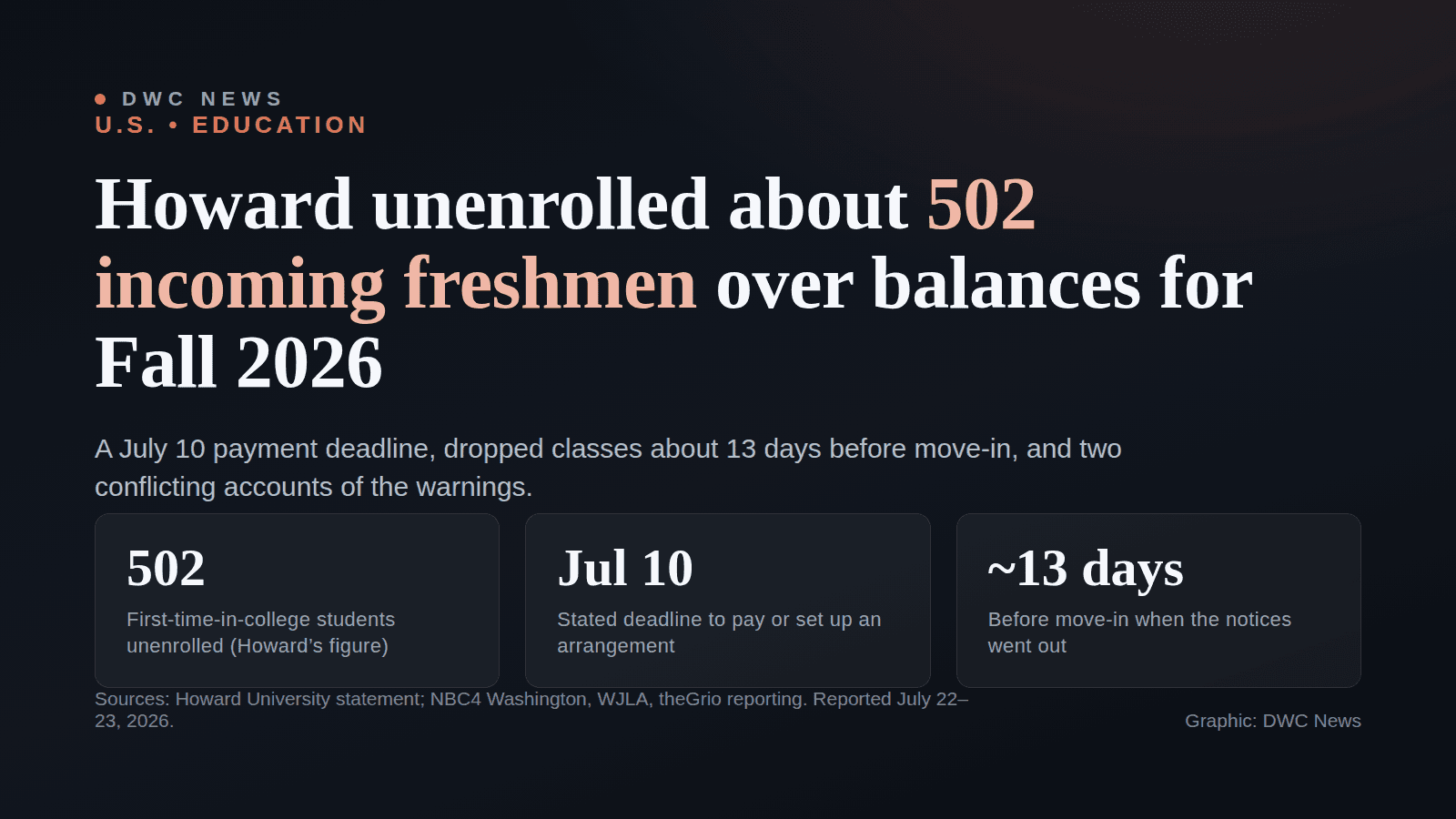
Howard emailed 502 first-time-in-college students on July 22 that they had been dropped from Fall 2026 classes over unpaid balances — about 13 days before move-in. Howard says it warned families since March; students say aid should have covered them and the guidance conflicted.

By David Weaver
Publisher & Editor
Published July 23, 2026, 8:13 PM ET
If a school ever drops your classes over a balance, the clock starts the moment you read the email — and the first hour you spend confirming your status, saving screenshots, and calling the right office in the right order matters more than the panic. That is the situation about 502 incoming Howard University freshmen woke up to this week, and it is one that lands on students at many schools every enrollment cycle. Below is what happened at Howard, both sides of the dispute, and a step-by-step checklist you can use whether or not you go to Howard.
What Howard did
On July 22, 2026, Howard University emailed incoming students that they had been unenrolled from their Fall 2026 classes and marked inactive — roughly 13 days before move-in. Early coverage described the group as "dozens" to "hundreds," but Howard’s on-record figure is 502 first-time-in-college students "whose accounts did not reflect the required enrollment and financial obligations by the previously communicated deadlines," according to the university’s own statement. That number is important: it is incoming freshmen, not the entire student body.
The stated trigger was a July 10, 2026 deadline to pay a balance or set up a payment arrangement to "secure enrollment." Several students showed NBC4 Washington copies of an email saying they had missed that deadline and, as a result, lost their place in the freshman class.
The dispute — both sides
This is where the two accounts diverge, and both deserve to be reported as what they are.
The students’ account. Students told theGrio and other outlets that a balance should not have triggered removal, because they believed their financial aid, grants and scholarships covered tuition — some said they had submitted scholarship documentation and still got the notice — and that the deadline guidance they received conflicted. Some students reported that after being unenrolled they could no longer see their aid statements in the portal, with figures "zeroed out."
Howard’s account. The university says it did not spring this without warning. In its statement, Howard says it sent repeated communications from March through July — emails, personalized financial-aid information, videos, and "Bison Prep" sessions — laying out the steps needed to secure enrollment. In Howard’s telling, the July 10 deadline was communicated in advance and the unenrollment followed from accounts that were not settled by it.
Present these as competing accounts, not a settled fact: as of publication, the core factual dispute — whether the guidance students received actually conflicted, and whether documented aid should have held their seats — has not been independently resolved.
What Howard says happens next
Howard’s statement acknowledged the update is "difficult and disappointing" and said it will review students with pending or anticipated scholarships and financial aid and "consider relevant circumstances" — language that implies at least some cases may be reinstated. Readers should verify that wording directly against Howard’s statement; we are summarizing it, not quoting policy.
Two widely circulated details need caution:
- The "transfer" instruction. NBC4 and WJLA reported that affected students were encouraged to consider applying as a transfer student in the future. That is a reported instruction, not a clearly settled policy path — get any such direction in writing before acting on it.
- The "$5,000" figure. Students told theGrio that the Financial Aid Office and Bursar had assured them that as long as a balance was under $5,000 they could register and pay later. Treat that as a student account of what they were told — it is not a confirmed Howard threshold, and no official policy setting $5,000 as a cutoff has been published.
There is no publicly confirmed formal appeal deadline or reinstatement process specific to this incident. If you are affected, the honest answer to "what is the process?" is: ask the offices directly, in writing, and document what they tell you.
The billing-system backdrop — and why this rhymes with 2025
Reporting ties the billing problems to Howard’s migration from its old student system, BisonWeb, to BisonHub, built on Workday. That matters because it is not the first time the switch has produced surprise balances.
In late July 2025, roughly 1,000 Howard students discovered unexpected unpaid balances — some dating back years — after the same platform change, and many crowdsourced money to cover them, as Inside Higher Ed documented. The university said then that the charges were not new but had been delayed in posting during the system transition. A year later, billing tied to the same system is again at the center of a Howard financial-aid crisis — which is exactly why the durable lesson here outlives this one news cycle.
If you’re ever dropped for a balance: a checklist
The single most useful thing you can do is act methodically instead of frantically. Confirm your exact status and balance and screenshot everything before access changes; read the notice for the precise deadline and amount; gather every aid letter and a dated record of every call; then contact the offices in order — Student Financial Services / Bursar first, then Financial Aid, then the Registrar, and Admissions only if you are explicitly directed to a transfer or readmission path. The interactive checklist below walks through it step by step and links Howard’s official offices, and it works for a balance or hold at any school.
If You Were Dropped for a Balance
Dropped or unenrolled for a balance or hold? A step-by-step checklist
If your classes were dropped or your enrollment was pulled over a past-due balance or a hold, work these steps in order: confirm your status, read the notice, gather your paper trail, contact the right offices in sequence, and protect your housing and aid. Written to be usable beyond any one school, with links to Howard's official offices.
This is general guidance, not official Howard University policy, and not legal or financial advice. Deadlines, dollar thresholds, and any reinstatement or appeal process are set by the school and can change — verify the current deadlines and process with the offices linked below before you act.
0 of 26 done
How this is calculated
The steps follow the standard order a bursar/financial-aid dispute moves through — verify the account of record, read the exact notice, assemble documentation, then escalate office by office — and mirror the resolution path Howard described in its own statement (reviewing pending scholarships and financial aid and 'considering relevant circumstances'). It is a procedure, not a scoring model: no dollar threshold, deadline, or reinstatement rule is asserted as policy, because those are set by each school and change. Where a step points at Howard, it links Howard's official offices so the reader confirms the current rule at the source.
Data as of July 22, 2026 · verified July 22, 2026 · v1
Assumptions, limitations & sources
Assumptions
- · The reader received a notice that their enrollment, registration, or classes were dropped/cancelled over a past-due balance or an account hold.
- · Exact deadlines, dollar thresholds, and any reinstatement or appeal process are set by the school and can change — this tool does not state them; the offices below are the authority.
Limitations
- · This is general guidance, not official Howard University policy and not legal or financial advice.
- · There is no publicly confirmed formal appeal deadline or reinstatement process specific to the July 2026 Howard incident — verify what applies to you with the offices below.
- · Contact details on the linked pages can change; confirm the current phone, email, and hours on the official page before relying on them.
- · Checklist progress is stored only in this browser tab.
Sources
- Howard University — Student Financial Services (Office of the Bursar, billing & payments) — Howard University, checked July 22, 2026
- Howard University — Student Financial Services: Important Deadlines — Howard University, checked July 22, 2026
- Howard University — Office of the Registrar (registration, holds) — Howard University, checked July 22, 2026
- Howard University Works to Support Students Facing Financial Aid and Account Challenges Ahead of Fall Semester (official statement) — Howard University, checked July 22, 2026
This is what modern SEO looks like: not just an article, but a useful resource people can return to, cite, and share. See how this newsroom is growing · See DavidWeaver's SEO packages
Questions students and parents are asking
Why was I unenrolled?
Per Howard’s statement, students were unenrolled because their accounts "did not reflect the required enrollment and financial obligations" by a communicated deadline — in practice, an unpaid balance or an account that was not settled or placed on a payment arrangement by July 10, 2026. Many students dispute that a balance should have applied to them; see below.
How many students were affected?
Howard’s official figure is 502 first-time-in-college students — incoming freshmen — per its statement. Early reports ranged from "dozens" to "hundreds." It is not the whole student body.
Can I be reinstated? Is this reversible?
Possibly, but there is no publicly confirmed formal process specific to this incident. Howard says it will review students with pending or anticipated scholarships and aid and "consider relevant circumstances," which implies some cases may be reinstated. The practical move is to contact the offices directly and ask, in writing, what triggers a reversal in your case and by when.
What was the deadline?
Howard cited a July 10, 2026 deadline to pay a balance or set up a payment arrangement to secure enrollment, per NBC4. Students say the guidance they received about deadlines conflicted; Howard says it communicated the requirements repeatedly from March through July.
Will I lose my housing and financial aid?
Unclear on the public record, and it may be handled separately from reinstatement. Some students reported losing visibility of their aid statements in the portal after being unenrolled. Do not assume: ask, in writing, whether reinstatement restores your housing assignment and your aid disbursement, and which deadlines still apply to you. We are not stating any housing-loss count as fact.
What about the "$5,000 balance is fine" guidance I was told about?
That is a student claim reported by theGrio: students say they were told that a balance under $5,000 would let them register and pay later. It is not a confirmed Howard policy or an official threshold. If you were given a specific assurance, save the exact message that said so — it is part of your paper trail.
Who should I contact?
Start with Student Financial Services / the Bursar (the office that owns your balance), then Financial Aid (to confirm pending aid and scholarships), then the Registrar (to lift a hold and re-register). Contact Admissions only if you are explicitly directed to a transfer or readmission path. Contact details on Howard’s pages can change, so confirm current phone, email, and hours on the official page: Student Financial Services and the Office of the Registrar.
Is this the same thing that happened last year?
It rhymes. In July 2025, about 1,000 Howard students hit unexpected balances after the BisonWeb-to-BisonHub switch and crowdsourced to cover them, per Inside Higher Ed. The 2026 episode centers on incoming freshmen and enrollment deadlines rather than back-dated charges, but both trace to billing tied to the same system.
The bottom line
Two things are true at once: Howard says it warned families for months and acted on a communicated deadline, and hundreds of incoming students say they believed their aid covered them and got conflicting guidance. Both accounts are on the record; the underlying dispute is not yet resolved, and this is a developing story. If you are one of the affected students — or land in the same spot at any school — the fastest path back is procedural: confirm your status, keep every record, and work the offices in order. The checklist above is built to do exactly that.
Sources
- Howard University Works to Support Students Facing Financial Aid and Account Challenges Ahead of Fall Semester (official statement) — Howard University · primary source
- Howard University students unenrolled before fall semester — NBC4 Washington
- Hundreds of Howard University freshmen unenrolled weeks before Fall semester — WJLA / ABC7
- ‘What happened to Truth and Service?’: Incoming Howard freshmen speak out after sudden unenrollment emails — theGrio
- Howard Students Crowdsource to Cover Unpaid Balances (July 2025 precedent) — Inside Higher Ed
- Howard University — Student Financial Services — Howard University