Yellowstone at peak season: the roadwork, the two bison injuries, and what the USGS actually says
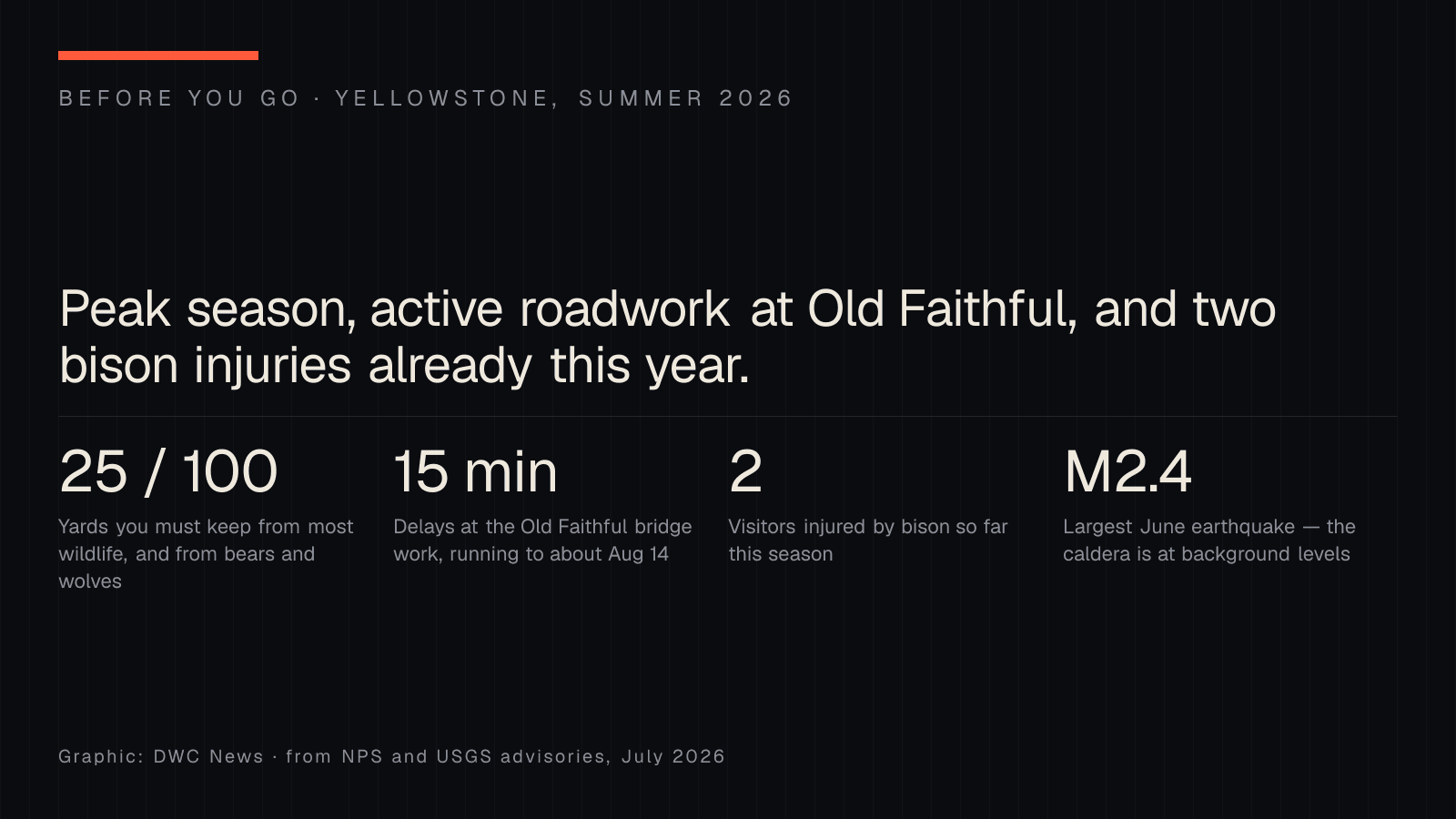
Old Faithful has active bridge work until mid-August. Two visitors have been injured by bison this season. And the caldera everyone worries about is sitting at background levels, with the largest June earthquake at magnitude 2.4.

By David Weaver
Publisher & Editor
Published July 25, 2026, 1:40 PM ET
Yellowstone is in the thick of its busiest weeks, and if you are going in the next month there are four things worth knowing before you reach the gate — three practical, one that people worry about far more than the data justifies.
What is affecting the park right now
Bridge preservation work at the Old Faithful interchange and overpass started July 20 and is expected to take about four weeks, finishing around August 14. Crews work 7 a.m. to 7 p.m., with one lane closed and delays of up to 15 minutes.
That is the kind of delay that is trivial if you know about it and infuriating if you planned a geyser eruption around a tight arrival time.
Beyond that, it is peak season, which means the parking at Old Faithful, Midway Geyser Basin and Grand Prismatic fills by mid-morning. Arriving before 9 a.m. or after 4 p.m. is the single biggest lever you have on the quality of the day.
Two bison injuries, and the rule both broke
The park has reported two visitors injured by bison this season:
- June 26 — a 12-year-old, near Mud Volcano just north of Fishing Bridge.
- July 10 — a 65-year-old at Bridge Bay Campground, who was thrown roughly eight feet in the air and suffered multiple broken bones. He was with his grandson when the animal turned and charged.
We covered that second incident and what the distance rules actually require when it happened.
Here are the numbers, because they are the whole story:
- 25 yards (23 m) from bison, elk and all other wildlife — about two school buses.
- 100 yards (91 m) from bears and wolves — a football field.
And the rule underneath the rules, which no sign states plainly enough: if the animal reacts to you, you are already too close. A bison that stops grazing and turns its head has told you something more useful than any tape measure. Bison are faster than you — roughly three times faster over open ground — and the gap between "fine" and "gored" closes in under two seconds.
The checklist below has all of it in order of what actually hurts people.
Run Through This Before You Drive In
Yellowstone in peak season: the distance rules, the thermal rules, and what is actually closed
A pre-visit checklist for Yellowstone built around what actually goes wrong: wildlife distances, boardwalk and thermal safety, current roadwork, peak-season timing, and what the USGS says about the caldera.
Safety guidance summarised from National Park Service rules — it does not replace them, and it is not live conditions. Roads and areas close without notice; check the park's current conditions page before you travel and follow rangers and posted signs over anything you read here. The distance rules exist because people are seriously injured in Yellowstone every year.
0 of 14 done
How this is calculated
Safety distances and thermal-area rules are the National Park Service's published regulations for Yellowstone, not general advice. Construction dates and delay estimates are those the park published for the current work. Volcanic status is taken from the USGS Yellowstone Volcano Observatory's monthly update rather than from secondary coverage. Incident references are to injuries the park itself reported this season, and are included because they show which rule gets broken, not for detail. Nothing here reports live conditions — road status and closures change daily and the park's own conditions page is the only current source.
Data as of July 24, 2026 · verified July 24, 2026 · v1
Assumptions, limitations & sources
Assumptions
- · Rules and distances are the National Park Service's published requirements for Yellowstone as of July 2026.
- · Construction timing is the park's published estimate and, like all roadwork, can move.
Limitations
- · Not live conditions. Roads, entrances and facilities close at short notice for weather, wildlife and incidents — check the park's current conditions page the morning you travel.
- · Distances are minimums, not targets. An animal that reacts to you is already too close regardless of how far away you technically are.
- · This covers the visit, not the drive to it. Regional highway conditions and gateway-town lodging are outside its scope.
- · Volcanic status is a monthly summary. The observatory is the authority and updates continuously.
Sources
- Top 10 things to know about visiting Yellowstone during the 2026 summer season — National Park Service, checked July 24, 2026
- Yellowstone current conditions — roads, closures and alerts — National Park Service, checked July 24, 2026
- Yellowstone visitor injured by bison encounter — National Park Service, checked July 24, 2026
- Yellowstone Volcano Observatory monthly update — U.S. Geological Survey, checked July 24, 2026
This is what modern SEO looks like: not just an article, but a useful resource people can return to, cite, and share. See how this newsroom is growing · See DavidWeaver's SEO packages
The boardwalk rule is the one that kills
Wildlife injuries make the news. Thermal injuries end differently.
In a thermal area the ground is a thin crust over water well above boiling, and it does not look different from the ground beside it. That is the entire hazard: the surface gives no warning. Stay on the boardwalks and marked trails, every time, including for a photograph, including for a dropped phone, including — and this is the one that recurs — if a pet gets loose.
On June 13, 2026, a small hydrothermal explosion occurred at Biscuit Basin. Those are steam events in the shallow plumbing rather than volcanic eruptions, and they are precisely why the boardwalk exists.
The volcano, answered by the people who monitor it
This is the search everyone is too embarrassed to admit they ran, so: the Yellowstone caldera is at background activity levels.
From the USGS Yellowstone Volcano Observatory's most recent monthly update:
- 118 located earthquakes in June, the largest magnitude 2.4. For scale, most people cannot feel anything below about magnitude 3.
- No significant uplift or subsidence of the caldera or the north caldera rim since January 2026.
That is a quiet volcano, continuously monitored, publishing its own data for free. The reason it does not feel that way is that Yellowstone eruption content is a durable engagement business, and a thumbnail asking whether the supervolcano is about to blow will always outperform a table of magnitude-2 earthquakes.
Get your status from the observatory. It updates continuously and it does not need your click.
The questions readers are asking
Is Yellowstone open right now? Yes, in peak summer operation, with lane closures at the Old Faithful interchange until roughly August 14. Roads and areas do close at short notice — check the park's current conditions page the morning you travel.
How close can I get to a bison? 25 yards, minimum, and further if it notices you. Two people have been injured this season by getting closer than that.
How close can I get to a bear? 100 yards. Different rule, bigger number.
Is the Yellowstone volcano going to erupt? Not on any evidence available. The USGS has it at background levels with no significant ground deformation since January.
What was the Biscuit Basin explosion? A small hydrothermal explosion on June 13, 2026 — a steam event, not volcanic activity.
When is the best time to arrive? Before 9 a.m. or after 4 p.m. if you want parking at the popular basins.
Do I need bear spray? If you are walking any trail, yes — and carry it where you can reach it in two seconds, not in a pack.
Is there mobile signal? Assume not. Coverage is absent across much of the park; download maps before you enter.
The short version
The things most likely to affect your visit are a 15-minute lane closure and a full car park. The things most likely to hurt you are 25 yards and a boardwalk. The thing you are worried about is having a very quiet month.
Sources
- Top 10 things to know about visiting Yellowstone during the 2026 summer season — National Park Service · primary source
- Yellowstone current conditions — roads, closures and alerts — National Park Service · primary source
- Yellowstone visitor injured by bison encounter — National Park Service · primary source
- Yellowstone Volcano Observatory monthly update — U.S. Geological Survey · primary source
- Tourist seriously injured after Yellowstone bison launches man eight feet in the air — Cowboy State Daily