Thousands of Marines return to Okinawa after a six-month Iran war deployment
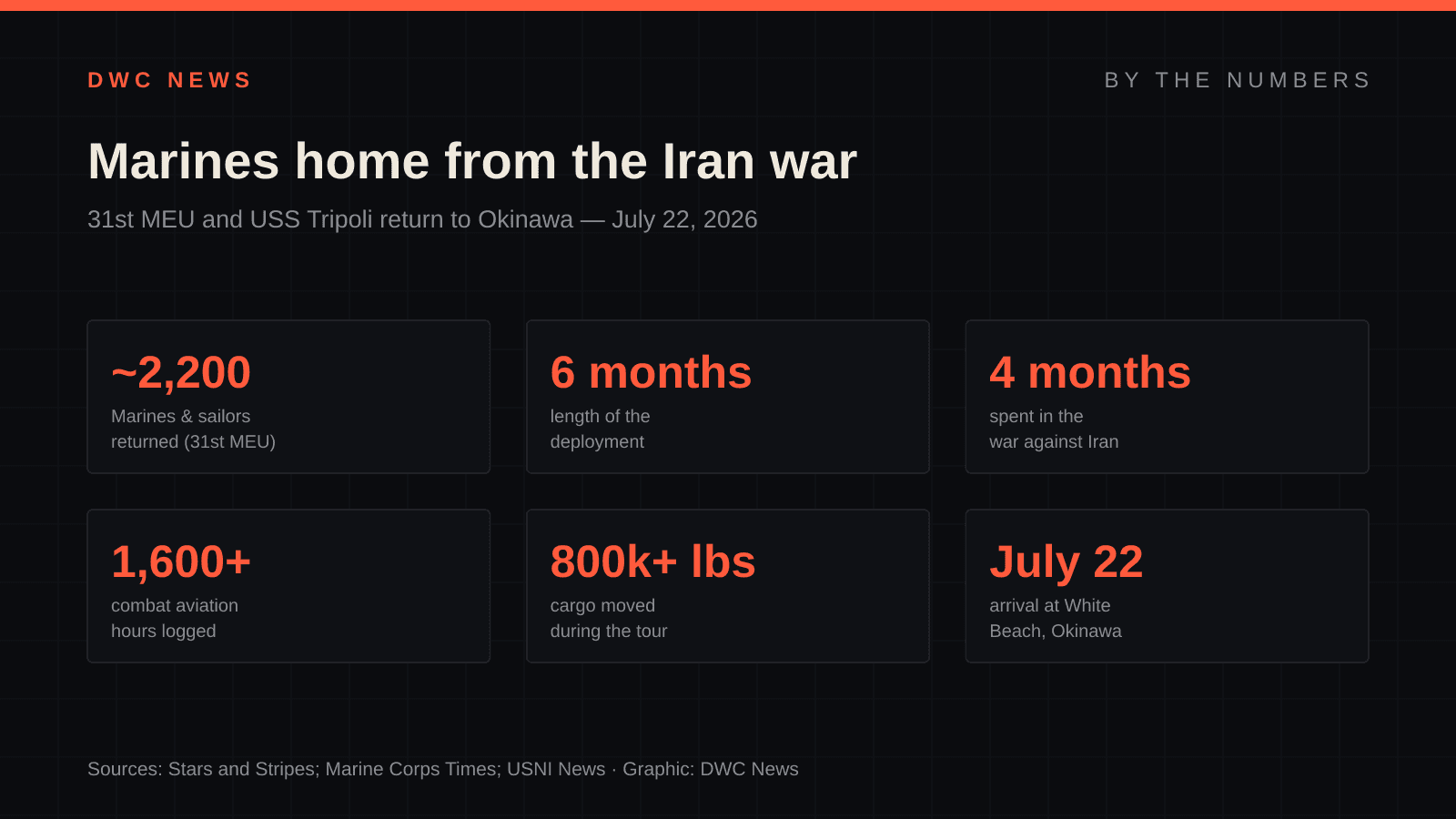
The amphibious assault ship USS Tripoli and about 2,200 Marines of the 31st Marine Expeditionary Unit returned to Okinawa on July 22, closing a six-month deployment — four months of it in Operation Epic Fury, the U.S. war against Iran. What they did, and why the war isn't over.

By David Weaver
Publisher & Editor
Published July 22, 2026, 10:00 AM ET
After six months at sea — four of them supporting a war with Iran — the Marines of Okinawa's 31st Marine Expeditionary Unit came home this week.
The amphibious assault ship USS Tripoli (LHA-7) pulled into White Beach Naval Facility on Okinawa on Wednesday, July 22, and began offloading its roughly 2,200 Marines and sailors, according to Stars and Stripes and Marine Corps Times. The return closes a deployment that began as a routine Western Pacific patrol in the spring and turned into a combat tour in the Middle East.
Who came home
The 31st MEU is the U.S. military's only permanently forward-deployed Marine expeditionary unit — a roughly 2,200-person, sea-based force built to respond to crises across the Indo-Pacific on short notice. It is based on Okinawa; the Tripoli is homeported in Sasebo, Japan.
In mid-March, the unit and its Amphibious Ready Group — the Tripoli and the transport dock USS New Orleans (LPD-18) among them — pivoted from that Pacific patrol toward U.S. Central Command after Defense Secretary Pete Hegseth approved a request for additional forces, per USNI News. The group reached Middle East waters on March 28.
What they did
Under Central Command, the Tripoli group spent about four months in Operation Epic Fury, the code name for the U.S. war against Iran. According to Stars and Stripes, the group:
- helped enforce the U.S. naval blockade of Iranian ports,
- carried out precision strikes,
- refueled hundreds of aircraft,
- logged more than 1,600 hours of combat aviation missions, and
- moved more than 800,000 pounds of cargo.
Those are the figures the Marine Corps and Navy have released about the deployment. The services did not publish a unit-level casualty breakdown for the returning Marines, and this article does not assume one.
How This Deployment Unfolded
The 31st MEU's Iran war deployment: a timeline
A dated, sourced timeline of the 31st Marine Expeditionary Unit's six-month deployment — from the start of the 2026 Iran war to the unit's July 22 return to Okinawa.
This is a fast-moving military situation. Dates, figures and status reflect official statements and reporting as of the dates shown and may have changed. Casualty totals are attributed to Pentagon data as of April 8, 2026; no unit-level breakdown for the returning Marines has been released.
Feb. 28, 2026
The U.S. and Israel open the war on Iran
Operation Epic Fury begins. U.S. and Israeli forces strike more than 1,000 sites across Iran in the first 24 hours, according to U.S. Central Command. News accounts and reference works reported that Iran's supreme leader and other senior officials were killed. Iran retaliated with drones and missiles and moved to close the Strait of Hormuz.
Source ↗March 13, 2026
Pacific-based Marines are ordered to the Middle East
Defense Secretary Pete Hegseth approves a Central Command request to send the USS Tripoli and about 2,200 Marines of the 31st MEU — the only permanently forward-deployed Marine unit in the Indo-Pacific — from the Pacific toward the Iran fight.
Source ↗March 28, 2026
The Tripoli group reaches Central Command waters
The USS Tripoli and the embarked 31st Marine Expeditionary Unit arrive in the U.S. 5th Fleet area of operations after pivoting from a routine Western Pacific patrol.
Source ↗April 8, 2026
A Pakistan-brokered ceasefire — and a casualty count
A two-week ceasefire mediated by Pakistan takes effect. Pentagon data reported the same day put U.S. losses at 13 service members killed and at least 346 wounded in action — including 19 Marines.
Source ↗April 13, 2026
The U.S. imposes a naval blockade of Iran
After talks in Islamabad fail to end the war, the U.S. begins a naval blockade of Iranian ports. Amphibious forces, including the Tripoli group, help enforce it along the Strait of Hormuz.
Source ↗June 17, 2026
A 14-point U.S.-Iran agreement, and a reopening
The U.S. and Iran sign a 14-point memorandum of understanding after two months of stalled negotiations, and commercial traffic starts returning to the Strait of Hormuz.
Source ↗July 14, 2026
The deal breaks down and the blockade returns
With the agreement collapsed, the U.S. reinstates its blockade of Iranian ports and coastline. Central Command forces disable an oil tanker days later, and Strait of Hormuz traffic falls to a new low.
Source ↗July 22, 2026
The Marines come home to Okinawa
The USS Tripoli pulls into White Beach Naval Facility on Okinawa and offloads the 31st MEU, ending a six-month deployment that logged more than 1,600 combat aviation hours and moved over 800,000 pounds of cargo, per Stars and Stripes. The war it left behind is still going.
Source ↗
How this is calculated
Events are ordered by date and drawn from official statements (U.S. Central Command, the Pentagon) and reporting by military and general-interest outlets. Each event carries its own source link and a status flag. This is a reference timeline — it performs no calculation and makes no prediction.
Data as of July 21, 2026 · verified July 21, 2026 · v1
Assumptions, limitations & sources
Assumptions
- · Dates reflect the public record and official announcements as of the data date.
- · Figures cited within events reflect the point in time when they were reported and are attributed to their source.
Limitations
- · This is a fast-moving military situation; the status of the blockade, the ceasefire, and troop movements can change quickly.
- · Casualty totals are attributed to Pentagon data as of April 8, 2026; no unit-level casualty breakdown for the returning 31st MEU has been publicly released.
- · Some reports differ on the exact composition of the Amphibious Ready Group; only consistently confirmed ships and figures are used here.
Sources
- Stars and Stripes — USS Tripoli drops off Okinawa-based Marines following return from Iran war — Stars and Stripes, checked July 21, 2026
- USNI News — USS Tripoli, 31st MEU heading to the Middle East — USNI News, checked July 21, 2026
- Military Times — USS Tripoli, embarked 31st MEU arrive in Middle East — Military Times, checked July 21, 2026
- Military Times — Pentagon data: 13 US troops killed, 346 wounded in Operation Epic Fury — Military Times, checked July 21, 2026
- USNI News — U.S. disables ship a day into blockade; Strait of Hormuz transits hit low — USNI News, checked July 21, 2026
- ABC News — How the US-Iran ceasefire and MOU broke down: a timeline — ABC News, checked July 21, 2026
- Britannica — 2026 Iran war (overview) — Encyclopaedia Britannica, checked July 21, 2026
This is what modern SEO looks like: not just an article, but a useful resource people can return to, cite, and share. See how this newsroom is growing · See DavidWeaver's SEO packages
Why they were there: the 2026 Iran war
The deployment only makes sense against the war it fed into. The 2026 Iran war began on February 28, when U.S. and Israeli forces launched Operation Epic Fury — strikes that hit more than 1,000 sites across Iran in the first 24 hours, according to U.S. Central Command. News accounts and reference works reported that the strikes killed Iran's supreme leader, Ayatollah Ali Khamenei, and other senior officials. Iran retaliated with drones and ballistic missiles and moved to close the Strait of Hormuz, the chokepoint that carries a large share of the world's seaborne oil.
The fighting has come in waves. A Pakistan-brokered ceasefire took effect on April 8. When follow-on talks in Islamabad failed, the U.S. imposed a naval blockade of Iranian ports on April 13. The two sides signed a 14-point memorandum of understanding on June 17, and traffic began returning to the strait — but that deal broke down, and the U.S. reinstated the blockade on July 14, disabling an oil tanker days later as strait traffic fell to a new low.
That is the war these Marines were part of, and it is why their homecoming is not the end of anything.
The questions readers are asking
Is the Iran war over? No. A ceasefire and the June 17 agreement both broke down, and the U.S. renewed its blockade of Iran on July 14. The homecoming marks the end of this unit's rotation, not the end of the conflict — other U.S. forces remain in the region.
Were any of these Marines killed? The Corps and Navy have not released a casualty breakdown for the returning 31st MEU. For the operation as a whole, Pentagon data reported by Military Times put U.S. losses at 13 service members killed and at least 346 wounded in action — including 19 Marines — as of April 8. Totals rose after fighting resumed in July, but a verified updated official figure was not available for this report. We are not printing an estimate as if it were a count.
What is a Marine Expeditionary Unit, and why does the 31st matter? An MEU is a self-contained force of about 2,200 Marines and sailors — infantry, aircraft and logistics — that deploys aboard Navy amphibious ships to handle crises without needing a land base. The 31st is the only one permanently forward-deployed, based on Okinawa to cover the Indo-Pacific.
Why send Pacific-based Marines all the way to the Middle East? Central Command asked for more amphibious capability, and Defense Secretary Pete Hegseth approved moving the nearest available force. That happened to be the 31st MEU, which redirected from a routine Western Pacific patrol — a reminder of how a single crisis can pull forces from the other side of the world.
Does that leave the Indo-Pacific short-handed? It is a real trade-off. Because the 31st is the only permanently forward-deployed MEU, sending it to Central Command for four months left the Pacific without its dedicated sea-based crisis force during that window — one reason its return to Okinawa is more than a symbolic homecoming.
What happens next
For the families at White Beach, the news is simple: their Marines are back. For the region, the picture is unsettled. The blockade is on again, the Strait of Hormuz is tense, and the 31st MEU is now resetting in the Indo-Pacific — the theater the Pentagon calls its top long-term priority. Whether these Marines stay home for long depends on a war that, as of July 22, no one is calling finished.
Sources
- USS Tripoli drops off Okinawa-based Marines following return from Iran war — Stars and Stripes
- Thousands of Marines, sailors back in Japan after deploying for Iran war — Marine Corps Times
- USS Tripoli, 31st MEU heading to the Middle East — USNI News
- USS Tripoli, embarked 31st MEU arrive in Middle East — Military Times
- Pentagon data: 13 US troops killed, 346 wounded in Operation Epic Fury — Military Times
- U.S. disables ship a day into blockade; Strait of Hormuz transits hit low — USNI News
- Forward-deployed U.S. Navy flattop concluding six-month mission — Forbes