Tossed 8 feet by a Yellowstone bison, a grandfather walks away with a lesson every park visitor needs
Carl Isom-McDaniel, 65, says the landing — not the launch — broke his femur in four places. The park won't punish the bull, because it was doing exactly what a 2,000-pound wild animal does in July. Here's the full story, what bison really are, and how to never be next.

By David Weaver
Publisher & Editor
Published July 21, 2026, 8:30 PM ET
Carl Isom-McDaniel remembers the flight less than the arrival. "I didn't get bruises from him launching me in the air — it was the landing that became the problem," the 65-year-old grandfather told interviewers after a bull bison hooked him with a horn and threw him roughly eight feet at Yellowstone National Park earlier this month. The landing broke his femur in four places. He had surgery, and — remarkably — was on his feet a day later, now telling his story to outlets from CBS Chicago to the BBC.
What happened at Bridge Bay
The attack came on July 10 at Bridge Bay Campground, the big lakeside campground on the northwest shore of Yellowstone Lake — one of the park's busiest, a place where tents, RVs and marina traffic sit directly inside prime summer bison range. The Lake area's open meadows draw bulls in July as the breeding season spins up, and this bull had reportedly already charged a group of teenagers before Isom-McDaniel and his 13-year-old grandson crossed its path while walking through the campground.
The grandson stopped to take a picture. By Isom-McDaniel's own account, the animal looked calm — "he was down, he wasn't showing aggression or anything like that." Video showed the bull taking a dust bath in the moments before it rose and charged. That detail matters more than it seems: a wallowing, apparently relaxed bison can go from zero to a full charge in seconds, and "it looked calm" is the sentence that precedes most bison injuries.
Why the park is not punishing the bison
Yellowstone officials announced they would take no management action — no relocation, no euthanization — against the bull, as Cowboy State Daily and others reported. The reasoning: given the distances involved, the animal was displaying natural behavior for the season. July and August are the bison rut, when mature bulls run on hormones and hair triggers and can be set off by the smallest disruption. In the park's calculus, a wild animal behaving like a wild animal inside its own habitat is not a problem animal — and the National Park Service notes that bison injure more Yellowstone visitors than any other animal, precisely because people misread them.
What 2,000 pounds actually means
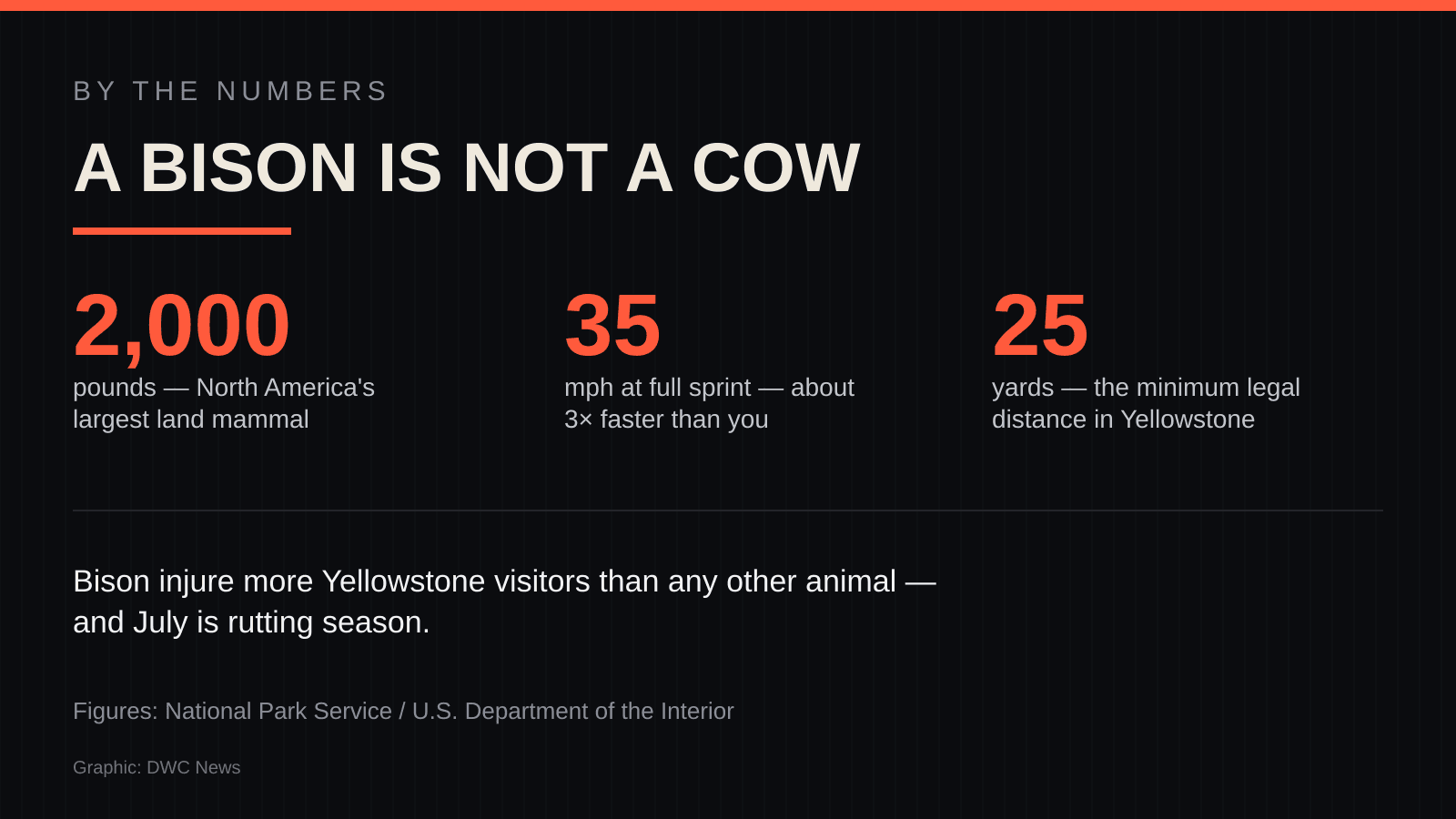
A mature bull is North America's largest land mammal — up to about 2,000 pounds and six feet at the shoulder hump, per the National Park Service — yet it sprints at up to 35 mph. The fastest human being who has ever lived topped out around 27. A bison covers 25 yards — the park's entire legal buffer — in about a second and a half. It can spin on its front hooves like an animal a tenth its size, clear a standard fence, and swim a river in flood. The hump that makes it look slow is a mass of muscle that lets it plow snow with its face. Nothing about a bison's shape is honest about what it can do, which is exactly why the calm ones fool people.
16 things most people don't know about bison
- Yellowstone's herd is the only one in America that has lived wild and continuously in one place since prehistoric times — every other herd was reintroduced.
- Tens of millions once roamed the continent; by the early 1900s, fewer than two dozen wild bison remained in Yellowstone. Every park bison today descends from that brink.
- The bison has been the official national mammal of the United States since 2016.
- Calves are born orange-red and are nicknamed "red dogs."
- A bison's tail is a mood gauge: hanging loose means calm; raised straight up often means a charge is coming, per the Interior Department.
- The "dust bath" Isom-McDaniel's bull was taking is called wallowing — bison roll in dirt to shed insects, loose fur, and, in rut, to advertise themselves.
- Despite the bulk, bison can jump close to their own height and are strong swimmers.
- They have poor eyesight but excellent smell and hearing — another reason surprising one at close range goes badly.
- Bulls in rut bellow so loudly the sound carries for great distances across a valley.
- In winter, bison face into storms rather than drifting away from them — one of the few large animals that does.
- Wild bison typically live 10 to 20 years.
- "Buffalo" is a centuries-old misnomer — true buffalo live in Africa and Asia; the American animal is bison, though even the Park Service uses both words.
- Roughly 500,000 bison exist in North America today, but the vast majority live in commercial herds; only a small fraction are in conservation herds like Yellowstone's roughly 5,000.
- Bison are ecosystem engineers: their grazing, wallows and even their carcasses shape prairie plant and animal life, which is why prairie restorations almost always start with bison.
- Yellowstone bison are so central to conservation history that the first federal bison restoration herds (1907) were stocked partly from lineages tied to the park's survivors.
- Every year, the animal responsible for the most visitor injuries in Yellowstone is not the grizzly or the wolf. It is this one — the one tourists walk up to.
Find Wild Bison Near You
Where to see bison in the U.S. — search public herds by state
Every major publicly viewable bison herd in the United States — national parks, refuges, state parks and preserves — searchable by state or place name, with who manages each herd and what it's known for.
| Yellowstone National Park | WY / MT / ID | National Park Service | America's only continuously wild herd since prehistoric times — roughly 5,000 animals, varying by year (NPS) |
| Wind Cave National Park | SD | National Park Service | One of the oldest genetically important conservation herds |
| Badlands National Park | SD | National Park Service | Free-roaming herd across mixed-grass prairie |
| Theodore Roosevelt National Park | ND | National Park Service | Herds in both park units; easy roadside viewing |
| Grand Canyon National Park (North Rim) | AZ | National Park Service | The Kaibab Plateau herd |
| Custer State Park | SD | South Dakota GFP | The famous annual Buffalo Roundup; one of the largest publicly owned herds |
| Antelope Island State Park | UT | Utah State Parks | Island herd in the Great Salt Lake; annual roundup |
| Henry Mountains | UT | BLM / Utah DWR | One of the few free-roaming, genetically pure wild herds outside a park |
| Bison Range | MT | Confederated Salish & Kootenai Tribes | Historic range restored to tribal management in 2022 |
| National Bison Refuges (Fort Niobrara) | NE | U.S. Fish & Wildlife Service | Century-old refuge herd on the Niobrara River |
| Wichita Mountains Wildlife Refuge | OK | U.S. Fish & Wildlife Service | Founding herd of the 1907 bison restoration |
| Tallgrass Prairie Preserve | OK | The Nature Conservancy | Large herd on the biggest protected tallgrass prairie left |
| Caprock Canyons State Park | TX | Texas Parks & Wildlife | The official Texas State Bison Herd — descendants of the Goodnight herd |
| Neal Smith National Wildlife Refuge | IA | U.S. Fish & Wildlife Service | Reconstructed prairie herd near Des Moines |
| Rocky Mountain Arsenal NWR | CO | U.S. Fish & Wildlife Service | Bison minutes from downtown Denver |
| American Prairie | MT | American Prairie (nonprofit) | Growing herd on a rewilded shortgrass prairie |
How this is calculated
The list covers established, publicly accessible conservation herds managed by the National Park Service, U.S. Fish & Wildlife Service, tribal nations, states, and conservation nonprofits. The approximate figure shown for Yellowstone comes from NPS reporting and varies by season and year; other herd sizes change often enough that we describe rather than count. Always check the destination's own site before a trip.
Data as of July 20, 2026 · verified July 20, 2026 · v1
Assumptions, limitations & sources
Assumptions
- · Herds listed remain publicly viewable under each manager's current rules.
Limitations
- · Not exhaustive — smaller municipal and private-ranch herds are excluded.
- · Viewing rules and distances differ by site; Yellowstone's 25-yard rule is the minimum standard to assume everywhere.
Sources
- NPS — Yellowstone bison — National Park Service, checked July 20, 2026
- U.S. Department of the Interior — facts about the American bison — U.S. Department of the Interior, checked July 20, 2026
This is what modern SEO looks like: not just an article, but a useful resource people can return to, cite, and share. See how this newsroom is growing · See DavidWeaver's SEO packages
How to behave around bison — the short course
The National Park Service's rules are simple, and every one of them exists because someone learned it the hard way:
- Stay at least 25 yards (23 meters) from bison and elk — 100 yards from bears and wolves. If an animal approaches you, back away and keep the distance.
- Watch the warning signs: pawing the ground, head shaking, snorting, a raised tail. Any of these means you are already too close — leave now, calmly, without turning your back at a sprint.
- The photo is never worth it. Use zoom. If the animal fills your phone's frame without zoom, you are inside its decision radius.
- Give wallowing or resting bison extra room. Calm-looking is not calm.
- In July and August, double your caution — rutting bulls charge with little warning, and the park itself says so.
- In campgrounds and trails, yield the space — walk around, wait, or turn back. Bison have the right of way everywhere in the park, legally and physically.
The takeaway
Isom-McDaniel has been notably good-humored about the worst vacation moment of his life, and the park's decision underlines the real lesson: nothing went wrong with the bison. The system in Yellowstone is working exactly as designed — the animals are wild, the people are guests, and 25 yards is not a suggestion. He gets to tell his grandson the story for the rest of his life. The next visitor may not land as luckily.
Sources
- NPS — Yellowstone bison (biology and safety guidance) — National Park Service · primary source
- CNN — grandfather recovering after bison attack — CNN
- BBC — Yellowstone bison attack report — BBC News
- Anchorage Daily News — 'hitting the ground was the worst part' — Anchorage Daily News / Washington Post
- CBS Chicago — grandfather speaks out (video interview) — CBS News Chicago
- Cowboy State Daily — park will take no action against the bison — Cowboy State Daily
- U.S. Department of the Interior — facts about the American bison — U.S. Department of the Interior