Costco will pay $14 million over its marketing emails — and claims close on August 24
A Washington class action over allegedly misleading subject lines ended in a $14 million settlement. No proof of purchase is needed to file, but the eligibility test is narrower than 'I shop at Costco' — and the deadline is real.

By David Weaver
Publisher & Editor
Published July 25, 2026, 12:20 PM ET
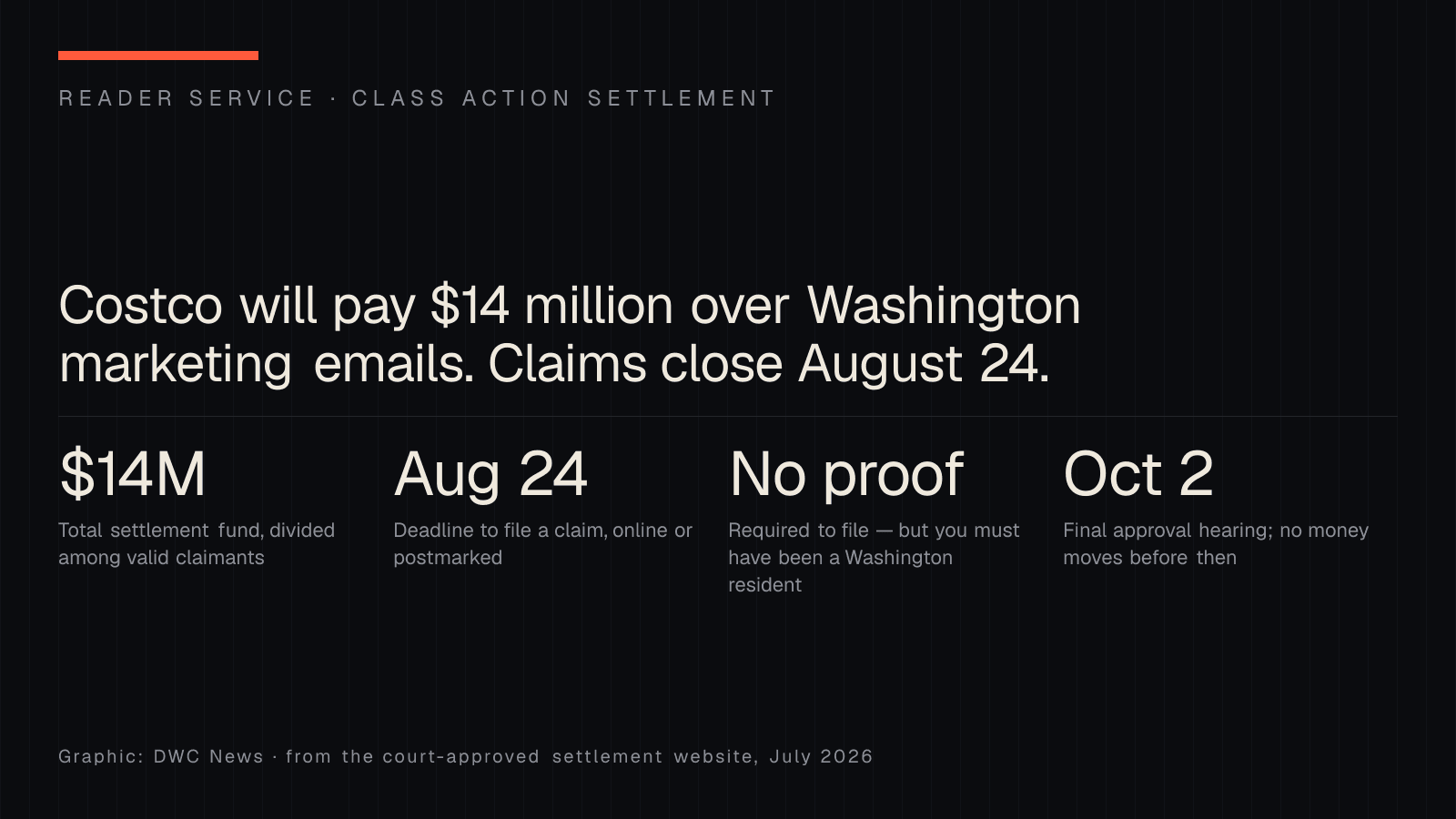
Costco has agreed to pay $14 million to settle a Washington class action alleging that its promotional emails carried misleading subject lines. If you lived in Washington and got marketing email from Costco in the past five years, you may be owed money — and you have until August 24, 2026 to ask for it.
Two sentences of caution before the details, because settlement coverage tends to skip both.
The test is not "do I shop at Costco." It is narrower and specific, and being a member has nothing to do with it.
Nobody can tell you what you will be paid. There is no fixed per-person amount, and any figure you see quoted as "your payout" is invented.
The tool below walks the actual eligibility test. First, what the case is.
What the lawsuit was about
The case is Aaland v. Costco Wholesale Corp., No. 25-2-16392-0, in King County Superior Court in Washington.
The allegation concerns subject lines — that Costco's promotional emails described their contents in ways the plaintiffs said were misleading. Washington has an unusually strong commercial email statute, which is why a case like this gets filed there and not somewhere else.
Costco has not admitted wrongdoing. Settlements resolve claims; they are not findings of liability, and this one should not be read as a court concluding the company did anything unlawful.
Who actually qualifies
The certified class is defined as everyone who:
received a commercial electronic mail message, and who were Washington residents at the time of the receipt of such commercial electronic mail message, that was transmitted by Costco Wholesale Corporation or someone acting on behalf of Costco Wholesale Corporation at any time from June 2, 2021, through July 7, 2026.
Unpack that and there are three tests, all of which must be true:
- You received a commercial email from Costco or from someone acting for it.
- You were a Washington resident at the time you received it — not now, and not where the warehouse is. If you moved into or out of the state during the period, what matters is where you were living when each email arrived.
- It arrived inside the window, June 2, 2021 through July 7, 2026.
Then a fourth thing that is not eligibility but decides everything anyway: you have to file by August 24, 2026.
The checker below runs those tests. It is deliberately cautious — if you answer "not sure" to anything, it tells you to go and check rather than guessing, because a claim form is signed under penalty of perjury.
Check Whether You Can Actually Claim
Costco Washington email settlement: check whether you qualify before the August 24 deadline
Five questions drawn from the certified class definition in the $14 million Costco Washington commercial email settlement, so you can tell whether you are covered and whether you can still file.
Uses: Were you living in Washington state when you received the Costco emails? · Did you receive promotional or marketing emails from Costco? · Did any of those emails arrive between June 2, 2021 and July 7, 2026? · Have you asked to be excluded from (opted out of) this settlement? · Can you submit a claim by August 24, 2026?
Not legal advice. This checks your answers against the published class definition; it cannot decide a claim, and only the settlement administrator and the court can. There is no guaranteed payment amount — the fund is split among valid claims, so the per-person figure depends on how many people file. File free through the court-approved website at washingtoncommercialemailsettlement.com, and never pay a third party to file for you. Confirm the deadline on the official site before relying on any date you read elsewhere.
Example — adjust the inputs above for your situation
You appear to qualify — file by August 24, 2026 to be paid.
Every requirement in the class definition looks met. Claims require no proof of purchase and no documentation of the emails, and the $14 million fund is divided pro rata among everyone who files a valid, timely claim — so the per-person amount depends entirely on how many people do. Nothing is paid until after the final approval hearing on October 2, 2026, and payment can be delayed further by appeals. File through the court-approved settlement website, never through a third party asking for a fee.
- You were a Washington resident when you received the email
- Met
- You received a commercial email from Costco, or from someone acting for Costco
- Met
- The email arrived between June 2, 2021 and July 7, 2026
- Met
- You have not opted out of, or been excluded from, the settlement class
- Met
- You can file by the August 24, 2026 deadline
- Met
How this is calculated
The questions are the elements of the certified class definition in Aaland v. Costco Wholesale Corp., taken together with the court's deadlines. The class covers anyone who received a commercial email transmitted by Costco or on its behalf while a Washington resident, at any time from June 2, 2021 through July 7, 2026. Every element must be satisfied, so any single 'no' produces an unlikely verdict; any 'not sure' produces a 'depends' verdict rather than a guess, because a claim form is signed under penalty of perjury. The deadline question is a separate gate: eligibility and timeliness are different things, and missing the second makes the first irrelevant.
Data as of July 24, 2026 · verified July 24, 2026 · v1
Assumptions, limitations & sources
Assumptions
- · The class definition and deadlines are those published on the court-approved settlement website as of July 25, 2026.
- · 'Washington resident' is assessed at the time each email was received, which is how the class definition frames it.
Limitations
- · Not legal advice. This tool cannot decide a claim — only the settlement administrator and the court can, and their determination controls.
- · Preliminary approval is not final approval. The final approval hearing is set for October 2, 2026, no money is distributed before then, and appeals can delay payment further.
- · There is no fixed per-person amount. The fund is divided pro rata after fees, expenses and any service award, so the payment depends on how many valid claims are filed — anyone quoting you a specific dollar figure is guessing.
- · Deadlines in class actions move occasionally and without much notice. Confirm the current date on the official settlement website before relying on it.
- · Never pay anyone to file a claim for you. Filing is free through the court-approved website.
Sources
- Washington Commercial Email Settlement — official court-approved settlement website — Settlement Administrator, Aaland v. Costco Wholesale Corp., checked July 24, 2026
- Case documents — class definition, deadlines and notice — Settlement Administrator, Aaland v. Costco Wholesale Corp., checked July 24, 2026
- $14M Costco settlement resolves class action over promotional email subject lines — ClassAction.org, checked July 24, 2026
- $14 million Costco settlement: who qualifies and how to file — Kiplinger, checked July 24, 2026
This is what modern SEO looks like: not just an article, but a useful resource people can return to, cite, and share. See how this newsroom is growing · See DavidWeaver's SEO packages
What it pays, honestly
Nobody knows yet, and that is not evasion — it is arithmetic.
The $14 million is a fund, not a per-person figure. Attorneys' fees, litigation expenses and a service award come out first. Whatever remains is divided pro rata among everyone who files a timely, valid claim.
That means the number moves in the opposite direction from attention: the more people who read a story like this and file, the smaller each check gets. Which is an uncomfortable thing for a news outlet to point out and true regardless.
The one thing that is unusually easy here: no proof is required. You do not need receipts, membership records, or copies of the emails. That lowers the friction dramatically compared with most consumer settlements — and it is also why the claim rate, and therefore the payment, is genuinely unpredictable.
When the money moves
Not soon. Three checkpoints:
- August 24, 2026 — claims close.
- October 2, 2026 — the final approval hearing. The settlement has preliminary approval only; the court has not yet signed off finally.
- After that — payment, unless somebody appeals, which can add months or longer.
Preliminary approval is a common point of confusion. It means the court has agreed the deal is worth notifying the class about. It does not mean the deal is final, and it does not mean anyone is getting paid this year.
The questions readers are asking
Do I need to be a Costco member? No. Membership is not part of the class definition. Receiving the email while a Washington resident is.
Do I need proof? No. No purchase records and no copies of the emails are required to file.
How much will I get? Unknown. The fund is divided among valid claims after costs. Treat any specific dollar figure you see as speculation.
What if I moved to Washington partway through the period? Then emails you received while living there may qualify and emails from before may not. The test is applied at the moment of receipt.
What if I deleted all the emails? They are not required. But you should be reasonably confident you actually received them, because you are attesting to it.
Is this a scam? The settlement is real, and the court-approved site is washingtoncommercialemailsettlement.com. The scams that surround settlements are the third-party sites that offer to file for you for a fee, and the emails and texts that ask for a bank login or a Social Security number to "release" your payment. Filing is free, and the administrator does not need your bank credentials to send a check.
Can I opt out? Yes, and it preserves your right to sue Costco separately over the same conduct. It also forfeits any payment from this fund. That trade only makes sense if you have a substantial individual claim and a lawyer telling you so.
Why Washington? The state's commercial electronic mail act gives consumers a private right of action with statutory damages, which makes cases like this viable there in a way they are not in most states.
The wider point
Settlements like this one only work if the people covered by them actually file, and most never do — claim rates in consumer class actions are routinely in the low single digits. The notice reaches an inbox, gets mistaken for spam, and the deadline passes.
If you are in Washington and got marketing email from Costco in the last five years, the whole process is a few minutes on the official site, with no documentation to dig up. The deadline is August 24.
This article is information, not legal advice. The settlement administrator and the court decide claims. Confirm all dates and details on the official settlement website before relying on them.
Sources
- Washington Commercial Email Settlement — official court-approved settlement website — Settlement Administrator, Aaland v. Costco Wholesale Corp. · primary source
- Case documents — class definition, deadlines and notice — Settlement Administrator, Aaland v. Costco Wholesale Corp. · primary source
- $14M Costco settlement resolves class action over promo emails with allegedly misleading subject lines — ClassAction.org
- $14 million Costco settlement: who qualifies, how to file a claim — Kiplinger
- Costco just settled a $14 million lawsuit over its emails — are you owed cash? — Inc.