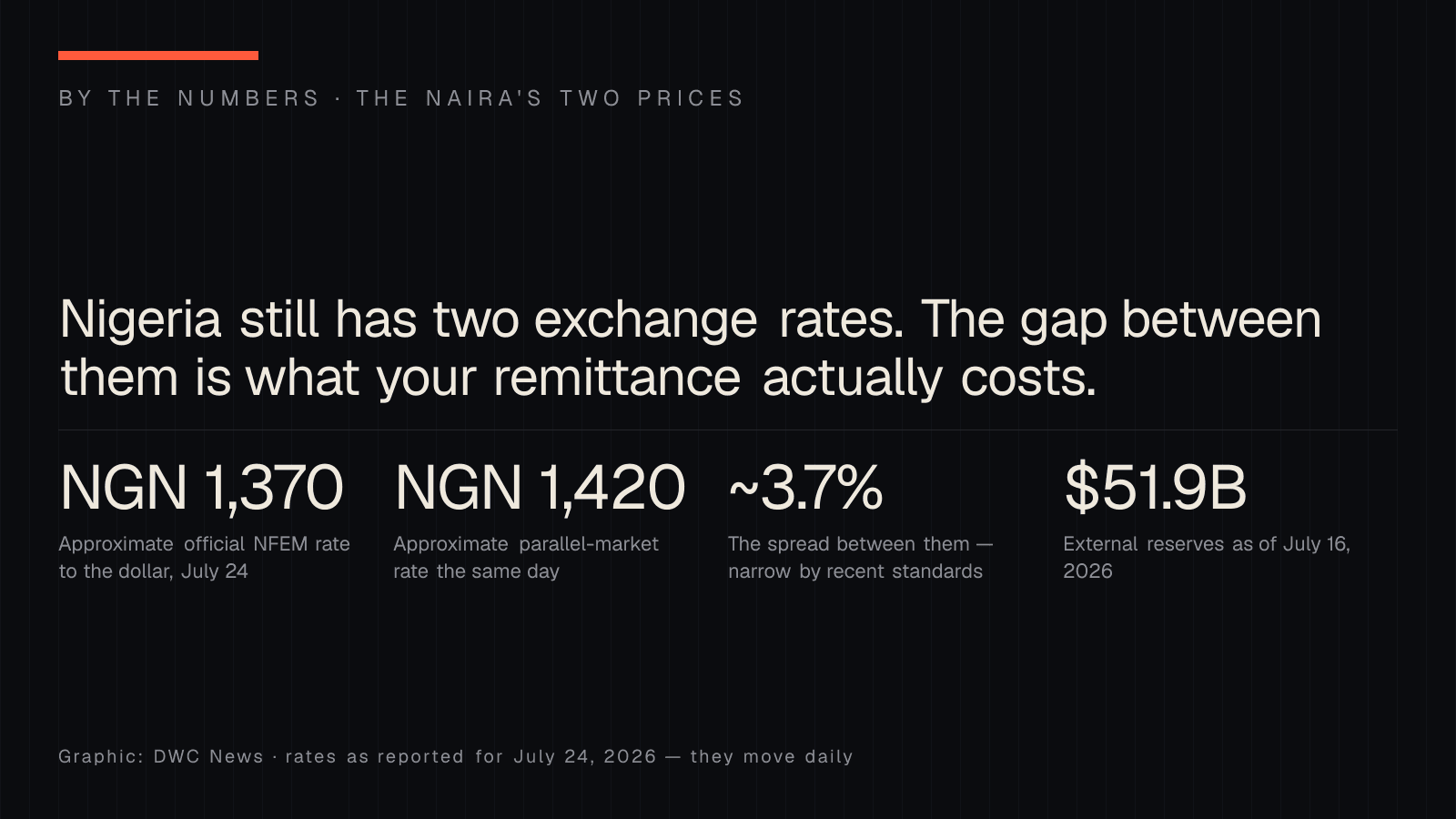
Nigeria still quotes two prices for the dollar. The gap is the quietest fee on your remittance
The naira has spent 2026 doing something it has not done in years: holding steady. Official and parallel rates have converged to a few percent apart, and reserves have climbed past $51 billion. Here is what that gap actually does to the money you send home.

By David Weaver
Publisher & Editor
Published July 24, 2026, 9:28 PM ET
If you searched "naira" this week, you were probably not looking for monetary policy. You were looking for a number — the one that tells you what the money you are about to send turns into at the other end.
Here is that number, and then here is the thing about it that most rate pages never explain: Nigeria quotes two prices for the dollar, and the gap between them usually costs more than your transfer fee does.
The rates, as of July 24, 2026
| | Naira per US dollar | | --- | --- | | Official — Nigerian Foreign Exchange Market (NFEM) | ₦1,369.92 | | Parallel market ("street" rate) | about ₦1,420 | | Spread between them | about 3.7% |
Both figures are a single day's snapshot. Nigerian FX rates move daily, and anything you read — including this — is a photograph, not a live feed.
Why a country has two exchange rates
Short version: because for years the official rate was a price the government set, and the parallel rate was the price people would actually pay.
When a central bank pegs its currency above what the market will bear, and hard currency is rationed at the official window, a second market appears for everyone who cannot get dollars at the official price. That is the parallel market. The size of the gap is a rough measure of how much the official rate is a policy statement rather than a price.
Nigeria floated the naira in 2023 and the gap has been closing since, through reforms aimed at unifying the two windows. A spread of roughly 3.7% is not convergence — it is not zero — but it is a different world from the tens of percent that were routine a few years ago. That is the actual news in "naira is trending": not a crash, but a currency that has been unusually boring in 2026.
Two other things sitting underneath the stability: external reserves rose to $51.92 billion as of July 16, 2026, extending a run of increases, and Nigerian coverage through July described the naira appreciating in the run-up to the central bank's rate decision. Reserves matter because they are the ammunition a central bank uses to defend a rate; a rising stock is why the official window has been able to hold.
What the gap does to your money
This is where the abstraction becomes a number in someone's account.
Send $500 with a 1.5% fee. The fee comes off first — $7.50 — leaving $492.50 to convert. At the official window that is about ₦674,686. At the parallel rate the same money is about ₦699,350.
The difference is roughly ₦24,664. Your fee was ₦10,000-ish worth of dollars. The spread was more than twice the fee, and nobody quoted it to you.
That is the general lesson, and it survives every rate change: the advertised fee is the part providers compete on loudly, and the exchange rate is where the rest of the margin lives. A transfer advertising "zero fees" can deliver fewer naira than one charging 2%, and the only way to tell is to compare the naira figure you are quoted, not the fee.
The calculator below does that arithmetic with your own numbers.
See What Your Dollars Turn Into
Naira remittance value: what your dollars become at Nigeria's official and parallel rates
Enter the amount you are sending and your provider's fee. This converts it at both of Nigeria's quoted dollar rates — the official NFEM window and the parallel market — and shows what the spread between them costs or gains at the other end.
Uses: Amount you are sending · Your provider's fee · Which rate to price it at
An arithmetic illustration using exchange rates reported for a single day, not a live quote, not financial advice, and not a recommendation about how to move money. Nigerian FX rates change daily and providers build margin into the rate as well as the fee — always compare the naira figure you are actually quoted before sending.
Example — adjust the inputs above for your situation
$500.00 becomes about ₦674,686 at the official NFEM window.
After a 1.5% fee ($7.50), $492.50 is actually converted. At the official NFEM window rate of ₦1,369.92 to the dollar, that is ₦674,686. The same money at the parallel market rate of ₦1,420.00 would be ₦699,350 — a difference of ₦24,664. That gap is the 3.7% spread between Nigeria's two prices for the dollar, and it is doing more work here than the fee is.
- Rate used (official NFEM window, July 24, 2026)
- ₦1,369.92 per $1
- Transfer fee
- $7.50 (1.5% of $500.00)
- Dollars actually converted
- $492.50
- Naira the recipient gets
- ₦674,686
- Same amount at the parallel market
- ₦699,350
- Difference between the two rates
- ₦24,664 (3.7% spread)
- Your effective rate after the fee
- ₦1,349.37 per $1
- ※ Rates are fixed values reported for July 24, 2026 — this tool does not read a live feed, and Nigerian FX rates move every day. Check a current quote before you send.
- ※ The fee is whatever your provider charges as a percentage. Many services advertise a low fee and take the rest in the exchange rate itself, so compare the naira figure you are quoted, not the fee.
- ※ Licensed money-transfer operators and banks settle at or near the official window. The parallel-market rate is what informal changers quote; it is not the rate a regulated transfer will normally give you.
- ※ Nothing here is financial advice or a recommendation about which channel to use.
How this is calculated
Deliberately simple arithmetic, in the order the money actually moves. The provider's percentage fee is deducted from the amount first, because fees are charged on the dollars before conversion. What remains is multiplied by the rate for the chosen basis to give the naira delivered, and again by the other basis's rate for comparison. The spread is computed as (parallel − official) ÷ official. The effective rate is the naira delivered divided by the original dollars, which is the only number that lets you compare providers honestly. Both rates are fixed constants as reported for July 24, 2026 — this tool reads no live feed and makes no forecast.
Data as of July 23, 2026 · verified July 24, 2026 · v1
Assumptions, limitations & sources
Assumptions
- · Rates are naira per US dollar as reported for July 24, 2026: ₦1,369.92 at the official NFEM window and about ₦1,420 in the parallel market.
- · The fee is charged as a percentage of the amount sent, before conversion — the most common structure, though not the only one.
- · The recipient receives the converted amount in full, with no separate receiving-side charge.
Limitations
- · These are not live rates. Nigerian FX rates move daily, and both figures here are a single day's snapshot — get a current quote before you send anything.
- · Many providers make their margin inside the exchange rate rather than in the stated fee, so a '0% fee' transfer can deliver fewer naira than a 2% one. Compare the naira figure you are quoted, not the fee.
- · Licensed money-transfer operators and banks settle at or near the official window. The parallel-market column shows what informal changers quote — it is a benchmark for understanding the gap, not a rate a regulated transfer will normally give you.
- · Not financial advice, and not a recommendation about which channel to use. Rules on FX transactions differ by country and by provider.
Sources
- Dollar to naira exchange rate today, July 24, 2026 (official and parallel quotes) — Vanguard (Nigeria), checked July 24, 2026 · Rates transcribed as reported; no averaging or adjustment applied.
- Naira extends appreciation against the US dollar (rate context and CBN backdrop) — Daily Post Nigeria, checked July 24, 2026
- Central Bank of Nigeria — official exchange rate and reserves data — Central Bank of Nigeria, checked July 24, 2026
This is what modern SEO looks like: not just an article, but a useful resource people can return to, cite, and share. See how this newsroom is growing · See DavidWeaver's SEO packages
The part that needs saying plainly
The parallel rate is higher, which means it delivers more naira. That is exactly why it exists and exactly why people ask about it.
It is also not what a regulated money-transfer operator or a bank will normally give you — those settle at or near the official window. The parallel column in the tool is there so you can read the gap and understand your quote, not as a recommendation to go looking for a street changer. Rules on foreign-exchange transactions vary, informal channels carry real counterparty risk, and this is a newsroom, not your financial adviser.
The questions readers are asking
What is the dollar to naira rate today? As of July 24, 2026: about ₦1,369.92 officially and about ₦1,420 parallel. If you are reading this later, treat those as history and check a current quote — rates move every day.
Why is the official rate lower than the street rate? Because the official window is a managed market and the parallel market is not. When dollars are scarcer than demand at the official price, a second, higher price emerges.
Which rate will I actually get? Whatever your provider quotes. Banks and licensed operators price at or near the official window; the number that matters is the naira total on your confirmation screen.
Is the naira getting stronger? Through July 2026 Nigerian outlets described it as appreciating and trading in a relatively stable range, with reserves rising. "Stronger over a few weeks" is not the same as "strong," and currency direction is not something anyone should promise you.
Is a narrow spread good news? Generally yes — it means the official rate is closer to a real market price, which reduces the incentive to route around it. A 3.7% gap is narrow by Nigeria's recent standards and wide by the standards of a freely floating currency.
Should I wait for a better rate? That is a bet on which direction the naira moves next, and nobody knows. If you need to send money for a specific bill, the timing question is usually less valuable than shopping the quote.
Why do rate sites disagree with each other? Because they sample different sources at different moments — official window, bureau de change, peer-to-peer platforms — and a currency with two markets has no single true price at any given second.
What to watch
Two things determine whether the calm holds. The first is reserves: they have been climbing, and a rising buffer is what has let the official window stay put. The second is the demand side — Nigerian coverage has flagged elevated hard- currency demand from importers and petroleum transactions as the pressure working against the trend.
If the spread starts widening again, that is the early signal, and it will show up in the gap between those two numbers before it shows up in a headline.
Sources
- Dollar to naira exchange rate today, July 24, 2026 — Vanguard (Nigeria) · primary source
- Naira extends appreciation against the US dollar, July 23, 2026 — Daily Post Nigeria
- Naira extends appreciation ahead of the CBN's interest rate decision, July 20, 2026 — Daily Post Nigeria
- Central Bank of Nigeria — official rates, reserves and policy statements — Central Bank of Nigeria · primary source
- Dollar to naira exchange rate today, July 20, 2026 — allAfrica