The Social Security email said seniors got $7,500. Here's what the tax break actually gives you.
A July 2 email from Social Security Commissioner Frank Bisignano told 35 million seniors they'd received 'an average of $7,500 in relief.' Five senators call it misleading. We checked what the new senior tax deduction actually does — and built a tool to estimate what it's worth to you.

By David Weaver
Publisher & Editor
Published July 22, 2026, 10:30 AM ET
If you are over 65, you may have received an email in early July from the Social Security Administration with an unusually cheerful subject line — "Making Life More Affordable for America's Seniors" — and an unusually political message inside. It is now the subject of a Senate inquiry, and it is worth walking through carefully, because the gap between what it said and what the law actually does is large, and it touches your money.
What the email said
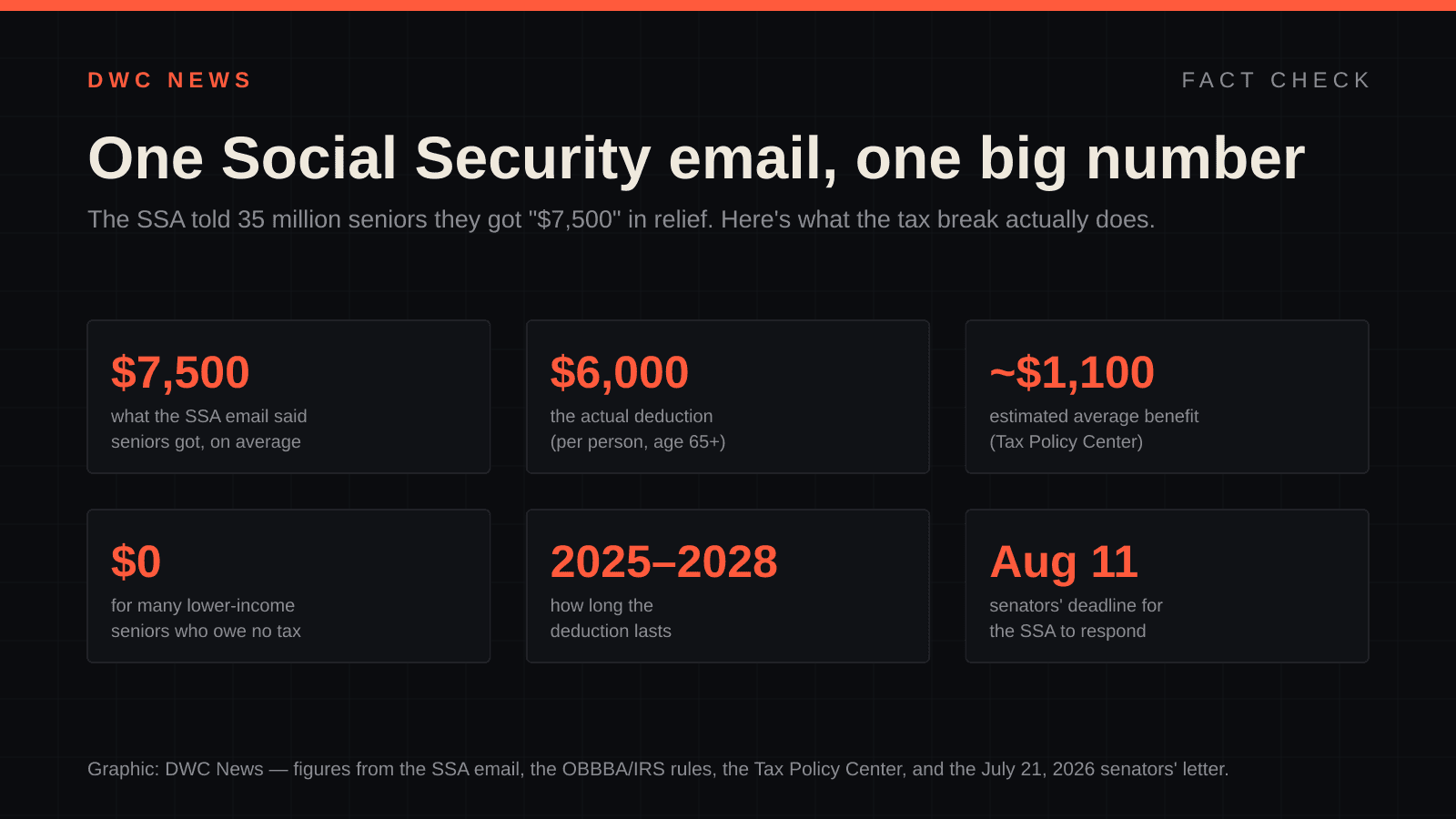
On July 2, 2026, Social Security Commissioner Frank Bisignano sent a mass email to beneficiaries stating: "Thanks to President Trump, over 35 million American seniors received an average of $7,500 in relief this tax season." It closed, "Put simply, America's seniors are winning!"
Bisignano, a former financial-technology executive, was confirmed as commissioner in 2025 after pledging to run the agency in a nonpartisan way.
What the senators said
On July 21, five Democratic senators — Elizabeth Warren, Ron Wyden, Tammy Baldwin, Sheldon Whitehouse and Ben Ray Luján — sent Bisignano a letter calling the email misleading, as CBS News reported. Their core objection: the email blurred the line between a new tax deduction and money "received," and the $7,500 figure vastly overstates what the law actually delivers. They asked him to respond by August 11.
So who is right? This is checkable, so let's check it — and then answer the questions the rest of the coverage tends to skip.
The questions other coverage leaves unanswered
1. So what would a senior actually get?
The law in question — the One Big Beautiful Bill Act — did not eliminate taxes on Social Security benefits. It created a temporary "senior bonus" deduction: up to $6,000 per person age 65 or older ($12,000 for a couple who are both 65+), for tax years 2025 through 2028, per the IRS. It phases out above $75,000 of income (single) or $150,000 (married).
Here is the key thing the "$7,500" line obscures: a deduction is not a check. It lowers your taxable income, so the actual money it saves you is the deduction times your tax bracket — for most seniors, a few hundred dollars up to about $1,300. The Tax Policy Center estimates the average senior's benefit at roughly $1,100. And many lower-income seniors get $0, because they already owe no federal income tax for a deduction to reduce.
The tool below estimates what it's worth for someone in your situation.
What Would You Actually Get?
The senior tax deduction, reality-checked: what it's really worth to you
The SSA email told seniors they'd received an average of $7,500. This estimates what the OBBBA senior deduction is actually worth for someone in your situation — usually a few hundred dollars to about $1,300, and $0 for many.
Uses: How do you file? · How many of you are 65 or older? · Approximate income (MAGI)
This is an informational estimate based on the published OBBBA senior-deduction rules, not tax advice and not an official determination. Your actual result depends on your full tax return. Confirm details with the IRS (irs.gov) or a qualified tax professional before relying on any figure.
Example — adjust the inputs above for your situation
Your senior deduction is about $6,000 — roughly $720 to $1,320 in tax savings.
The deduction lowers your taxable income; the cash savings is that deduction times your tax bracket, so most seniors see a few hundred to about $1,300 — and many with lower incomes see $0. The SSA email said seniors got an average of $7,500; independent estimates put the real average nearer $1,100.
- Senior deduction you may claim
- $6,000
- Estimated tax savings (12%–22% bracket)
- $720–$1,320
- SSA email's claimed average
- ~$7,500 per senior
- Income phase-out begins at
- $75,000 (single)
- ※ This is a rough estimate against the published OBBBA rules, not tax advice. Your actual savings depend on your full return.
- ※ Many lower-income seniors already owe no federal income tax and would save $0 from this deduction.
- ※ It is a deduction (it lowers taxable income), not a check or a credit — and it is temporary, for tax years 2025 through 2028.
How this is calculated
No model output — just the published OBBBA rules. The senior 'bonus' deduction is up to $6,000 per person age 65+ ($12,000 for a couple who are both 65+) for tax years 2025–2028, phasing out at 6% of income above $75,000 (single) or $150,000 (married filing jointly). Because it is a deduction, the cash it saves is roughly the deduction times your tax bracket, so we show a range using the 12%–22% brackets most seniors fall in — and note that many lower-income seniors owe no federal income tax and save $0. It is an estimate against published rules, not a tax return.
Data as of July 21, 2026 · verified July 21, 2026 · v1
Assumptions, limitations & sources
Assumptions
- · Uses the OBBBA senior deduction rules for tax years 2025–2028.
- · Tax-savings range assumes a 12%–22% marginal bracket; your actual bracket may differ.
Limitations
- · An estimate against published rules — not tax advice, and not a substitute for your actual return or a tax professional.
- · Many lower-income seniors already owe no federal income tax and would save $0 from a deduction.
- · The phase-out above the income limits is applied at the commonly cited 6% rate and is approximate near the top of the range; confirm your figure with the IRS.
Sources
- IRS — new senior deduction under the One Big Beautiful Bill (age 65+, 2025–2028) — Internal Revenue Service, checked July 21, 2026
- Tax Policy Center — estimated average senior tax reduction (~$1,100) — Urban-Brookings Tax Policy Center, checked July 21, 2026
- CBS News — senators call the SSA email's tax-relief claims misleading — CBS News, checked July 21, 2026
This is what modern SEO looks like: not just an article, but a useful resource people can return to, cite, and share. See how this newsroom is growing · See DavidWeaver's SEO packages
2. Where did "$7,500" even come from?
This is the question almost no one answers, so here is the honest version: the SSA has not published a basis for $7,500 as the value of this deduction, and it does not match the deduction's actual math. A $6,000 deduction cannot produce $7,500 in savings; even a two-senior household maxing the $12,000 deduction saves well under that. The most charitable reading is that the email conflated a broad, unrelated tax figure with "relief seniors received" — but as a description of this deduction's value, $7,500 is not supported by the rules. Independent fact-checks reached the same conclusion.
3. Why did a government agency email me political-sounding messaging — and can I opt out?
The SSA does hold email addresses for people who have a my Social Security account or who subscribed to updates, and it uses a government mailing system to reach them. You can manage or unsubscribe from those messages through your my Social Security account's notification settings, or via the "unsubscribe" link in the email's footer. What unsettled many recipients was not the channel but the content: a benefits agency crediting a sitting president by name in an official message is a break from how the SSA historically communicates.
4. Is this legal? The Hatch Act question, actually explained
Critics invoked the Hatch Act, so here is what it actually is: a law barring federal employees from using their official position for partisan political activity. Praising a sitting president's policy in an official government email is the kind of thing it is meant to discourage. But two honest caveats: the U.S. Office of Special Counsel would have to investigate and make a finding, and no such ruling has been made here; and for a Senate-confirmed presidential appointee, the practical enforcement is limited — discipline ultimately runs through the President. In other words, "raises Hatch Act concerns" is real, but it is not the same as "broke the law," and nothing has been adjudicated.
5. How do I tell a real SSA email from a scam?
This is the most important practical takeaway, and it is the quiet risk of a flashy official email: SSA impersonation is one of the most common government scams, and every time a real SSA message looks slick and urgent, it makes the fakes easier. The SSA Office of the Inspector General says the real agency will never threaten you, demand immediate payment, ask for gift cards, or ask for your SSN or bank details by email or text. Real links go to ssa.gov. When in doubt, don't click — go directly to your my Social Security account or call 1-800-772-1213, and report suspected scams to the OIG.
6. Does any of this change my check or what I owe?
No. The email is messaging, not a change to your benefits. Your monthly payment is unchanged, and the senior deduction is something you (or your preparer) claim on your tax return — it is not deposited, and it did not alter this month's check.
What happens next
Bisignano has until August 11 to answer the senators. Watch for whether the SSA stands by or walks back the "$7,500" figure (the agency has, in the past, acknowledged inaccuracies in mass emails), and whether the Office of Special Counsel opens a Hatch Act review. Whatever the politics, the number that matters to your household is not the one in the subject line — it's the one the calculator above gives you.
Sources
- Social Security email sent to retirees included 'misleading information,' Democratic senators say — CBS News
- One Big Beautiful Bill Act — tax deductions for working Americans and seniors — Internal Revenue Service · primary source
- What the One Big Beautiful Bill Act means for older adults (average ~$1,100) — Urban-Brookings Tax Policy Center · primary source
- Fact-checking the Social Security Commissioner's email — Advisor Perspectives
- Commissioner Frank J. Bisignano — Social Security Administration — Social Security Administration · primary source
- Protect yourself from Social Security scams (Office of the Inspector General) — SSA Office of the Inspector General · primary source