The government just told a court how it picked which grants to cancel — by which way the state voted
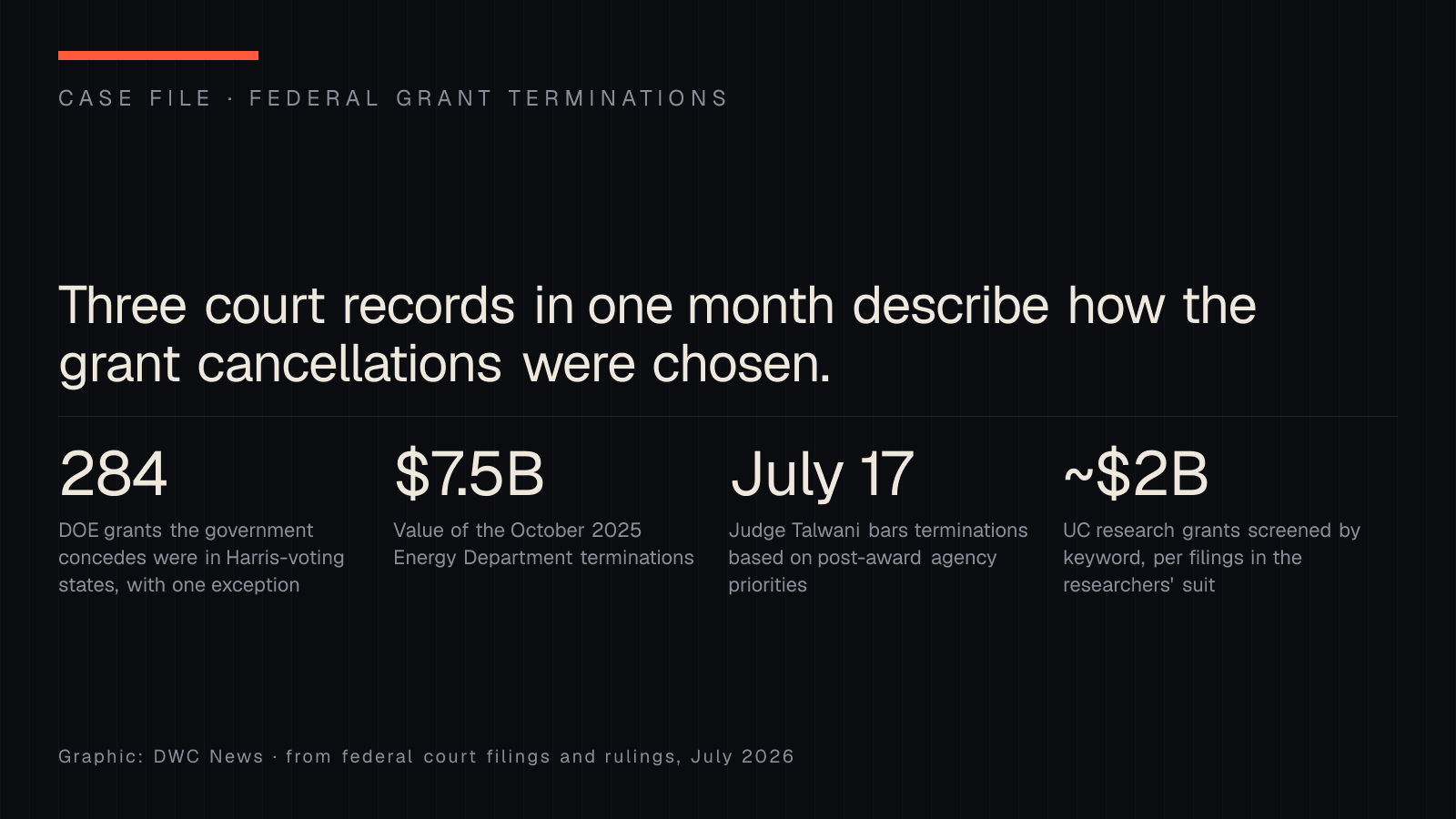
Three sets of federal court records this month describe the method behind the grant terminations: an Energy Department concession that politics selected 284 awards, filings showing agencies screened research by keyword, and a ruling limiting when a grant can be cancelled at all.

By David Weaver
Publisher & Editor
Published July 24, 2026, 7:44 PM ET
Federal agencies have cancelled billions of dollars in grants over the past year, and the argument about it has mostly been conducted in adjectives. In July 2026, that changed. Three separate sets of court records — a concession, a set of disclosures, and a ruling — put the method on the docket.
Taken together they answer a question that had only been inferred before: not whether the cancellations were political, but how the list was made.
The concession: "solely" on political criteria
The document driving the traffic is a court filing from this month in which a lawyer for the Department of Energy conceded that, with one exception, the 284 terminated grants had a recipient location and/or at least one place of performance in a state that awarded its electoral votes to Kamala Harris in 2024 and has two Democratic-caucusing senators.
The filing goes further than the correlation. As reported, it states that none of the terminated grants was selected on programmatic, statutory, cost-reduction or performance grounds — and that the political identity of the recipient's state played a preponderant role in the October 2025 termination decisions. DOE's October tranche was announced at more than $7.5 billion across hundreds of clean-energy awards, covering things like grid upgrades in California and Oregon.
The counterpart detail matters just as much: the department left hundreds of energy grants in Republican-represented, Trump-voting states untouched, even though DOE had recommended cancelling them.
One honest caveat. Multiple outlets reported this concession on July 23 and 24, and they do not agree on which docket the filing sits in — some frame it in the Energy Department litigation, at least one places it in the University of California researchers' suit. We are not going to pick one for you. The concession is well corroborated; the case number is not, and the explorer below marks that row's court as unidentified rather than guessing.
The method: Ctrl+F
The second set of records is about how a different pile of grants got flagged, and it is almost mundane enough to miss the significance.
In litigation brought by University of California researchers, agencies acknowledged using keyword searches to identify grants for termination. The National Institutes of Health used an internal search tool to flag awards containing terms including health equity, workforce diversity, structural racism and sexual orientation — suspending or cancelling more than 1,000 UC grants, nearly 700 of them at UCLA, across work on vaccines, cancer and health outcomes. The Department of Transportation identified about $42 million in projects flagged for language like transportation equity and disadvantaged communities. The plaintiffs put the total at close to $2 billion.
A keyword search does not read a grant. It reads the words in a grant. A cancer study that mentioned disparities in outcomes and a project whose entire purpose was a diversity initiative look identical to a text match — which is the plaintiffs' whole argument, and why the disclosure of the method is more damaging than the disclosure of the total.
The ruling: priorities are not a termination clause
The third record is the one with legal teeth, and it came on July 17, when U.S. District Judge Indira Talwani in Boston granted summary judgment to a coalition of 23 states and the District of Columbia.
At issue was a clause in an Office of Management and Budget regulation that the administration read as letting agencies terminate grants that no longer align with the president's priorities. Talwani held that reading has no basis in law: the clause "does not permit agencies to terminate grants based on program goals and agency priorities identified after grants were awarded," and demands only that grantees be told about such goals before the award is made. Terminating on that basis, she found, improperly trampled the spending authority of Congress, which appropriated the money. She also denied the government's motion to dismiss.
That was not the first adverse ruling. In January 2026, Judge Amit P. Mehta of the U.S. District Court for the District of Columbia held in City of Saint Paul v. Wright that DOE's termination decisions violated the Fifth Amendment's guarantee of equal protection, and vacated the October notices as to the seven awards before him.
The explorer below is built for the question grantees keep asking and coverage keeps leaving out: does any of this reach my grant? Each row records what the document established, who it covers, and what it explicitly does not do.
Search The Court Record
Federal grant terminations: every ruling and admission on the record, and who each one covers
A searchable table of the rulings, filings and agency concessions in the federal grant-termination litigation — which agency, which court, what was decided, who it covers, and what it does not do.
A reference map of public court records and the reporting on them — not legal advice. Whether any ruling reaches a specific grant depends on the agency, the plaintiff class and the award's own terms. Grantees should consult their institution's counsel or a lawyer, and the dollar figures shown overlap between cases and must not be added together.
| July 2026 — Energy Department concession that political criteria drove the October 2025 terminations | Department of Energy. Docket not identified in the public reporting. | A DOE lawyer conceded that, with one exception, the 284 terminated grants had a recipient location and/or a place of performance in a state that gave its electoral votes to Kamala Harris in 2024 and has two Democratic-caucusing senators — and that no programmatic, statutory, cost or performance factor selected them. Hundreds of energy grants in Trump-voting states were left alone despite being recommended for cancellation. | COVERS: the October 2025 DOE termination tranche, reported at more than $7.5 billion in clean-energy awards. DOES NOT: it is an admission of fact in litigation, not an order — on its own it restores no money and reverses no termination. |
| July 17, 2026 — ruling that grants cannot be terminated for post-award changes in agency priorities | Multiple agencies, under an OMB-wide regulation. U.S. District Court for the District of Massachusetts, Judge Indira Talwani. | Summary judgment for the plaintiffs: the OMB regulation's termination clause does not permit agencies to end grants over goals and priorities identified after the award was made, and doing so trampled Congress's spending power. The court called the government's reading of the clause without basis in law, and denied the motion to dismiss. | COVERS: the suit brought by 23 states and the District of Columbia. DOES NOT: it does not hold that grants can never be terminated — the regulation still allows termination on grounds disclosed before the award — and as a district court decision it can be appealed. |
| July 21-22, 2026 — court filings showing keyword screening of research grants | NIH, Department of Transportation and others. University of California researchers' suit, N.D. Cal. | Agencies acknowledged flagging grants with keyword searches. NIH used an internal search tool for terms including 'health equity,' 'workforce diversity,' 'structural racism' and 'sexual orientation,' suspending or cancelling more than 1,000 UC grants — nearly 700 at UCLA. The Transportation Department identified about $42 million in projects flagged for 'transportation equity' and similar language. | COVERS: University of California researchers whose awards were terminated; plaintiffs put the total at close to $2 billion. DOES NOT: the filings describe method, not legality — the court had not resolved the researchers' claims on this record at the time of writing. |
| January 12, 2026 — ruling that seven DOE award terminations were unconstitutional | Department of Energy. U.S. District Court for the District of Columbia, Judge Amit P. Mehta, City of Saint Paul v. Wright, 1:25-cv-03899. | The court held the challenged termination decisions violated the Fifth Amendment's guarantee of equal protection and vacated the October termination notices as to the seven awards before it. | COVERS: the seven specific awards litigated in that case, out of a DOE tranche the department announced as $7.5 billion across 321 awards. DOES NOT: it did not vacate the whole tranche — awards outside that case were not restored by this ruling. |
| Filed 2025, live in 2026 — state coalition suit over the DOE energy and infrastructure terminations | Department of Energy and OMB. Suit by a coalition of state attorneys general, including Rhode Island. | States sued over the termination of energy and infrastructure funding, naming DOE, Energy Secretary Chris Wright, OMB and OMB Director Russell Vought. Rhode Island alone described three cancelled grants worth about $14 million. | COVERS: the plaintiff states — reported as including California, Colorado, Connecticut, Illinois, Maryland, Massachusetts, New Jersey, New York, Oregon, Rhode Island, Vermont, Washington and Wisconsin. DOES NOT: being a resident of a plaintiff state does not make an individual grantee a party; relief runs to the claims the states actually pleaded. |
How this is calculated
One row per proceeding, order or filing. Each row records the date and the case and court where those are on the public record, the agency involved, what the document established, and — in the same cell, labelled COVERS and DOES NOT — whom it reaches and what it explicitly fails to do. Dollar figures and grant counts are reproduced as stated in the filings or in the reporting that quotes them, with the source named — they are not summed across rows, because the cases overlap and double counting would be misleading. Where the docket for a specific July 2026 filing has not been publicly identified in the reporting, the row says so rather than guessing at a case number.
Data as of July 23, 2026 · verified July 23, 2026 · v1
Assumptions, limitations & sources
Assumptions
- · Case names, courts and judges are recorded only where the public record or the reporting identifies them explicitly.
- · Figures are as stated in the cited filing or coverage, on the date shown; litigation totals move as cases are amended.
Limitations
- · This is a map of the public record, not legal advice. Whether any ruling reaches a particular grant depends on the agency, the plaintiff class and the terms of the award — a lawyer or the grantee's institutional counsel is the right place for that question.
- · Litigation is live. Rulings can be stayed, narrowed or reversed on appeal, and several of these are likely to be appealed.
- · The July 2026 Energy Department concession has been reported by multiple outlets, but accounts differ on which docket the filing sits in. That row records the concession and flags the ambiguity instead of naming a case.
- · Dollar figures across rows overlap and must not be added together.
Sources
- Trump administration concedes it canceled research grants in blue states — NBC News, checked July 23, 2026
- Trump administration admits canceling grants to states that didn't vote for him — GV Wire, checked July 23, 2026
- In court, administration admits canceling New Mexico grants 'solely' over the state's politics — New Mexico Political Report, checked July 23, 2026
- U.S. judge rejects the administration's justification for terminating thousands of grants — Science (AAAS), checked July 23, 2026
- Trump officials can't revoke grants due to new agency goals, judge rules — Higher Ed Dive, checked July 23, 2026
- DEI keyword search led to billions in cancelled California university grants — CalMatters, checked July 23, 2026
- Ctrl+F: federal agencies used keyword searches to nix grants en masse, court records show — Higher Ed Dive, checked July 23, 2026
- City of Saint Paul, Minnesota v. Wright, 1:25-cv-03899 (D.D.C.) — case record — Civil Rights Litigation Clearinghouse, checked July 23, 2026
- Court finds DOE clean energy grant cancellation unconstitutional (January 2026 ruling) — Solar Builder, checked July 23, 2026
This is what modern SEO looks like: not just an article, but a useful resource people can return to, cite, and share. See how this newsroom is growing · See DavidWeaver's SEO packages
What this does not mean
Four cautions, because the gap between "the government admitted it" and "the money is coming back" is wide:
- An admission is not an order. The DOE concession is a statement of fact in litigation. On its own it restores nothing.
- A ruling covers its plaintiffs. Talwani's decision runs to the states that sued. Mehta's January ruling vacated seven termination notices, not the 321 awards in DOE's announced tranche.
- District courts get appealed. Every one of these decisions can be, and several likely will be.
- The dollar figures overlap. $7.5 billion, $2 billion, $82.1 million and $42 million describe different cases with different scopes. Adding them produces a number that means nothing.
The questions readers are asking
Did the government actually admit cancelling grants for political reasons? In substance, yes — in a court filing, as to the Energy Department's October 2025 terminations, describing the political identity of the recipient's state as the selection criterion.
Is my grant coming back? Not automatically, and not because of the concession. Restoration depends on which case covers your award, what relief the court ordered, and whether it survives appeal. That is a question for your institution's counsel, not a news article — the explorer above is meant to tell you which proceedings are even in the neighbourhood.
Can an agency ever cancel a grant? Yes. Nothing here holds otherwise. Talwani's ruling is narrower than it sounds: agencies may still terminate on grounds disclosed to grantees before the award. What they cannot do is invent a new priority afterward and use it as a termination clause.
Why does it matter which state a grantee is in? Because the Constitution's spending clause gives Congress, not the executive, the power to decide where appropriated money goes — and because selecting recipients by their state's election results is precisely the equal-protection problem Judge Mehta identified in January.
Was DOGE involved? The health research agency has said it is possible that DOGE — the federal office Elon Musk led in 2025 — used AI to help target grants for termination. That is a stated possibility in the record, not an established fact, and we are not treating it as one.
Who is actually suing? Several distinct groups: a coalition of state attorneys general over the energy and infrastructure terminations; 23 states plus D.C. in the Massachusetts case; and University of California researchers in California. Being a resident of a plaintiff state does not make an individual grantee a party to anything.
What happens next
Watch three things. Whether the government appeals the Talwani ruling, and how fast. Whether the DOE concession is used as evidence in the other cases — an admission in one proceeding tends not to stay in one proceeding. And whether agencies that terminated awards on the OMB priorities clause now start reissuing terminations on different grounds, which would restart the whole fight on new facts.
This story is developing, and the record is still being filed.
Sources
- Trump administration concedes that it canceled research grants in blue states — NBC News
- Trump administration admits canceling grants to states that didn't vote for him — GV Wire
- In court, the administration admits canceling New Mexico grants 'solely' over the state's politics — New Mexico Political Report
- U.S. judge rejects the administration's justification for terminating thousands of grants — Science (AAAS)
- Trump officials can't revoke grants due to new agency goals, judge rules — Higher Ed Dive
- DEI keyword search led to billions in cancelled California university grants — CalMatters
- Ctrl+F: federal agencies used keyword searches to nix grants en masse, court records show — Higher Ed Dive
- City of Saint Paul, Minnesota v. Wright, 1:25-cv-03899 (D.D.C.) — case record — Civil Rights Litigation Clearinghouse · primary source
- Court finds DOE clean energy grant cancellation unconstitutional (January 2026 ruling) — Solar Builder