Permanent daylight saving time passed the House. Here is exactly what it would do to your state's sunrise
The House passed H.R. 139 on July 14 by 308–117, and 19 states already have year-round daylight saving laws waiting on Congress. The bill changes nothing about how much daylight you get — it changes when the clock says you get it. Pick your state and see the actual times.

By David Weaver
Publisher & Editor
Published July 24, 2026, 7:41 PM ET
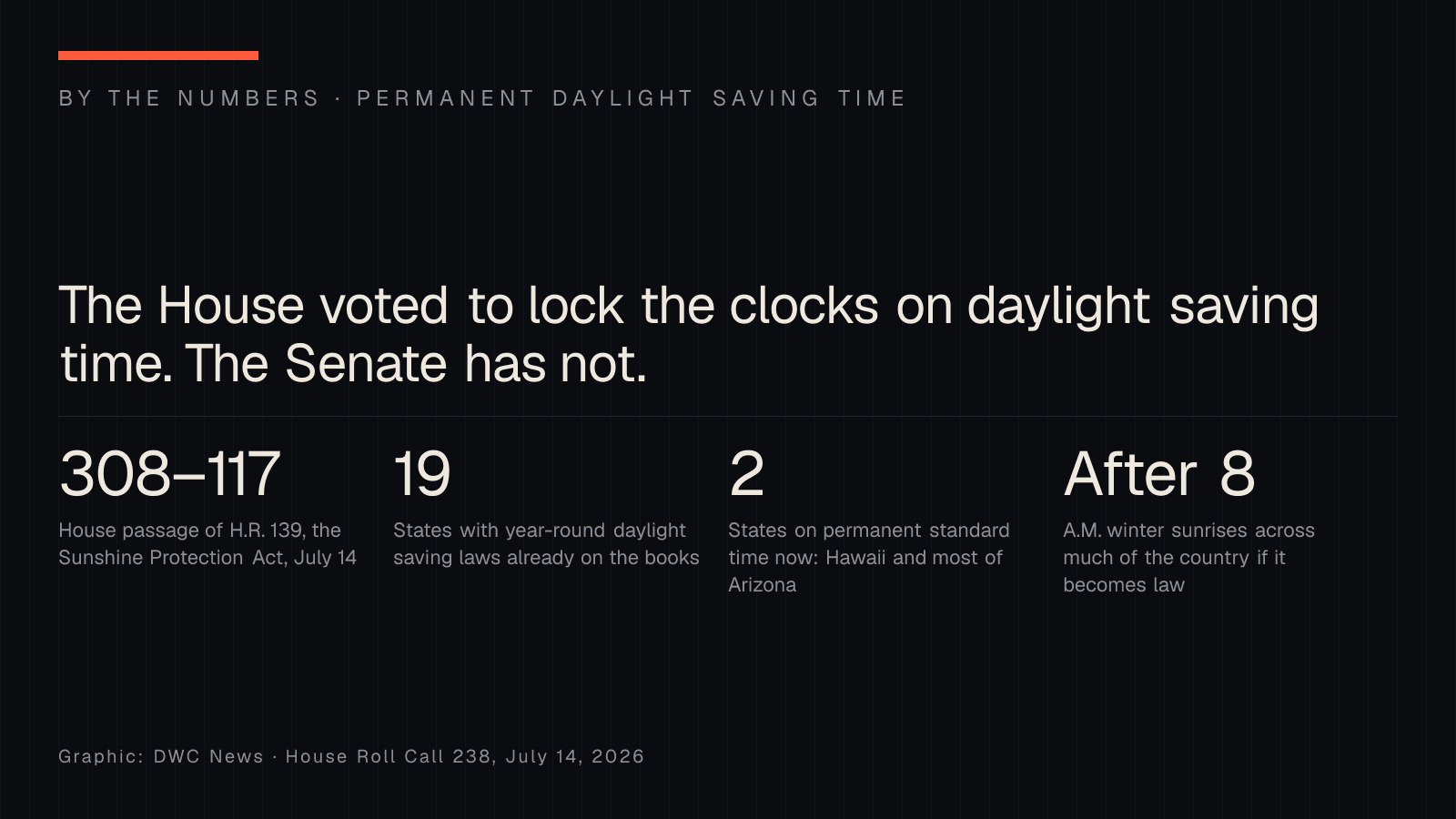
On July 14, 2026, the House passed H.R. 139, the Sunshine Protection Act, and sent it to the Senate. If it becomes law, the twice-yearly clock change ends and the country stays on the time it currently keeps from March to November — unless a state exempts itself before the act takes effect.
Most of the coverage since has argued about whether that is a good idea. Almost none of it has answered the question people actually have, which is smaller and much more concrete: what time would the sun come up where I live?
So we built that. Pick your state below and see your own sunrise and sunset under all three clocks — permanent daylight saving, permanent standard, and the law as it stands today — computed from the NOAA solar equations rather than quoted from a press release.
First, the vote — and a number a lot of outlets got wrong
The official House record for Roll Call 238 is 308 yea, 117 nay, with 6 members not voting. That is a comfortable bipartisan supermajority.
It is worth stating precisely, because a transposed version — 308–171 — spread through a lot of the coverage in the days after the vote. The two figures imply very different things about the bill's support: 308–171 does not even add up to a plausible House roll call. If you saw that number, the Clerk of the House's own tally is the one to trust.
The bill was sponsored by Rep. Vern Buchanan of Florida, who has been filing versions of it since 2021, and NBC News described it as Trump-backed. The history here is almost a mirror image: the Senate passed a similar measure on March 15, 2022, by unanimous consent — and the House never brought it to a vote. Now the chambers have swapped roles, and the bill's fate is the Senate's problem.
What the bill actually does
Three provisions matter, and they are simpler than the debate around them:
- It makes today's summer clock the year-round clock. Not new daylight — the same daylight, labeled an hour later.
- It lets states opt out, but only in one direction. A state can exempt itself and stay on permanent standard time — the choice Hawaii and most of Arizona already made — right up until the act takes effect. What it cannot do is invent a third option.
- The switchover is tied to a first Sunday in November following enactment. The precise date depends on when, or whether, the bill is signed. Anyone quoting you a firm changeover date right now is guessing.
Nineteen states are already waiting on this
This is the part that makes the Senate vote consequential rather than symbolic. Nineteen states have already passed laws putting themselves on year-round daylight saving time — laws that are legally dormant, because federal law does not currently allow it. They are: Alabama, Colorado, Delaware, Florida, Georgia, Idaho, Louisiana, Maine, Minnesota, Mississippi, Montana, Oklahoma, Oregon, South Carolina, Tennessee, Texas, Utah, Washington and Wyoming.
If H.R. 139 is enacted, those nineteen do not need to do anything. Their statutes simply switch on.
The two exceptions run the other way. Hawaii and most of Arizona already sit on standard time all year and never change their clocks, and the bill's exemption provision lets them keep doing exactly that.
The thing the clock cannot do
Here is the sentence that should be at the top of every story on this and rarely is:
Permanent daylight saving time does not create daylight.
On December 21 in New York City, there are 9 hours and 15 minutes of daylight. That is a fact about the tilt of the Earth and it does not care what Congress does. Permanent daylight saving time takes that same 9 hours and 15 minutes and relabels both ends of it: sunrise moves from 7:16 a.m. to 8:16 a.m., and sunset moves from 4:31 p.m. to 5:31 p.m.
That is the entire trade. You are moving an hour of light from the morning to the evening. Whether that is an improvement depends on whether you would rather commute to work in the dark or come home in it — which is a preference, not a fact, and which is why this argument has run for fifty years.
The tool below makes the trade concrete for your own state. The winter dates are where the change lives; switch it to June and you will see the answer that explains why nobody argues about summer.
What Time Would The Sun Come Up In Your State?
Permanent daylight saving time, state by state: what your sunrise and sunset would actually be
Pick your state and a date. This computes sunrise and sunset for a representative city with the NOAA solar equations, then shows the same day on three clocks: permanent daylight saving time, permanent standard time, and the law as it stands today.
Uses: Your state · Which day
Example — adjust the inputs above for your situation
On December 21 in New York City, permanent daylight saving time would push sunrise from 7:16 a.m. to 8:16 a.m.
The sun comes up at the same moment either way. Under today's law this date is on standard time, so the clock reads 7:16 a.m. Under permanent daylight saving time the same sunrise reads 8:16 a.m., and sunset moves from 4:31 p.m. to 5:31 p.m. Daylight itself is unchanged at 9 hr 15 min.
- Location used
- New York City, New York
- Date
- December 21 (2027 reference year)
- Sunrise under permanent daylight saving time
- 8:16 a.m.
- Sunrise under permanent standard time
- 7:16 a.m.
- Sunset under permanent daylight saving time
- 5:31 p.m.
- Sunset under permanent standard time
- 4:31 p.m.
- What your clock says on this date today
- sunrise 7:16 a.m., sunset 4:31 p.m. — standard time
- Hours of daylight (unchanged either way)
- 9 hr 15 min
- ※ Permanent daylight saving time does not add daylight. It moves the label on the clock forward one hour, so mornings get darker and evenings get lighter by exactly the same amount.
- ※ New York has not passed a year-round daylight saving law; under H.R. 139 it would be switched over unless it exempts itself before the act takes effect.
- ※ Times are computed for the representative city shown, not for the whole state, and are good to about a minute or two.
How this is calculated
Sunrise and sunset are computed from scratch using the NOAA General Solar Position Calculations — the same equations behind NOAA's public solar calculator — for the representative city's latitude, longitude and standard-time UTC offset, with the usual 90.833° zenith that accounts for atmospheric refraction and the width of the solar disc. A fixed 2027 reference year keeps the result deterministic; sunrise on a given calendar date shifts by well under a minute from year to year. The three clock regimes are then pure labelling: permanent standard time is the computed local standard clock, permanent daylight saving time is that clock plus exactly 60 minutes, and today's law is standard time in winter and daylight saving time in summer. Nothing is estimated or modelled — the sun's position is astronomy, and the hour shift is arithmetic.
Data as of July 23, 2026 · verified July 23, 2026 · v1
Assumptions, limitations & sources
Assumptions
- · Each state is represented by one city — usually its largest — so the figures describe that city, not every town in the state.
- · Times use a 2027 reference year; a given calendar date's sunrise moves by well under a minute between years.
- · Under today's law, the December, January and mid-November dates fall in standard time and the June date falls in daylight saving time.
- · Hawaii and most of Arizona are treated as already on year-round standard time, which the House bill would let them keep.
Limitations
- · The NOAA equations are accurate to roughly a minute at these latitudes; representative-city coordinates add a little more error. Treat the times as ±2 minutes, not to the second.
- · Terrain is ignored. A city ringed by mountains sees the sun later than the flat-horizon calculation says.
- · Fourteen of the states listed span more than one time zone; clocks in the other zone differ by an hour from the figures shown.
- · This shows what the bill would do to the clock. It cannot tell you what that would do to sleep, school schedules, traffic safety or energy use — those are contested empirical questions, and the article covers where the evidence actually stands.
- · H.R. 139 has passed only the House. Nothing here has taken effect, and the bill's own effective date depends on when, or whether, it is enacted.
Sources
- NOAA General Solar Position Calculations (the equations used to compute sunrise and sunset) — NOAA Global Monitoring Laboratory, checked July 23, 2026 · Implemented verbatim as a pure function; outputs rounded to the minute for display.
- NOAA Solar Calculator (reference implementation used to spot-check the outputs) — NOAA Global Monitoring Laboratory, checked July 23, 2026
- H.R. 139, the Sunshine Protection Act of 2025 — bill text, actions and status — U.S. Congress, checked July 23, 2026
- Final Vote Results for Roll Call 238 (H.R. 139 House passage, July 14, 2026) — Office of the Clerk, U.S. House of Representatives, checked July 23, 2026
- What permanent daylight saving time would look like in your state (states with year-round DST laws) — The Hill, checked July 23, 2026
- Daylight Saving Time in the United States — which jurisdictions do not observe it — timeanddate.com, checked July 23, 2026
This is what modern SEO looks like: not just an article, but a useful resource people can return to, cite, and share. See how this newsroom is growing · See DavidWeaver's SEO packages
Why sleep researchers are against it
The strongest organised opposition is not partisan. The American Academy of Sleep Medicine, which represents sleep physicians and researchers, condemned the House vote — and its objection is specific enough to be worth understanding, because it is easy to mistake for a defence of the status quo.
The AASM agrees the clock changes should stop. It simply wants the country to stop on standard time instead, and its January 2024 position statement argues that permanent standard time is the healthier choice because it aligns the clock more closely with the sun.
The mechanism is morning light. Human circadian rhythms are set primarily by light early in the day. Push sunrise an hour later in winter and, for a lot of people, the alarm goes off well before the sun does for months at a stretch — the mismatch researchers call social jet lag. Under permanent daylight saving time, sunrise falls after 8 a.m. across much of the country in midwinter, and after 9 a.m. in parts of the north. In Seattle on December 1, it would be about 8:38 a.m.; in Cleveland, about 8:31; in Raleigh, the latest sunrise of the year would come at 8:33.
There is a competing bill: the bipartisan Sunshine for Our Kids Act of 2026, from Reps. Mary Gay Scanlon and Pat Harrigan, which would end the clock changes on permanent standard time instead. It has nothing like H.R. 139's momentum.
Worth being straight about the evidence, though: the claim that ending clock changes helps is much better supported than the claim about which fixed clock is best. The morning-light argument for standard time is a reasonable reading of circadian science, not a settled experimental result, and the evening-daylight arguments for the other side — retail activity, recreation, some traffic-safety studies — are contested in the same way. What is not seriously disputed is that the switch itself is disruptive.
The questions readers are asking
Would my state be affected? If your state changes its clocks today, yes — unless it exempts itself before the act takes effect. The tool above tells you whether your state already has a year-round law on the books, and what the change would look like on your own morning.
Is this law now? No. It has passed the House only. It needs the Senate and the president's signature, and Senate action is not scheduled.
When would clocks stop changing? Tied to a first Sunday in November following enactment. Since enactment has not happened, no date is fixed.
What about Arizona and Hawaii? They are already on permanent standard time and the bill lets them stay. Arizona's Navajo Nation, which does observe daylight saving time, is the wrinkle that keeps "most of Arizona" in every careful sentence about this.
Does this mean more evening daylight in summer? No — summer is already on daylight saving time. The bill changes winter and the shoulder months. That is why the tool's June setting shows no difference at all.
Wouldn't permanent standard time mean dark evenings? In winter, yes — earlier sunsets than we have now would not be the change, since winter is already on standard time. The real contrast is summer: permanent standard time would mean sunset around 7:30 p.m. instead of 8:30 p.m. in late June for much of the country. Neither option gives you both a light morning and a light evening in December. There is not enough daylight in December for that.
Has this been tried before? Yes, and it collapsed. Congress passed the Emergency Daylight Saving Time Energy Conservation Act in December 1973 as a two-year energy-saving trial, and President Nixon signed it; year-round daylight saving time took effect on January 6, 1974. Polling showed roughly 79% support going in. Then winter mornings arrived. Reporting on children walking to school in the dark — including fatal predawn accidents involving schoolchildren in Florida — moved approval down to about 42% by February. President Ford signed the repeal on October 5, 1974, and the experiment ended that month. Supporters note that school schedules and car safety have changed since; opponents note that the sun has not.
What happens next
The bill is in the Senate, where a similar measure died on the vine in 2022 after sailing through. There is no scheduled floor action, and the calendar is the real obstacle: bills that pass one chamber with a supermajority still need someone to decide the other chamber's floor time is worth spending.
Two things to watch. Whether Senate leadership gives it a slot — and whether any of the nineteen states with dormant statutes moves to repeal, now that "what the clock would say in January" has stopped being hypothetical.
Sources
- Final Vote Results for Roll Call 238 — H.R. 139, July 14, 2026 — Office of the Clerk, U.S. House of Representatives · primary source
- H.R. 139 — Sunshine Protection Act of 2025: text, actions and status — U.S. Congress · primary source
- House passes legislation to make daylight saving time permanent — U.S. House Committee on Energy and Commerce · primary source
- House passes Trump-backed bill that would make daylight saving time permanent — NBC News
- What permanent daylight saving time would look like in your state — The Hill
- AASM condemns House passage of the Sunshine Protection Act — American Academy of Sleep Medicine · primary source
- What permanent daylight saving time would look like across the U.S. — TIME
- NOAA General Solar Position Calculations — the equations behind the sunrise times — NOAA Global Monitoring Laboratory · primary source
- Buchanan calls for the Senate to pass his permanent daylight saving time bill — Office of Rep. Vern Buchanan · primary source
- When the U.S. tried permanent daylight saving time in 1974 — History.com
- Emergency Daylight Saving Time Energy Conservation Act — the 1974 trial and its repeal — Wikipedia