DHS rescinds the 2022 public-charge rule, widening the benefits test for green cards from Sept. 18
On July 20, DHS published a final rule scrapping the 2022 public-charge regulation and returning green-card decisions to a ‘totality of the circumstances’ standard. From Sept. 18, officers may weigh benefits like Medicaid, SNAP and housing aid. A $100,000 State Dept. visa bond is only a proposal.

By David Weaver
Publisher & Editor
Published July 23, 2026, 5:46 PM ET
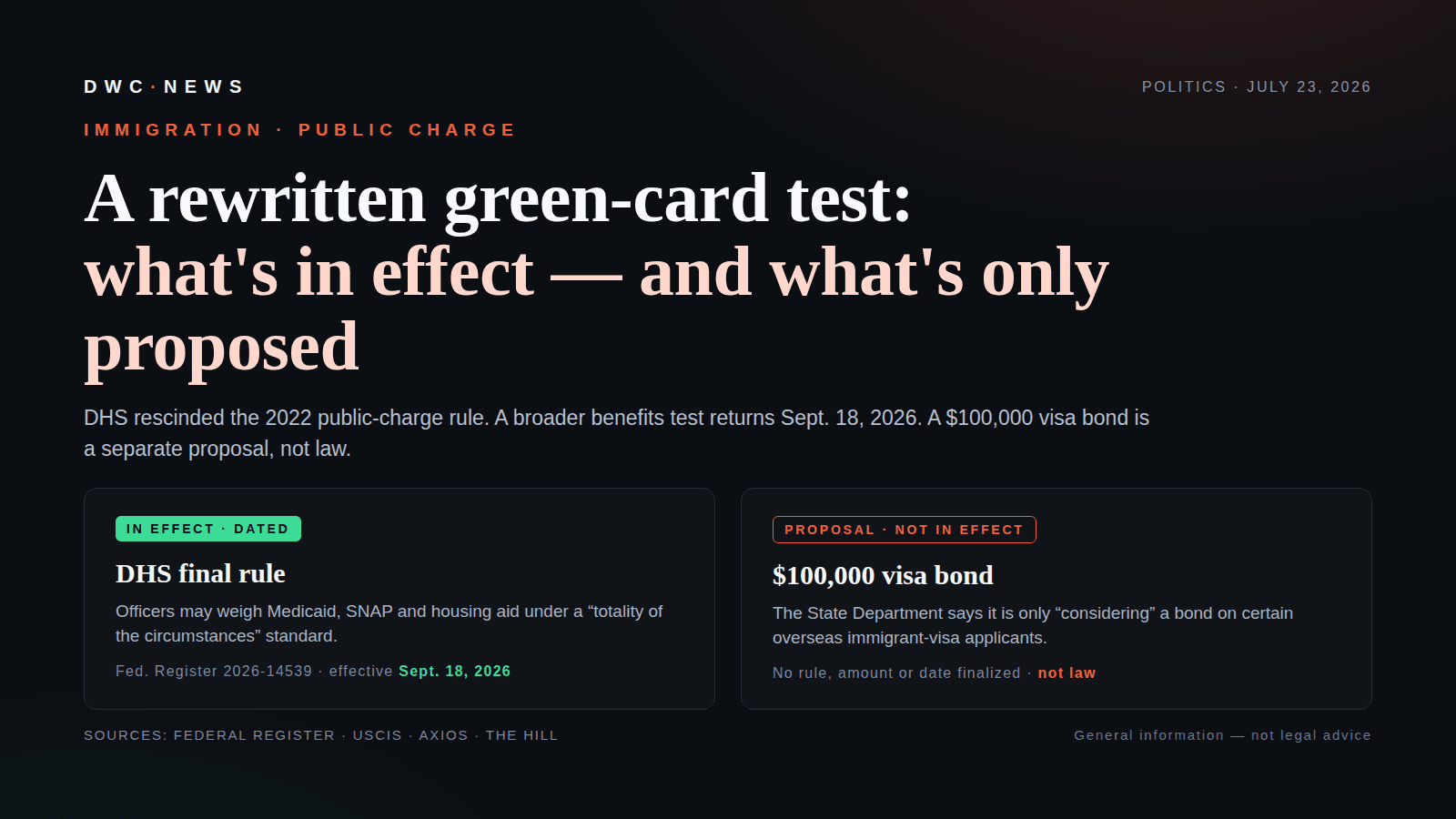
The change immigration lawyers spent the weekend reading is a final rule, not a proposal. On July 20, 2026, the Department of Homeland Security published a rule rescinding the 2022 public-charge regulation and returning green-card decisions to a broad, discretionary “totality of the circumstances” standard, according to the Federal Register notice (document 2026-14539, Vol. 91, No. 137). It takes effect September 18, 2026, the immigration firm Berry Appleman and Leiden reports.
“Public charge” is a long-standing test in immigration law: before granting a green card, the government asks whether an applicant is “likely at any time to become a public charge” — that is, primarily dependent on the government for support. What has changed is how much an officer may consider in answering that question.
What actually changes on September 18
From the effective date, USCIS officers may weigh a wider range of public benefits — including Medicaid, SNAP (food assistance) and housing assistance — when making that judgment, Axios reported. That is broader than the 2022 standard it replaces, which counted only cash aid and long-term institutionalization at government expense. The decision returns to a case-by-case, discretionary weighing of an applicant’s circumstances rather than a narrow checklist.
The people most directly exposed are family-based adjustment-of-status applicants — those seeking a green card from inside the United States, per Axios and U.S. News.
DHS also described a transition, or safe harbor: according to the department, benefits received before September 18, 2026 are not counted against an applicant, and a case filed before September 18 stays under the current, narrower rule. Timing, in other words, matters — which is exactly the kind of decision a reader should confirm against official USCIS guidance rather than a news summary.
The $100,000 bond is a proposal, not a rule
A second item has traveled alongside the rule and is easy to conflate with it: a $100,000 bond. Around July 17, 2026, State Department spokesperson Tommy Pigott said the department is “considering” a bond on certain immigrant-visa applicants processed abroad, The Hill reported.
That is where it stands: a statement that the idea is under consideration. Nothing about the bond is in effect. It is not part of the DHS final rule; it would require its own separate rulemaking; and no covered visa categories, dollar amount or effective date have been finalized. Treat the $100,000 figure as a proposal under discussion, not an enacted requirement.
What each side says
DHS frames the rule as a return to first principles, saying it “restores the basic principle that immigrants must be able to support themselves.”
Immigrant-rights groups read it very differently. The California Immigrant Policy Center warned the discretionary standard invites “arbitrary denials and political bias.” The Presidents’ Alliance on Higher Education and Immigration opposed the change, and the American Association of People with Disabilities said it “strongly condemns” it. A recurring concern across these groups is a chilling effect: that eligible members of mixed-status families, including U.S.-citizen children, will forgo benefits they lawfully qualify for out of fear it could hurt a relative’s case.
Both characterizations are presented here as what each side has said. This article takes no position on the merits.
In effect vs. proposed, side by side
Because the rule and the bond are so easily blurred together, the map below splits every claim into two tracks — what is in effect and dated, and what is only a proposal — with a source on each point and links back to the official record.
In Effect vs. Just Proposed
Green-card public-charge changes: what's in effect, and what's only a proposal
A two-track fact map of the 2026 public-charge changes: the DHS final rule that is dated and takes effect September 18, 2026, kept strictly separate from the $100,000 immigrant-visa bond the State Department says it is only 'considering.' Each claim is sourced and routed to the official record.
This is general information about the public record, not legal advice. Immigration outcomes turn on individual facts — consult a licensed immigration attorney or a Department of Justice accredited representative before you file, delay, or change anything. Verify every point against the official USCIS (uscis.gov), Federal Register, and travel.state.gov pages, which govern in case of any conflict.
[IN EFFECT — FINAL RULE] On July 20, 2026, DHS published a final rule rescinding the 2022 public-charge regulation and returning green-card adjudications to a broad, discretionary “totality of the circumstances” standard.
ConfirmedPublished in the Federal Register as document 2026-14539 (Vol. 91, No. 137). This is a dated final rule on the official record, not a proposal.
[IN EFFECT — DATED] The final rule takes effect on September 18, 2026.
ConfirmedImmigration firm Berry Appleman & Leiden and the Federal Register notice give the effective date as September 18, 2026 — roughly two months after publication.
[IN EFFECT — FROM SEPT. 18] From the effective date, USCIS officers may weigh a wider range of public benefits — including Medicaid, SNAP (food assistance) and housing assistance — in deciding whether an applicant is “likely at any time to become a public charge.”
ConfirmedThis is broader than the narrower 2022 standard it replaces, which counted only cash aid and long-term institutionalization at government expense. Reported by Axios; the standard is set out in the final rule.
[IN EFFECT — WHO IT AFFECTS] The change most directly affects family-based adjustment-of-status applicants — people seeking a green card from inside the United States.
ConfirmedPer reporting from Axios and U.S. News. The public-charge test is applied at adjustment of status and at immigrant-visa processing.
[IN EFFECT — DHS SAFE HARBOR] According to DHS, public benefits received before September 18, 2026 are not counted against an applicant, and a case filed before September 18 stays under the current, narrower rule.
ConfirmedDHS-stated transition treatment as summarized in immigration-practice guidance. Confirm timing against official USCIS pages before relying on it for a filing decision.
[PROPOSAL — NOT IN EFFECT] A separate idea — a $100,000 bond on certain immigrant-visa applicants processed abroad — is only under consideration at the State Department and is not law.
UnknownState Department spokesperson Tommy Pigott said on or around July 17, 2026 that the department is “considering” such a bond. That statement is on the record, but no bond rule has been proposed or finalized, and it is not part of the DHS final rule above.
[PROPOSAL — NOT IN EFFECT] Whether any such bond is ever imposed, on whom, and in what amount is unresolved.
UnknownAny bond would need its own notice-and-comment rulemaking; covered visa categories, the amount, and an effective date have not been finalized. The $100,000 figure is not an enacted requirement.
How this is calculated
Claims are split into two tracks. Track 1 ('in effect') covers the DHS final rule as published in the Federal Register (document 2026-14539) and summarized by immigration-practice and news sources; these points are dated and marked confirmed. Track 2 ('proposal') covers the State Department's stated consideration of a $100,000 immigrant-visa bond; because no rule has been proposed or finalized, its operative status is marked unknown even though the spokesperson's statement itself is on the record. Nothing here is legal advice; readers are routed to the official USCIS, Federal Register, and travel.state.gov pages to verify their own situation.
Data as of July 22, 2026 · verified July 22, 2026 · v1
Assumptions, limitations & sources
Assumptions
- · Effective date and transition treatment reflect the DHS final rule and immigration-practice summaries as of the data date; readers should confirm against official USCIS and Federal Register pages before acting.
- · The $100,000 bond is treated strictly as a proposal because, as of the data date, no bond rule has been proposed or finalized.
Limitations
- · This is general information about the public record, not legal advice; individual eligibility turns on facts a licensed immigration attorney or accredited representative should review.
- · The rule's practical impact will depend on how USCIS officers apply the 'totality of the circumstances' standard after September 18, 2026 — that discretion is not something this map can predict.
- · The minute-level timing of the July 23 search spike is inferred from peaking coverage of the July 20 rule and the bond proposal; no single confirmed July 23 trigger event is claimed.
- · Policy in this area is moving; a point that is accurate today may change through litigation, guidance, or further rulemaking.
Sources
- Federal Register — Public Charge Ground of Inadmissibility (final rule, doc 2026-14539, Vol. 91 No. 137) — Office of the Federal Register / U.S. Department of Homeland Security, checked July 22, 2026
- BAL — DHS final rule rescinds 2022 public charge regulation, effective Sept. 18 — Berry Appleman & Leiden LLP, checked July 22, 2026
- Axios — New public charge test could weigh health and benefits for green cards — Axios, checked July 22, 2026
- U.S. News — Green card applicants face mounting denials as rules peel back protections — U.S. News & World Report, checked July 22, 2026
- The Hill — State Department considering $100,000 green-card bond — The Hill, checked July 22, 2026
- USCIS Newsroom — News releases (official public-charge guidance and updates) — U.S. Citizenship and Immigration Services, checked July 22, 2026
This is what modern SEO looks like: not just an article, but a useful resource people can return to, cite, and share. See how this newsroom is growing · See DavidWeaver's SEO packages
Why the surge in searches now
Interest in “public charge” and “green card” climbed sharply on July 23. The most likely explanation is timing rather than a single new event: peaking coverage of the July 20 final rule, amplified by the separate $100,000 bond headlines, converging over a few days. That connection is inferred — no single confirmed July 23 trigger event is being claimed here.
Not legal advice — verify before you act
This article is general information about the public record, not legal advice. Immigration outcomes turn on individual facts. If any of this could affect you or your family, consult a licensed immigration attorney or a Department of Justice accredited representative before you file, delay, or change anything — and verify every detail against the official USCIS, Federal Register, and travel.state.gov pages, which govern in case of any conflict.
Sources
- Public Charge Ground of Inadmissibility (final rule, doc 2026-14539, Vol. 91 No. 137) — Office of the Federal Register / U.S. Department of Homeland Security · primary source
- DHS final rule rescinds 2022 public charge regulation, effective Sept. 18 — Berry Appleman & Leiden LLP
- New public charge test could weigh health and benefits for green cards — Axios
- Green card applicants face mounting denials as rules peel back protections — U.S. News & World Report
- State Department considering $100,000 green-card bond — The Hill
- USCIS Newsroom — news releases — U.S. Citizenship and Immigration Services