Trump wore a 'Trump 2028' hat and joked about a fourth term. Here is what the Constitution actually allows
At a rescheduled, scaled-down White House Correspondents' dinner, the president put on a red 'Trump 2028' hat and announced his intention to run for a fourth term. The room read it as a joke. The search traffic did not. So: what would a third term actually require?

By David Weaver
Publisher & Editor
Published July 24, 2026, 9:20 PM ET
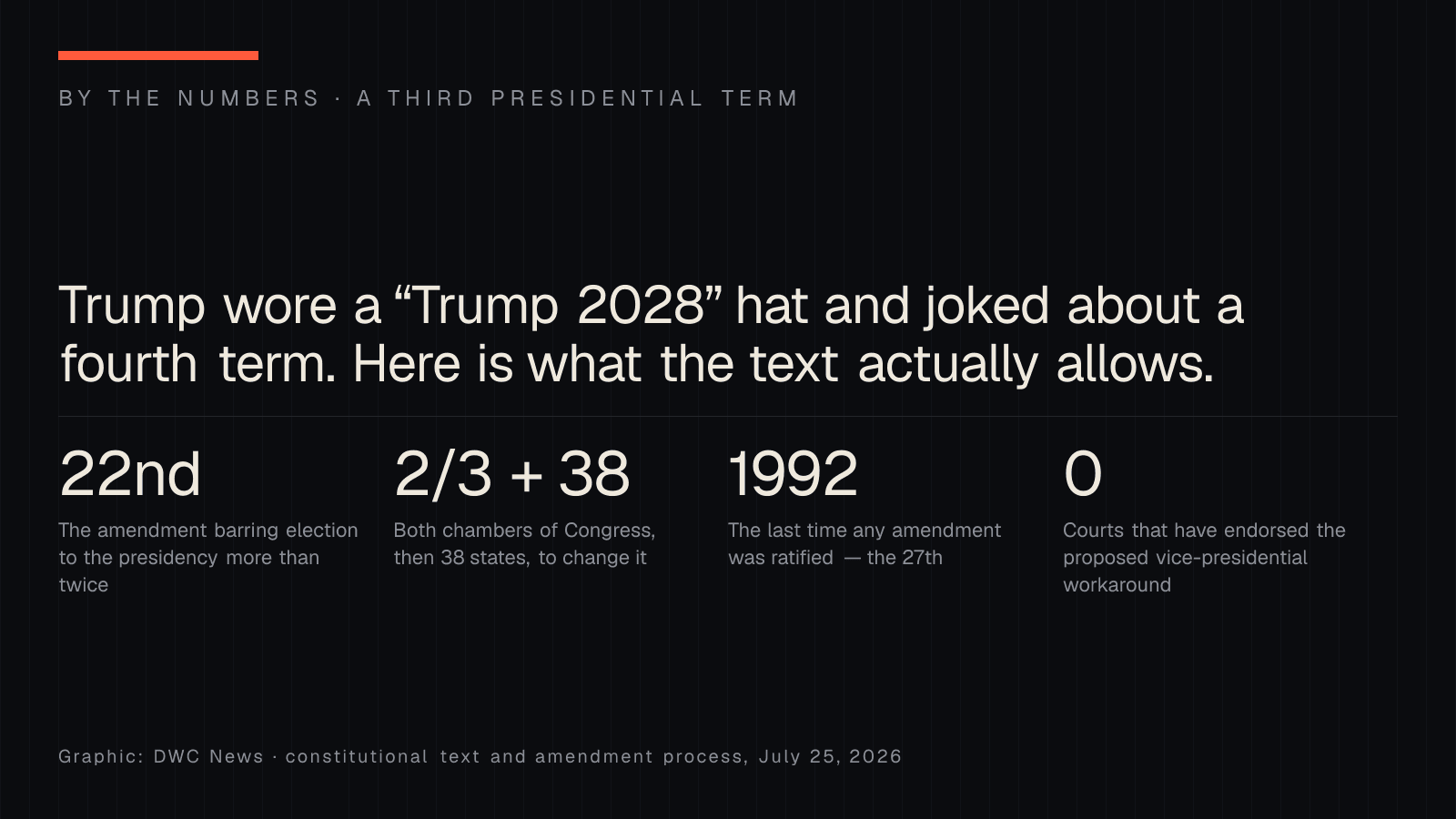
At the rescheduled White House Correspondents' Association dinner on Friday, July 24, 2026, President Trump put on a red hat reading "Trump 2028" and told the room: "I'm pleased to announce my intention to, and this is somewhat of a scoop, my intention to run for a fourth term as president of the United States. I will be doing that."
It was a joke, in a set that CNN reported mostly fell flat. Within hours "Trump 2028" was one of the most-searched phrases in the country.
The joke is not the story. The question underneath it is, and it has a gettable answer — which is that the plain text is clear, one popular workaround is contested, and the part everyone treats as settled has never actually been to court.
What the text says
The 22nd Amendment, ratified in 1951, opens with eleven words that do most of the work:
No person shall be elected to the office of the President more than twice.
It adds a second clause for people who inherit the job: anyone who has served more than two years of another president's term may be elected only once more.
That is the settled part. Nobody serious disputes it, including — on the record — the president, who has said it is "pretty clear" he is not permitted to seek a third term. He has also, on other occasions, declined to rule it out and joked about it. Both things are true, and neither changes the amendment.
The workaround, and why lawyers dislike it
The theory that circulates every time this comes up goes like this: the 22nd Amendment says elected, not serve. So a twice-elected president could run for vice president, win, and then take over when the president resigns. No third election, no violation.
The obstacle is the 12th Amendment, which ends with this:
But no person constitutionally ineligible to the office of President shall be eligible to that of Vice-President of the United States.
The entire dispute lives in that sentence. Is a twice-elected president "ineligible to the office of President," or merely ineligible to be elected to it? Read the first way, the workaround is dead on arrival. Read the second, there is a gap.
Legal scholars are lopsided about which reading wins. Georgetown's David A. Super called the loophole argument "implausible," citing what he described as a clear misreading of the 12th Amendment. Northeastern's Jeremy Paul called it "a ludicrous argument" and said he expects a court to strike it down. FactCheck.org and PolitiFact both found the consensus running heavily against it.
The honest counterweight: it is not unanimous. A Yale law professor has acknowledged a "possible loophole" in the wording — not an endorsement of the scheme, but an admission that the drafters wrote "elected" and that words in the Constitution are read for what they say.
And no court has ruled on any of it. That is not a small caveat. It is the single most important fact in this whole discussion, and it cuts both ways: the workaround has never been blessed, and it has never been formally buried either.
The tool below takes each claim in circulation — the amendment's text, the vice-presidential path, the "elected versus serve" reading, the amendment route — and grades it against the Constitution, with sources. It is built to be useful the next time this comes up, not just this week.
Check The Third-Term Claims Against The Text
A third presidential term: every claim about the 22nd Amendment, checked against the Constitution
The claims that circulate whenever a third presidential term comes up — the 22nd Amendment's wording, the vice-presidential workaround, the succession theory, the amendment route — each graded against the constitutional text with sources.
A reading of constitutional text and published legal analysis, not legal advice and not an election forecast. The workaround theories described here have never been tested in court; strong scholarly consensus against them is not the same as a ruling, and the rows below say which is which.
The Constitution bars anyone from being elected president more than twice.
ConfirmedThe 22nd Amendment, ratified in 1951, opens: "No person shall be elected to the office of the President more than twice." It adds that anyone who has served more than two years of someone else's term may be elected only once more. This is the settled part, and nothing else on this list changes it.
At the July 24, 2026 correspondents' dinner, the president wore a 'Trump 2028' hat and said he intended to run for a fourth term.
ConfirmedReporting from the dinner describes him wearing the hat and saying, "I'm pleased to announce my intention to, and this is somewhat of a scoop, my intention to run for a fourth term as president of the United States. I will be doing that." Coverage characterised the line as a joke in a set whose jokes largely fell flat. It is on the record as something he said; it is not a filing, a declaration of candidacy, or a change in the law.
NBC News — live coverage of the dinner ↗CNN — Trump's jokes mostly fall flat at the WHCA dinner ↗
Trump himself has said he is not allowed to run again.
ConfirmedHe has said publicly that it is "pretty clear" he is not permitted to seek a third term. He has also, on other occasions, declined to rule it out and joked about it — including at this dinner. Both are on the record; neither settles anything legally.
Trump says it's 'pretty clear' he's not allowed to run for a third term ↗
A twice-elected president could run for vice president, then take over when the president resigns.
DisputedThis is the most-circulated workaround. The counter-argument is the 12th Amendment, which says "no person constitutionally ineligible to the office of President shall be eligible to that of Vice-President of the United States." Whether a twice-elected president is "ineligible to the office" or merely ineligible to be *elected* to it is the entire dispute. Legal scholars overwhelmingly reject the workaround — Georgetown's David A. Super called the argument "implausible," and Northeastern's Jeremy Paul called it "a ludicrous argument" he expects courts to strike down — while at least one Yale law professor has acknowledged a "possible loophole" in the wording. No court has ruled either way.
FactCheck.org — legal scholars dispute the 'loophole' ↗PolitiFact — can Donald Trump become a three-term president? ↗ABA Journal — Yale professor on the 'possible loophole' ↗12th Amendment — full text ↗
The 22nd Amendment only bars being elected a third time, not serving a third time.
DisputedThis is the textual reading the workaround theories rest on: the amendment says "elected," so a twice-elected president who reaches the office by succession rather than election would not be barred. Proponents note the drafters wrote "elected" and not "serve." Opponents answer that the 12th Amendment's eligibility bar closes the gap, and that the reading defeats the amendment's evident purpose. Contested text, no controlling decision.
PolitiFact — the 'elected' versus 'serve' argument ↗22nd Amendment — full text ↗
The 22nd Amendment could simply be repealed or amended before 2028.
ConfirmedPossible on paper, and brutal in practice. Article V requires a two-thirds vote in both the House and the Senate, then ratification by three-fourths of the states — 38 of 50. The alternative route, a convention called by two-thirds of state legislatures, has never been used. For scale: the most recent amendment ratified was the 27th, in 1992, and it had been pending since 1789. Resolutions to repeal the 22nd Amendment have been introduced repeatedly by members of both parties over the decades and have never come close.
Article V — the amendment process ↗22nd Amendment — full text ↗
Whether any court would accept a workaround if someone actually tried it.
UnknownNobody knows, because nobody has tried. The path would run through state ballot-access decisions first — secretaries of state deciding whether to print the name — then almost certainly to the Supreme Court on an emergency timetable. Scholarly consensus points one way; there is no holding, and predicting the outcome would be forecasting, not reporting.
How this is calculated
Each row is one claim in public circulation. CONFIRMED means the claim states what the constitutional text says or what is on the public record. DISPUTED means the claim is a contested legal theory — the row records who advances it, what the counter-argument is, and the fact that no court has ruled on it. UNKNOWN means the outcome genuinely depends on future events nobody can score today. Constitutional text is quoted from the amendments themselves; the amendment-ratification arithmetic comes from Article V. Where legal scholars are lopsided on a question, the row says so and names them rather than laundering the consensus as neutral fact.
Data as of July 24, 2026 · verified July 24, 2026 · v1
Assumptions, limitations & sources
Assumptions
- · Claims are assessed as constitutional questions, not political predictions.
- · Statements by public figures are recorded as things they said, with the reported context, not as statements of intent.
Limitations
- · This is a reading of constitutional text and published legal commentary, not legal advice, and not a prediction of what any court would do.
- · No court has ruled on the vice-presidential or succession theories. Scholarly consensus against them is strong but is not a holding, and the rows say so.
- · Nothing here forecasts an election. Whether anyone attempts any of these paths is a political question this tool does not answer.
Sources
- 22nd Amendment — full text — Constitution Annotated, U.S. Congress, checked July 24, 2026
- 12th Amendment — full text — Constitution Annotated, U.S. Congress, checked July 24, 2026
- Article V — the amendment process — Constitution Annotated, U.S. Congress, checked July 24, 2026
- Legal scholars dispute constitutional 'loophole' for a third Trump term — FactCheck.org, checked July 24, 2026
- Can Donald Trump become a three-term president? — PolitiFact, checked July 24, 2026
- Yale law professor acknowledges a 'possible loophole' to the 22nd Amendment ban — ABA Journal, checked July 24, 2026
- Trump swipes at journalists and jokes about running for a fourth term at the correspondents' dinner — NBC News, checked July 24, 2026
- Trump says it's 'pretty clear' he's not allowed to run for a third term — Yahoo News, checked July 24, 2026
This is what modern SEO looks like: not just an article, but a useful resource people can return to, cite, and share. See how this newsroom is growing · See DavidWeaver's SEO packages
The other route: change the Constitution
If the text bars it, change the text. On paper that is available. In practice the arithmetic is punishing.
Article V requires a two-thirds vote in both the House and the Senate, followed by ratification by three-fourths of the states — 38 of 50. The alternative, a convention called by two-thirds of state legislatures, has never been used in American history.
For a sense of scale: the most recent amendment ratified was the 27th, in 1992, and it had been sitting pending since 1789. Members of both parties have introduced resolutions to repeal the 22nd Amendment repeatedly over the decades — Democrats did it during Bill Clinton's presidency, Republicans have done it since — and none has come close to a floor vote, let alone 38 states.
Getting 38 state legislatures to agree that any specific sitting president should be allowed more time is a heavier lift than the phrase "just amend it" suggests.
The dinner itself
Worth recording, because it explains the setting.
This was a do-over. The 2026 correspondents' dinner was originally scheduled for April and was cancelled following a shooting at the event. The rescheduled evening moved to the Waldorf Astoria and shrank from about 2,600 guests to roughly 680 — a smaller, more subdued room than the association's usual night.
The White House had trailed the speech as "unifying yet vicious." Reporting on the night described the jokes landing poorly and the tone turning serious and bitter, with the president attacking journalists and political opponents. One term-limits line — that politicians eventually "can't even go up the stairs" to meet their wives — drew little laughter.
The questions readers are asking
Can Trump legally run in 2028? Not for president. The 22nd Amendment bars election to the presidency more than twice, and he has been elected twice.
What about the vice-president trick? It is a real theory that real people argue, and most constitutional scholars think it fails at the 12th Amendment. It has never been tested in court.
Was he serious? Coverage of the dinner treated it as a joke, and he has elsewhere said it is "pretty clear" he cannot run again. He has also repeatedly declined to close the door. We are reporting what he said, not what he intends.
Who decides if someone tries it? In the first instance, state election officials deciding whether to put a name on a ballot — and then, almost certainly and very quickly, the federal courts. Ballot-access fights are the mechanism by which eligibility questions actually get litigated.
Could Congress repeal the 22nd Amendment? Congress alone cannot. It can propose repeal with two-thirds of both chambers, but 38 states have to ratify it.
Has any president tried for a third term? Franklin D. Roosevelt won four elections, which is precisely why the 22nd Amendment exists — it was proposed in 1947 and ratified in 1951, after his presidency. Before him the two-term limit was a tradition dating to George Washington, not a rule.
Why does 'Trump 2028' merchandise exist if it is unconstitutional? Selling a hat is not a candidacy, and nothing stops anyone from printing one. Merchandise is not a legal filing and should not be read as one.
What happens next
Almost certainly nothing, legally, for a long while. There is no filing, no declared candidacy, and no litigation — a hat and a punchline do not create a case or controversy for a court to decide.
What is worth watching is narrower and slower: whether any state legislature or member of Congress moves on a repeal resolution, and whether the vice-presidential theory migrates from talk-show argument into an actual filing somewhere. Until one of those happens, the answer to "can he run in 2028?" is the amendment's own eleven words, and they have not changed since 1951.
Sources
- 22nd Amendment — full text — Constitution Annotated, U.S. Congress · primary source
- 12th Amendment — full text — Constitution Annotated, U.S. Congress · primary source
- Article V — the amendment process — Constitution Annotated, U.S. Congress · primary source
- Trump swipes at journalists and jokes about running for a 4th term at the correspondents' dinner — NBC News
- Trump jokes mostly fall flat at WHCA dinner as he attacks journalists and political foes — CNN
- President Trump roasts media at rescheduled, pared-down White House Correspondents' Dinner — The Hollywood Reporter
- Legal scholars dispute constitutional 'loophole' for a third Trump term — FactCheck.org
- Can Donald Trump become a three-term president? — PolitiFact
- Yale law professor acknowledges a 'possible loophole' to the 22nd Amendment ban — ABA Journal