Trump administration imposes 10% and 12.5% tariffs on 60 economies over forced labor
The U.S. Trade Representative took final Section 301 action on July 23, 2026, imposing 10% or 12.5% duties on imports from 60 economies — about 99.4% of U.S. imports — for what it calls a failure to ban goods made with forced labor. The EU and China rejected the accusation.

By David Weaver
Publisher & Editor
Published July 23, 2026, 6:22 PM ET
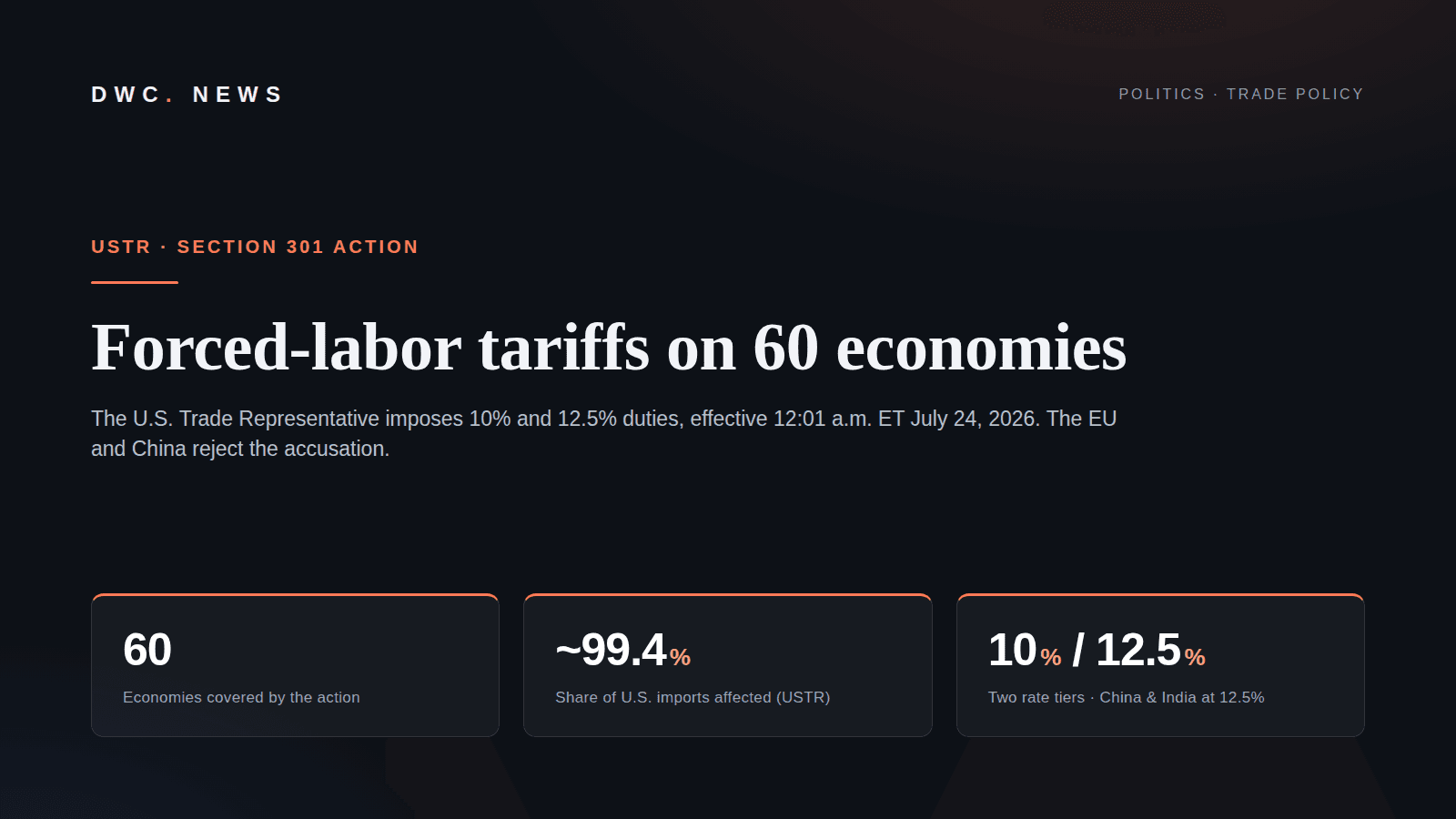
The U.S. Trade Representative took final action under Section 301 of the Trade Act of 1974 on Thursday, July 23, 2026, imposing new tariffs of 10% or 12.5% on imports from 60 economies — described by USTR as roughly 99.4% of U.S. imports — for what the agency calls a failure to prohibit or effectively enforce bans on goods produced with forced labor. The action was taken by Ambassador Jamieson Greer at President Trump's direction, according to USTR and contemporaneous reporting.
The duties take effect at 12:01 a.m. Eastern Time on Friday, July 24, 2026 — the same moment the administration's temporary 10% "stopgap" tariff under Section 122 is set to expire. This report attributes the government's rationale and the objections raised against it; it takes no position on either.
Two tiers, and where the lines fall
USTR set two rates. The lower 10% rate applies to economies that USTR says have a forced-labor import prohibition, a partial regime, or a reciprocal-trade commitment. USTR named this group as the European Union, United Kingdom, Canada, Mexico, Taiwan, Indonesia, Argentina, Bangladesh, Cambodia, Ecuador, El Salvador, Guatemala, Malaysia, and Pakistan.
The higher 12.5% rate applies to the remaining economies that USTR found lack an adequate legal prohibition on forced-labor imports. That higher tier includes China and India.
The exact split between the tiers is approximate. The named 10% group above is about 14 economies, and the higher tier is the rest — roughly 44 to 46. The full 12.5% membership is not something to state with false precision here; it should be confirmed against the official USTR fact sheet. The table below lets you look up a given economy's rate, the stated basis for its tier, the effective date, the legal authority, and the notable exclusions.
2026 Tariff Explorer: Rates by Economy
2026 forced-labor tariff explorer: rates by economy and group
A neutral, searchable table of the additional Section 301 tariffs the U.S. Trade Representative imposed on July 23, 2026 — 10% or 12.5% by economy — with USTR's stated basis for each tier, the effective date, the legal authority, and the notable exclusions. Tier membership is as USTR classified it; the full 12.5% list should be confirmed against the USTR fact sheet.
| European Union | 10% | Forced-labor import prohibition, partial regime, or reciprocal-trade commitment | Jul 24, 2026 (12:01 a.m. ET) | Section 301, Trade Act of 1974 | Sec. 232 goods; certain raw materials; informational materials | USTR fact sheet (Jul 23, 2026) |
| United Kingdom | 10% | Forced-labor import prohibition, partial regime, or reciprocal-trade commitment | Jul 24, 2026 (12:01 a.m. ET) | Section 301, Trade Act of 1974 | Sec. 232 goods; certain raw materials; informational materials | USTR fact sheet (Jul 23, 2026) |
| Canada | 10% | Forced-labor import prohibition, partial regime, or reciprocal-trade commitment | Jul 24, 2026 (12:01 a.m. ET) | Section 301, Trade Act of 1974 | USMCA-compliant goods; Sec. 232 goods; certain raw materials | USTR fact sheet (Jul 23, 2026) |
| Mexico | 10% | Forced-labor import prohibition, partial regime, or reciprocal-trade commitment | Jul 24, 2026 (12:01 a.m. ET) | Section 301, Trade Act of 1974 | USMCA-compliant goods; Sec. 232 goods; certain raw materials | USTR fact sheet (Jul 23, 2026) |
| Taiwan | 10% | Forced-labor import prohibition, partial regime, or reciprocal-trade commitment | Jul 24, 2026 (12:01 a.m. ET) | Section 301, Trade Act of 1974 | Sec. 232 goods; certain raw materials; informational materials | USTR fact sheet (Jul 23, 2026) |
| Indonesia | 10% | Forced-labor import prohibition, partial regime, or reciprocal-trade commitment | Jul 24, 2026 (12:01 a.m. ET) | Section 301, Trade Act of 1974 | Sec. 232 goods; certain raw materials; informational materials | USTR fact sheet (Jul 23, 2026) |
| Argentina | 10% | Forced-labor import prohibition, partial regime, or reciprocal-trade commitment | Jul 24, 2026 (12:01 a.m. ET) | Section 301, Trade Act of 1974 | Sec. 232 goods; certain raw materials; informational materials | USTR fact sheet (Jul 23, 2026) |
| Bangladesh | 10% | Forced-labor import prohibition, partial regime, or reciprocal-trade commitment | Jul 24, 2026 (12:01 a.m. ET) | Section 301, Trade Act of 1974 | Sec. 232 goods; certain raw materials; informational materials | USTR fact sheet (Jul 23, 2026) |
| Cambodia | 10% | Forced-labor import prohibition, partial regime, or reciprocal-trade commitment | Jul 24, 2026 (12:01 a.m. ET) | Section 301, Trade Act of 1974 | Sec. 232 goods; certain raw materials; informational materials | USTR fact sheet (Jul 23, 2026) |
| Ecuador | 10% | Forced-labor import prohibition, partial regime, or reciprocal-trade commitment | Jul 24, 2026 (12:01 a.m. ET) | Section 301, Trade Act of 1974 | Sec. 232 goods; certain raw materials; informational materials | USTR fact sheet (Jul 23, 2026) |
| El Salvador | 10% | Forced-labor import prohibition, partial regime, or reciprocal-trade commitment | Jul 24, 2026 (12:01 a.m. ET) | Section 301, Trade Act of 1974 | DR-CAFTA textiles/apparel; Sec. 232 goods; certain raw materials | USTR fact sheet (Jul 23, 2026) |
| Guatemala | 10% | Forced-labor import prohibition, partial regime, or reciprocal-trade commitment | Jul 24, 2026 (12:01 a.m. ET) | Section 301, Trade Act of 1974 | DR-CAFTA textiles/apparel; Sec. 232 goods; certain raw materials | USTR fact sheet (Jul 23, 2026) |
| Malaysia | 10% | Forced-labor import prohibition, partial regime, or reciprocal-trade commitment | Jul 24, 2026 (12:01 a.m. ET) | Section 301, Trade Act of 1974 | Sec. 232 goods; certain raw materials; informational materials | USTR fact sheet (Jul 23, 2026) |
| Pakistan | 10% | Forced-labor import prohibition, partial regime, or reciprocal-trade commitment | Jul 24, 2026 (12:01 a.m. ET) | Section 301, Trade Act of 1974 | Sec. 232 goods; certain raw materials; informational materials | USTR fact sheet (Jul 23, 2026) |
| China | 12.5% | USTR found no adequate legal prohibition on forced-labor imports | Jul 24, 2026 (12:01 a.m. ET) | Section 301, Trade Act of 1974 | Sec. 232 goods; certain raw materials; informational materials | USTR fact sheet (Jul 23, 2026) |
| India | 12.5% | USTR found no adequate legal prohibition on forced-labor imports | Jul 24, 2026 (12:01 a.m. ET) | Section 301, Trade Act of 1974 | Sec. 232 goods; certain raw materials; informational materials | USTR fact sheet (Jul 23, 2026) |
| All other covered economies (roughly 44–46; confirm full list) | 12.5% | USTR found no adequate legal prohibition on forced-labor imports | Jul 24, 2026 (12:01 a.m. ET) | Section 301, Trade Act of 1974 | Sec. 232 goods; certain raw materials; informational materials | USTR fact sheet (confirm per-economy) |
How this is calculated
Rows are drawn from the U.S. Trade Representative's July 23, 2026 announcement of final Section 301 action. USTR set two tiers: 10% for economies it says have a forced-labor import prohibition, a partial regime, or a reciprocal-trade commitment, and 12.5% for economies it found lack an adequate legal prohibition. The 10% group is USTR's named list; the 12.5% tier includes China and India plus the remaining covered economies. The named 10% group totals about 14 economies and the higher tier the rest — roughly 44–46 — but the exact split is approximate and should be confirmed against the USTR fact sheet. USTR describes this as a pivot to a more litigation-resistant authority after courts struck earlier tariff regimes: the Supreme Court struck the IEEPA tariffs on Feb 20, 2026, and a temporary 10% Section 122 'stopgap' (announced Feb 24) was struck by the Court of International Trade on May 7 and expires July 24 — the same moment this action takes effect. Rates shown are the additional Section 301 duties this action imposes and sit on top of duties an importer may already pay.
Data as of July 22, 2026 · verified July 22, 2026 · v1
Assumptions, limitations & sources
Assumptions
- · Each economy's tier is shown as the U.S. Trade Representative classified it in its July 23, 2026 announcement.
- · Rates shown are the additional Section 301 duties this action imposes; they sit on top of any duties an importer already pays.
- · The effective date is 12:01 a.m. Eastern Time on Friday, July 24, 2026 for every covered economy.
Limitations
- · USTR published a named group of economies at 10%; the exact membership and total count of each tier — reported as roughly 14–16 at 10% and 44–46 at 12.5% — should be confirmed against the official USTR fact sheet.
- · The 12.5% tier rows beyond China and India are summarized as 'all other covered economies'; the full list is not reproduced here and should be verified against the USTR fact sheet.
- · Exclusions are condensed. The full exclusion categories — Section 232 goods, USMCA-compliant goods, DR-CAFTA textiles and apparel, informational materials, donations, accompanied baggage, and certain raw materials — are defined in the USTR fact sheet.
- · This table covers only the forced-labor Section 301 action. A separately reported 'Japan 15%' figure appears to belong to a different bilateral track and is not part of this action.
- · Rates, effective dates, and tier membership are a government action as of publication and can change through subsequent notices or litigation.
Sources
- Office of the U.S. Trade Representative — press release and fact sheet on Section 301 forced-labor tariffs (July 2026) — Office of the United States Trade Representative, checked July 22, 2026
- Trump reimposing tariffs on 60 countries, citing forced labor — Forbes, checked July 22, 2026
- Trump to impose forced-labor duties on imports from about 60 economies — Reuters (via Yahoo Finance), checked July 22, 2026
- USTR proposes 10%/12.5% tariffs under Section 301 investigations into the regulation of imports produced with forced labor — White & Case, checked July 22, 2026
This is what modern SEO looks like: not just an article, but a useful resource people can return to, cite, and share. See how this newsroom is growing · See DavidWeaver's SEO packages
What's excluded
Per the USTR fact sheet, the action carves out several categories of goods: goods already subject to Section 232 tariffs (such as steel, aluminum, and autos); USMCA-compliant goods; DR-CAFTA textiles and apparel; informational materials, donations, and accompanied baggage; and certain raw materials where the tariffs could cause supply disruption. Because those carve-outs overlap with duties importers already pay, Reuters noted the change is "unlikely to immediately translate into higher prices" for most Americans, reporting that it largely preserves existing duties.
The government's stated rationale
USTR and the Department of Homeland Security frame the action as a response to trade partners' failure to ban or enforce against forced-labor imports. In support, USTR cites public hearings and more than 2,100 public comments gathered during its Section 301 investigations, according to the agency and an analysis by law firm White & Case. Those figures and characterizations are USTR's own.
The objections
The response from named trade partners was sharp. Bernd Lange, chair of the European Parliament's trade committee, called the forced-labor accusation "absurd," noting that the EU has "the world's strictest rules." China's Foreign Ministry called the measure "political manipulation" and rejected the allegations outright. Both reactions are presented here as the parties' own characterizations; readers can weigh them against USTR's stated basis in the table above.
Why this authority, and why now
The move is the administration's pivot to a more litigation-resistant authority after courts struck earlier tariff regimes. The Supreme Court struck the IEEPA tariffs on February 20, 2026. A 10% global "stopgap" imposed under Section 122 on February 24 was itself struck by the Court of International Trade on May 7 and is set to expire July 24 — the day this new action begins. The Section 232 sectoral tariffs on steel, aluminum, and autos remain in place and are excluded from this forced-labor action, per USTR. Section 301, the authority used here, is the same statute the U.S. has used in past tariff disputes and is generally regarded as harder to challenge in court than the emergency authorities that were struck.
What is still unconfirmed
A few points are worth flagging plainly. The exact per-tier counts and the full 12.5% list are approximate as reported and should be checked against the USTR fact sheet. A separately reported "Japan 15%" figure has circulated in trade coverage this week; it appears to belong to a different bilateral track, not this forced-labor Section 301 action, and is not folded into the numbers above. Any market reaction is still developing and may postdate this announcement, so specifics are omitted here. This is a developing story, and the official USTR fact sheet is the controlling record for every figure cited.
Sources
- USTR press release and fact sheet on Section 301 forced-labor tariffs (July 2026) — Office of the United States Trade Representative · primary source
- Trump reimposing tariffs on 60 countries, citing forced labor — Forbes
- Trump to impose forced-labor duties on imports from about 60 economies — Reuters (via Yahoo Finance)
- Trump tariffs and the trade deadline — CNBC
- USTR proposes 10%/12.5% tariffs under Section 301 forced-labor investigations — White & Case