House passes $1.14 trillion 2027 defense bill, sending pay-raise and Israel-tech fights to the Senate
The House approved H.R. 8800, the roughly $1.14 trillion defense policy bill for fiscal 2027, on July 22 by a 219-206 vote. It now heads to the Senate, where a tiered troop pay raise and a contested U.S.-Israel defense-tech provision remain unsettled. It is not yet law.

By David Weaver
Publisher & Editor
Published July 22, 2026, 10:00 AM ET
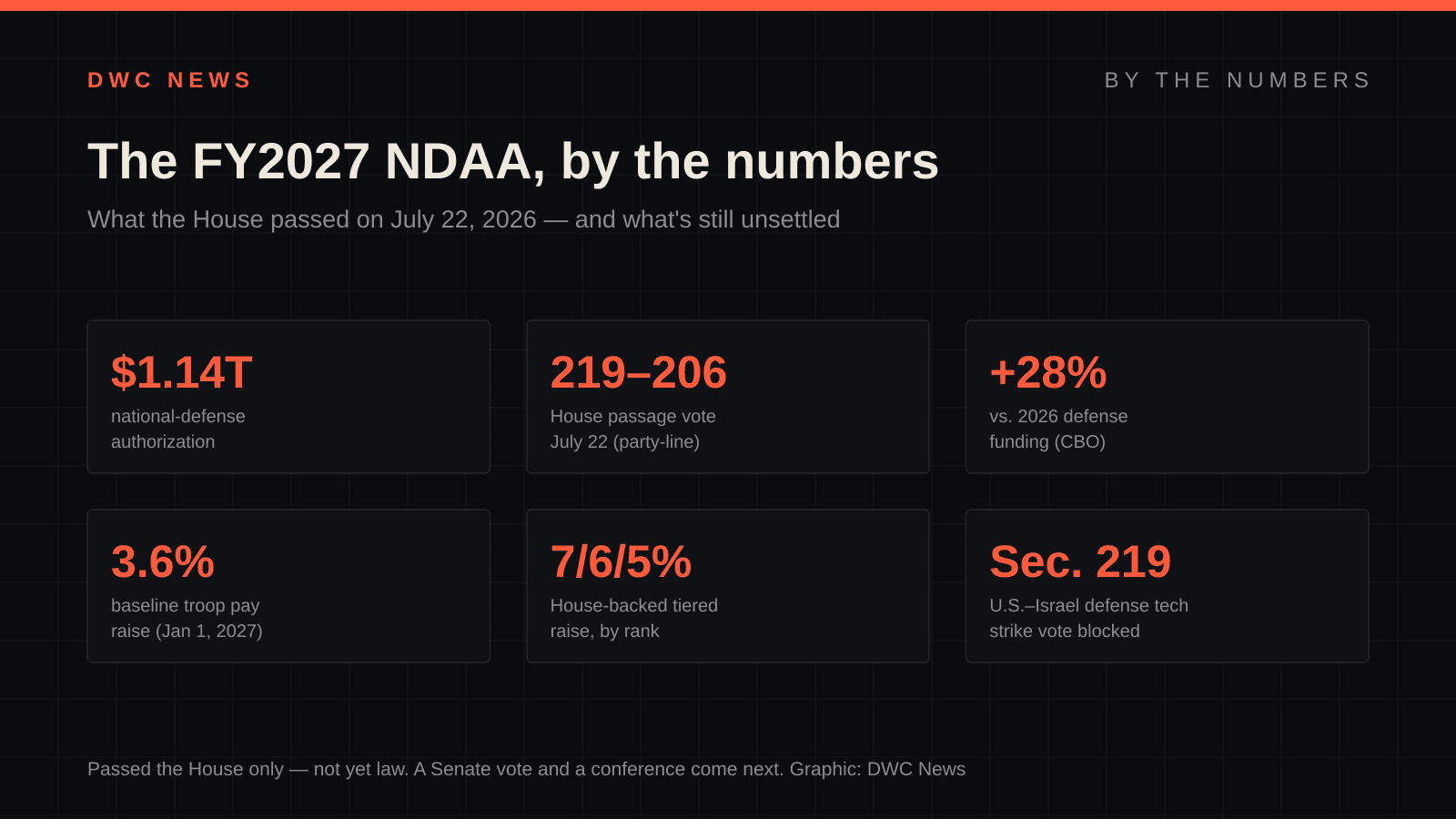
The U.S. House of Representatives passed the National Defense Authorization Act for fiscal year 2027 on July 22, approving the roughly $1.14 trillion policy bill that sets pay, priorities, and rules for the U.S. military — but doing so on a sharply partisan vote that leaves several of its most contested pieces to be settled by the Senate.
The measure, H.R. 8800, passed 219-206, largely along party lines, according to congressional vote records. That is a notably divided margin for a bill that for more than six decades has usually drawn broad bipartisan support. It is sponsored by House Armed Services Committee Chairman Mike Rogers (R-Ala.), with ranking member Adam Smith (D-Wash.) as the traditional Democratic co-lead.
One thing to be clear about up front: passing the House does not make it law. The NDAA moves in stages, and this is only the first chamber.
What the NDAA actually is
The National Defense Authorization Act is Congress's yearly defense policy bill. It does two big things: it authorizes how much money the Department of Defense (and the national-security programs of the Department of Energy) may spend, and it sets the policies that govern the military — everything from troop pay to weapons programs to how the Pentagon deals with allies.
An "authorization" is not the same as a check. It sets ceilings and rules; the actual money is provided by a separate appropriations bill later. But the NDAA is where Congress makes most of its big defense decisions, which is why it draws so much attention and so many amendments each year.
The topline: about $1.14 trillion
H.R. 8800 authorizes roughly $1.14 trillion for national defense in fiscal 2027 — the amount the administration requested for the programs under the Armed Services committees' jurisdiction. The Congressional Budget Office estimates that is about $252 billion (28%) more than the $891 billion in discretionary funding appropriated for defense in fiscal 2026, a substantial increase.
A word on a bigger number you may see: the administration's total fiscal 2027 national-defense request was often described as roughly $1.5 trillion. That larger figure includes an assumed ~$350 billion in separate mandatory funding that the budget expected to come through a reconciliation law — money that is not part of the NDAA. The NDAA scope is the ~$1.14 trillion piece.
The troop pay fight
Military pay is one of the sharpest House-Senate disagreements in this year's bill.
- The baseline raise, set by a statutory formula tied to the Employment Cost Index, is 3.6%, effective January 1, 2027.
- The House backs the administration's tiered raise instead: 7% for junior enlisted troops (grades E-5 and below), 6% for mid-grade personnel (E-6 through O-3), and 5% for senior officers (O-4 and above).
- The Senate Armed Services Committee rejected the tiered plan in its own version and kept a flat 3.6% raise for everyone, citing the 2024 Quadrennial Review of Military Compensation.
Which raise troops actually get will not be decided until the two chambers reconcile their bills.
Section 219 and the Israel-tech fight
The provision that drove much of the opposition is Section 219, which directs the defense secretary to designate a Pentagon "executive agent" to run a U.S.-Israel Defense Technology Cooperation Initiative — coordinating joint research, testing, weapons development, and industrial cooperation between the two countries' militaries.
Reps. Thomas Massie (R-Ky.) and Ro Khanna (D-Calif.) offered a bipartisan amendment to strike Section 219, but the House Rules Committee blocked it from getting a floor vote — the second time in a month the committee kept the proposal off the floor. Because the amendment never got a vote, the provision stayed in the House-passed bill, and the fight over it helped make the final tally unusually partisan.
What's Actually in the 2027 NDAA
FY2027 NDAA provisions explorer — search the defense bill's key items and dollar figures
Search the major provisions and toplines of the fiscal 2027 National Defense Authorization Act — what each does, its dollar figure where one is published, and where it stands (House-passed, Senate committee, disputed, or blocked from a vote).
This bill is not law. These are provisions in the House-passed bill (H.R. 8800) and the Senate committee bill (S. 4784) as of July 22, 2026; figures and language can change in a House-Senate conference or be dropped entirely. Authorization amounts set policy and ceilings, not final spending.
| Total authorization | Authorizes roughly $1.14 trillion for national defense in fiscal 2027 — the amount the administration requested for programs in the Armed Services committees' jurisdiction. | ~$1.14 trillion | In House-passed bill; Senate committee version slightly lower |
| Increase over 2026 | CBO estimates the bill authorizes about $252 billion (28%) more than the $891 billion in discretionary funding appropriated for defense in fiscal 2026. | +$252.4 billion | Per CBO cost estimate of H.R. 8800 |
| Troop pay raise — baseline | The statutory across-the-board raise set by the Employment Cost Index formula, effective January 1, 2027, if Congress adopts no larger increase. | 3.6% | Baseline in both chambers' bills |
| Troop pay raise — House (tiered) | The House backs the administration's tiered raise: 7% for junior enlisted (E-5 and below), 6% for E-6 through O-3, and 5% for O-4 and above. | 7% / 6% / 5% | In House-passed bill; rejected by Senate committee |
| Troop pay raise — Senate (flat) | The Senate Armed Services Committee rejected the tiered plan and kept a flat 3.6% raise for all ranks, citing the 2024 Quadrennial Review of Military Compensation. | 3.6% flat | In Senate committee bill (S. 4784) |
| Section 219 — U.S.-Israel defense tech | Directs the defense secretary to name a Pentagon 'executive agent' to run a U.S.-Israel Defense Technology Cooperation Initiative covering joint research, testing, and industrial cooperation. | — | In House-passed bill; amendment to strike it (Massie-Khanna) blocked from a floor vote |
| Shipbuilding jobs (Golden amendment) | Bars the Pentagon from sending U.S. shipbuilding work overseas and adds funding for another destroyer built at Bath Iron Works in Maine. | — | Adopted in House-passed bill |
| Indo-Pacific microreactor | Creates a program to deploy a transportable nuclear microreactor within the U.S. Indo-Pacific Command area of responsibility. | — | In House-passed bill |
| Indo-Pacific training environment | Establishes a synthetic (simulated) training environment to support Indo-Pacific operations. | — | In House-passed bill |
| Reconciliation defense funding (separate) | The budget request assumed about $350 billion in additional mandatory defense funding enacted through a separate reconciliation law — this is NOT part of the NDAA. | ~$350 billion | Separate from the NDAA; excluded from H.R. 8800 |
How this is calculated
Each row summarizes a provision or topline as reported by Congress.gov, the House and Senate Armed Services Committees, the Congressional Budget Office, the Congressional Research Service, and named member offices. Dollar figures are authorizations (ceilings and policy), not final spending, which is set later in appropriations. The status column reflects the legislative stage as of July 22, 2026, and notes where the House-passed bill (H.R. 8800) and the Senate committee bill (S. 4784) differ. Where no separate dollar figure is published for a provision, the amount is shown as a dash.
Data as of July 21, 2026 · verified July 21, 2026 · v1
Assumptions, limitations & sources
Assumptions
- · Figures and text reflect the bills as they stood on July 22, 2026; a House-Senate conference can change or drop any of them.
- · Authorization amounts set ceilings and policy; actual money is provided by separate appropriations bills.
Limitations
- · This is not a complete list of the bill's many hundreds of provisions — it covers the items most in the news.
- · The NDAA is not law: the full Senate must still pass its version, the chambers must reconcile in conference, and the president must sign it.
- · Some provisions have no separately published dollar figure and are shown with a dash.
Sources
- H.R. 8800 — National Defense Authorization Act for Fiscal Year 2027 — U.S. Congress (Congress.gov), checked July 21, 2026
- FY27 NDAA Resources — U.S. House Committee on Armed Services, checked July 21, 2026
- SASC Completes Markup of the NDAA for Fiscal Year 2027 — U.S. Senate Committee on Armed Services, checked July 21, 2026
- Cost estimate for H.R. 8800 — Congressional Budget Office, checked July 21, 2026
- FY2027 NDAA: Summary of Funding Authorizations (IN12703) — Congressional Research Service, checked July 21, 2026
- Senate NDAA rejects White House's tiered military pay raise, proposes 3.6% increase — Federal News Network, checked July 21, 2026
- Israel Defense Provision Blocked From House Vote Despite Bipartisan Push — Military.com, checked July 21, 2026
- Golden wins NDAA amendment to block Pentagon from sending U.S. shipbuilding jobs overseas — Office of Rep. Jared Golden, checked July 21, 2026
This is what modern SEO looks like: not just an article, but a useful resource people can return to, cite, and share. See how this newsroom is growing · See DavidWeaver's SEO packages
What else is in it
A few other notable provisions of the House-passed bill:
- Shipbuilding jobs. An amendment from Rep. Jared Golden (D-Maine) bars the Pentagon from sending U.S. shipbuilding work overseas, and adds funding for another destroyer built at Bath Iron Works in Maine.
- Indo-Pacific. The bill creates a program to deploy a transportable nuclear microreactor within the U.S. Indo-Pacific Command's area of responsibility, and establishes a simulated ("synthetic") training environment to support operations in the region.
- Homeland missile defense. The bill continues the buildup that includes the administration's "Golden Dome" missile-defense effort.
Where it is in the process
Here is the honest status, stage by stage:
- House Armed Services Committee approved its version (the Chairman's Mark) in early June.
- Senate Armed Services Committee completed its markup on June 11 and advanced its companion bill, S. 4784.
- The full House passed H.R. 8800 on July 22 — the step in today's news.
- Still to come: the full Senate must pass its bill; a House-Senate conference must reconcile the two versions (pay raise, Section 219, and dozens of other differences); both chambers must approve the final compromise; and the president must sign it.
In recent years that final signature has typically come in December. So as of today, the FY2027 NDAA is a House-passed bill — not law.
The questions readers are asking
What is the NDAA? Congress's annual defense policy law. It authorizes military spending levels and sets the rules the Pentagon operates under. A version has been enacted every year for decades.
How much money is in it? The House bill authorizes about $1.14 trillion for national defense in fiscal 2027 — roughly 28% above the prior year's $891 billion, per the CBO. A separate ~$350 billion in mandatory funding sits outside the NDAA.
What's the pay raise for troops? The default is 3.6%. The House wants a tiered raise instead — 7% for junior enlisted, 6% and 5% for higher grades. The Senate committee wants a flat 3.6%. It is not final.
What's the controversial provision? Section 219, on U.S.-Israel defense technology cooperation. A bipartisan amendment to remove it was blocked from a floor vote, and it remains in the House bill.
Where is it in the process, and when does it become law? The House has passed its version; the Senate has not yet passed its full bill. After a House-Senate conference and a final vote in each chamber, it would go to the president. In recent years the NDAA has been signed in December — but the exact timing for this year is not set.
Why it matters and what's next
The NDAA is the single biggest policy vehicle Congress passes on the military each year, and this one carries real stakes for service members' paychecks, for shipyards and defense manufacturing, and for how closely the United States ties its defense industry to Israel's. The partisan margin on a bill that usually sails through is itself notable.
The next thing to watch is the Senate floor: whether senators take up and pass S. 4784, and how far their version diverges from the House on pay and on Section 219. Those gaps are what a conference committee will have to close before anything reaches the president's desk. We will update this story as the bill moves.
Sources
- H.R. 8800 — National Defense Authorization Act for Fiscal Year 2027 — U.S. Congress (Congress.gov) · primary source
- FY27 NDAA Resources — U.S. House Committee on Armed Services · primary source
- SASC Completes Markup of the NDAA for Fiscal Year 2027 — U.S. Senate Committee on Armed Services · primary source
- Cost estimate for H.R. 8800, the National Defense Authorization Act for Fiscal Year 2027 — Congressional Budget Office · primary source
- FY2027 NDAA: Summary of Funding Authorizations (IN12703) — Congressional Research Service · primary source
- Senate NDAA rejects White House's tiered military pay raise, proposes 3.6% increase — Federal News Network
- Israel Defense Provision Blocked From House Vote Despite Bipartisan Push — Military.com
- Golden wins NDAA amendment to block Pentagon from sending U.S. shipbuilding jobs overseas — Office of Rep. Jared Golden · primary source