Jim Jordan refers Jack Smith to the Justice Department: what a criminal referral is — and isn't
House Judiciary Chairman Jim Jordan asked the Justice Department to consider prosecuting former Special Counsel Jack Smith. A referral is a request, not a charge — here is what is established, what is contested, and what happens next.

By David Weaver
Publisher & Editor
Published July 22, 2026, 7:00 PM ET
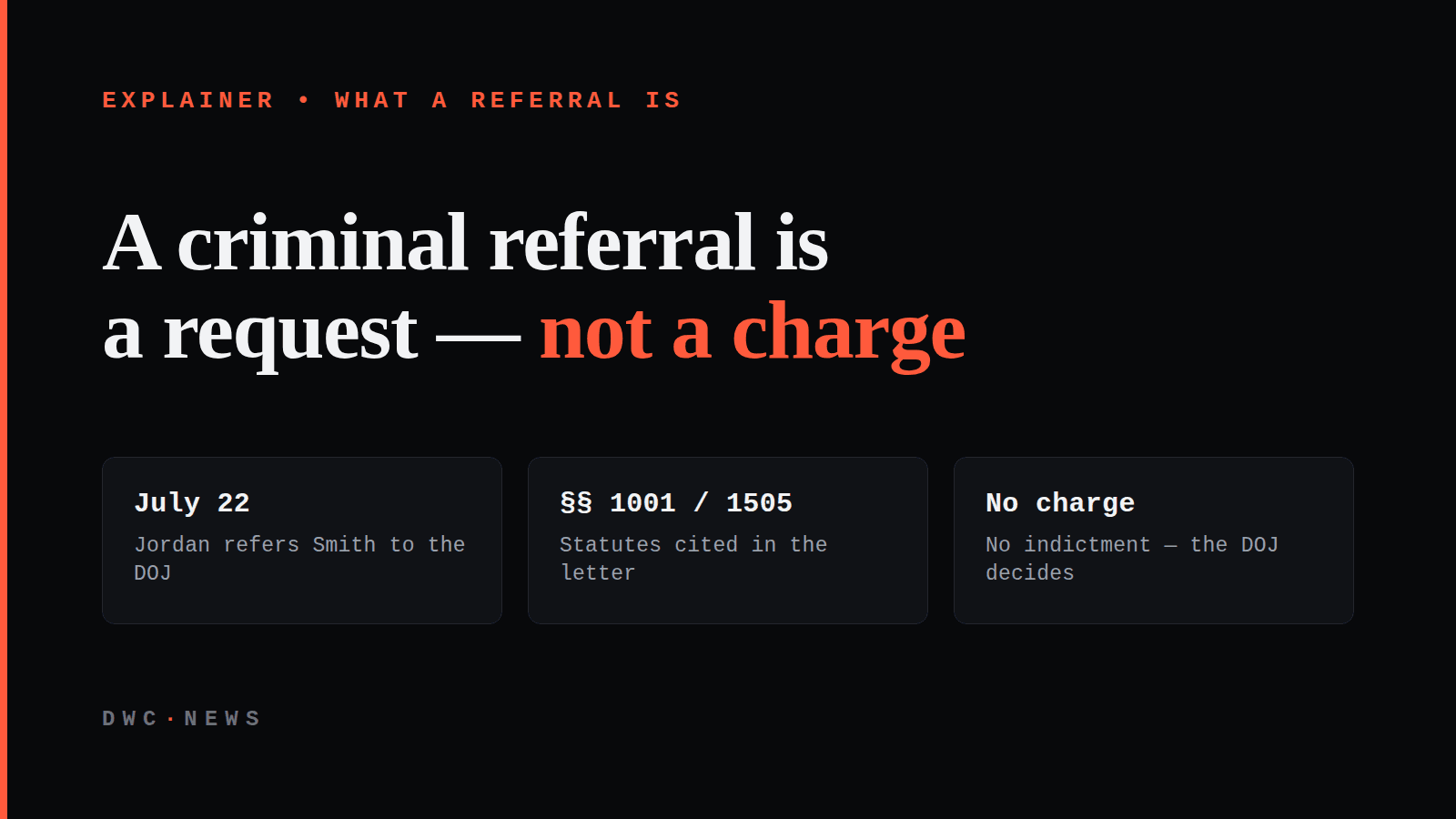
If you saw the headline "Jim Jordan refers Jack Smith to the Justice Department" and want the plain answer to the obvious question — is Jack Smith being charged, or arrested? — the answer, as of this writing, is no. What happened on July 22 is a criminal referral, and the single most important thing to understand about a referral is what it is not.
A referral is a request, not a charge
A congressional criminal referral is a letter asking the Justice Department to consider prosecuting someone. It is a request, not a decision. It does not file charges, it does not begin a prosecution, it does not require the DOJ to do anything, and it carries no independent legal force. Only a prosecutor can bring charges, and only a grand jury or a court can act on them. A referral is where that process could start — it is not proof that it will.
That distinction matters here because the coverage moves fast and the language gets loose. So this piece separates what is established from what is contested, and attributes each claim to whoever is making it.
What Rep. Jordan actually sent
According to the House Judiciary Committee's Republican press release and the referral letter itself, Chairman Rep. Jim Jordan (R-OH) sent a criminal referral of former Special Counsel Jack Smith to the DOJ on July 22, 2026. The letter is addressed to Acting Attorney General Todd Blanche — who, several outlets including CBS News note, previously served as a personal defense attorney for President Trump. Those outlets flag that prior role as a potential conflict of interest; that is reported context, not a legal finding.
The statutes — and the "perjury" shorthand
The referral cites two federal statutes: 18 U.S.C. § 1001, which covers false statements, and 18 U.S.C. § 1505, which covers obstruction of a congressional proceeding. Some coverage has loosely described the referral as alleging "perjury." It is worth being precise: the cited statutes are the false-statement and obstruction laws, not the federal perjury statutes. The distinction is not pedantic — it changes what any prosecutor would have to prove.
The allegation, and who is making it
Here is the contested core, stated as what it is — an allegation, not a finding. Jordan's letter alleges that Smith made "willfully and intentionally false statements" at a closed-door deposition on December 17, 2025, before the committee. The letter says there is "strong evidence" for that claim. That is Jordan's characterization of the record.
The factual basis Jordan points to is attributed to a Senate Judiciary Committee disclosure of DOJ records, associated with Sen. Chuck Grassley (R-IA). According to that disclosure, a "filter team" inside Smith's special counsel office reviewed the content of text messages involving 44 members of Congress — communications said to span roughly October 2020 through January 20, 2021 — obtained through White House records.
The disputed exchange: asked at the deposition whether his team had looked at "the content of text messages" sent by lawmakers, Smith reportedly answered "No." Jordan argues the records contradict that answer. Whether that "No" was a knowingly false statement — as opposed to a truthful, narrowly responsive answer to the specific question asked — is exactly the point in dispute. This story does not assert that Smith lied, and it does not assert that he told the truth. Both are contested claims.
How the DOJ responded
A DOJ spokesperson told CBS News the department received the referral and "will investigate all evidence of criminal conduct." Read that carefully: it is an acknowledgment of receipt and a general statement of practice, not a commitment to bring charges. Referrals are received routinely; most do not become cases.
Jack Smith's response
Through his attorneys Peter Koski and Lanny Breuer, Smith pushed back directly, per reporting on their statement. They called the referral "based on a spurious claim," and argued that it "is made not because Mr. Smith made a false statement — the letter concedes he did not — but because he did not proactively disclose information that was not responsive to a question asked." They said Smith "provided truthful, responsive answers" and asked that the deposition video and transcript be released publicly so people can judge the exchange for themselves.
The Democratic response
Ranking Member Rep. Jamie Raskin (D-MD) called the referral "baseless and vindictive" and predicted it would "get laughed out of court," describing it as harassment. That is the opposing political characterization, offered alongside Jordan's.
Referral, Not a Charge: What's Established and What's Contested
Jordan's Jack Smith referral: what's established and what's contested
A claim-by-claim map of Rep. Jim Jordan's criminal referral of Jack Smith — each point tagged confirmed, disputed, or unknown, with its sources, so readers can tell a request from a charge.
On July 22, 2026, House Judiciary Chairman Rep. Jim Jordan (R-OH) sent a criminal referral of former Special Counsel Jack Smith to the DOJ, addressed to Acting Attorney General Todd Blanche.
ConfirmedThe referral is documented in Jordan's own letter and the committee's press release. Multiple outlets note that Blanche previously served as a personal defense attorney for President Trump and flag that prior role as a potential conflict of interest — reported context, not a legal finding.
The referral cites 18 U.S.C. § 1001 (false statements) and 18 U.S.C. § 1505 (obstruction of a congressional proceeding).
ConfirmedSome coverage loosely described the referral as alleging 'perjury,' but the cited statutes are the false-statement and obstruction laws, not the federal perjury statutes. The distinction changes what any prosecutor would have to prove.
A congressional criminal referral is a request to the DOJ — it does not charge anyone, does not begin a prosecution, does not require the DOJ to act, and carries no independent legal force.
ConfirmedOnly a prosecutor can bring charges, and only a grand jury or court can act on them. Former prosecutor Dave Aronberg described a congressional referral as 'a partisan suggestion, not a criminal charge' that 'carries no direct legal weight' — attributed legal opinion consistent with the mechanics.
A 'filter team' in Smith's special counsel office reviewed the content of text messages involving 44 members of Congress, spanning roughly October 2020 through January 20, 2021, obtained via White House records.
ConfirmedThis factual basis is attributed to a Senate Judiciary Committee disclosure of DOJ records associated with Sen. Chuck Grassley (R-IA). It establishes that a review of message content occurred; it does not, by itself, establish that Smith's deposition answer was knowingly false.
A DOJ spokesperson told CBS News the department received the referral and 'will investigate all evidence of criminal conduct.'
ConfirmedThis is an acknowledgment of receipt and a general statement of practice, not a commitment to bring charges. Referrals are received routinely and most do not become cases.
Whether Smith's deposition answer — reportedly 'No' when asked if his team looked at 'the content of text messages' sent by lawmakers — was a knowingly false statement.
DisputedJordan's letter alleges a 'willfully and intentionally false' statement and says there is 'strong evidence.' Smith's attorneys, Peter Koski and Lanny Breuer, call the referral 'based on a spurious claim,' say the letter itself 'concedes he did not' make a false statement, argue the issue is that he 'did not proactively disclose information that was not responsive to a question asked,' and say he 'provided truthful, responsive answers.' No court or neutral authority has resolved this.
Whether the referral is a legitimate accountability step or a partisan act of harassment.
DisputedJordan frames it as following 'strong evidence' of false statements. Ranking Member Rep. Jamie Raskin (D-MD) called it 'baseless and vindictive' and predicted it would 'get laughed out of court,' describing it as harassment. These are the competing political characterizations.
House Judiciary GOP press release ↗House Judiciary Democrats ↗
Whether the DOJ will act on the referral — review it, decline it, or open a case — and any eventual outcome.
UnknownThe decision rests entirely with the DOJ's prosecutorial discretion and had not been made public as of the data date. As of July 23, 2026 there is no charge, no indictment, and no court finding against Jack Smith.
How this is calculated
Each claim is tagged by what the record supports: 'confirmed' means primary documents (the referral letter, official press releases) or multiple reputable outlets establish it; 'disputed' means the two sides directly contradict each other and no neutral authority has resolved it; 'unknown' means it is officially undecided. The core dispute — whether Smith's deposition answer was a knowing false statement — is presented as each side describes it, with neither adopted as fact.
Data as of July 22, 2026 · verified July 22, 2026 · v1
Assumptions, limitations & sources
Assumptions
- · A congressional criminal referral is treated as a request to the DOJ, not as a charge, an indictment, or a finding of wrongdoing.
- · Statuses reflect the public record as of the data date and will change if the DOJ acts or new records are released.
Limitations
- · This is a fast-developing political and legal story; a claim marked disputed or unknown today may be resolved later.
- · The deposition video and transcript at the center of the dispute had not been released publicly as of the data date, so readers cannot yet judge the exchange directly.
- · This map does not assert whether Smith's testimony was truthful or false — that is the disputed core, and no court or neutral authority has ruled on it.
Sources
- Referral letter, Chairman Jim Jordan to Acting AG Todd Blanche, July 22, 2026 — House Judiciary Committee (Republicans), checked July 22, 2026
- House Judiciary Committee refers Jack Smith to DOJ for criminal prosecution — House Judiciary Committee (Republicans), checked July 22, 2026
- House Judiciary Committee Democrats — Ranking Member Raskin statement — House Judiciary Committee (Democrats), checked July 22, 2026
- CBS News — House committee refers Jack Smith to DOJ for possible prosecution — CBS News, checked July 22, 2026
- The Hill — Jordan recommends charges against Jack Smith — The Hill, checked July 22, 2026
- Axios — Jim Jordan sends Jack Smith DOJ referral — Axios, checked July 22, 2026
- Raw Story — Jack Smith responds to criminal referral — Raw Story, checked July 22, 2026
This is what modern SEO looks like: not just an article, but a useful resource people can return to, cite, and share. See how this newsroom is growing · See DavidWeaver's SEO packages
What a referral carries — an outside view
For a read that is neither Jordan's nor Smith's, former prosecutor Dave Aronberg described a congressional referral as "a partisan suggestion, not a criminal charge" that "carries no direct legal weight." That is attributed legal opinion, and it lines up with the mechanics: a referral is an input to a prosecutor's discretion, nothing more.
Where this actually stands
Stripped of the framing on both sides, the legal status is simple. A congressional criminal referral is a request. It does not initiate a prosecution, it does not obligate the DOJ, and it has no independent legal force. As of July 23, 2026, there is no charge, no indictment, and no court finding against Jack Smith. What comes next is entirely the DOJ's call — whether it reviews the referral, declines it, or acts on it — and that decision had not been made public. Everything else at this stage is allegation and argument, which is why the fact map above keeps the two carefully apart.
Sources
- Referral letter, Chairman Jim Jordan to Acting Attorney General Todd Blanche, July 22, 2026 — House Judiciary Committee (Republicans) · primary source
- House Judiciary Committee refers Jack Smith to DOJ for criminal prosecution — House Judiciary Committee (Republicans) · primary source
- House Judiciary Committee Democrats — Ranking Member Raskin statement, July 22, 2026 — House Judiciary Committee (Democrats) · primary source
- House committee refers Jack Smith to DOJ for possible criminal prosecution — CBS News
- Jordan recommends charges against Jack Smith — The Hill
- Jim Jordan sends Jack Smith DOJ referral — Axios
- Jack Smith responds to criminal referral — Raw Story